

Crop Watch: Rapid bean emergence affects weed plans
 © Tim Scrivener
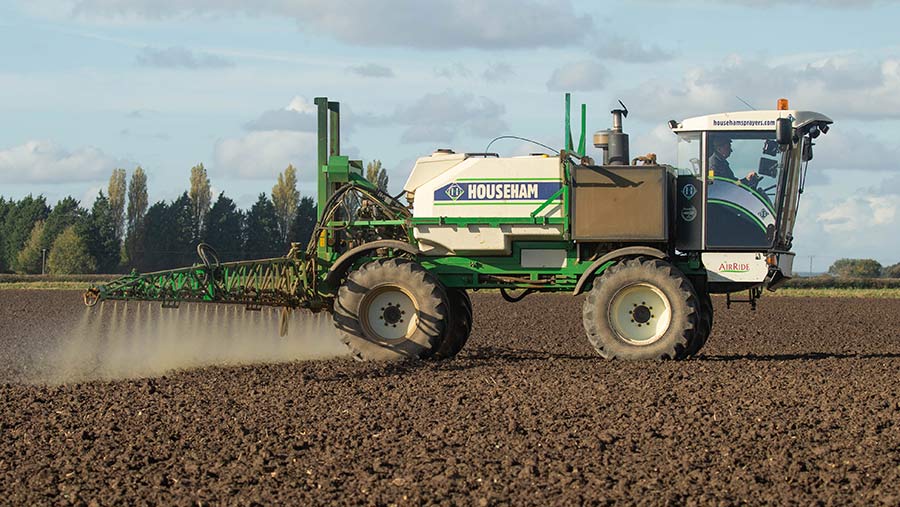
 Beans is one topic discussed by our Crop Watch agronomists this week, with the rapid emergence because of the milder conditions increasing the urgency to complete pre-emergence herbicide sprays, although some have missed out on their propyzamide sprays.
These mild conditions have also led to a rethink for managing volunteer beans in wheat crops in the North.
See also: Video: Danish potato starch harvest season draws to close
North
Patrick Stephenson, AICC (Yorkshire)
When looking back on the autumn drilling season of 2022, I will have to reflect on it as being very successful.
This is the second autumn where conditions have certainly favoured my northern growers for establishment and spraying.
Winter wheat crops look well and the combinations of pre-, peri- and post-emergence sprays appear to be working well.
Volunteer beans are a pain. Last year, I put my faith in a Siberian winter that didn’t happen, which meant that by spring I had the equivalent of a bean forest.
This year, I have recommended spraying most fields to ease my worries.
The warm soils have meant that even the late-drilled crops have surged out of the ground and look very good. It is early days yet to assess the blackgrass control programme, but courtesy of some good rain in September, control levels look good.
I have Jekyll and Hyde personality when it comes to dealing with the threat of barley yellow dwarf virus. Social media and company advertorials show huge aphid populations and impending doom.
However, walking fields and examining crops, I am finding low numbers. I freely admit that my eyes no longer have 20:20 vision, but surely epidemic levels would be easy to see?
So, I revert to a risk-based approach, crops drilled in early to mid-September are at high risk and the rest are low.
Sadly, practicality also comes into the equation, and if growers are spraying for manganese or contact graminicides then the temptation to include an insecticide is overpowering.
When I compare this to earlier in my career, when there was very little concern made for the need of an aphicide or the effectiveness and everything was sprayed, I feel we have moved on for the benefit of all.
Bleached barley
The barrage of pre-emergence sprays has certainly left their mark on the winter barley crops, with the countryside littered with bleached crops. These vary from not too bad, to wow!
Having enjoyed a warm and calm October, most affected crops have managed to recover and some have a significant number of tillers and disease.
Mildew and net blotch are the most significant diseases and easy to see.
The first frost of the autumn was reminder that winter is around the corner, so I will not be rushing to treat them.
Winter barley is a bit of a Cinderella of a crop, and in gross margin terms it is a challenge.
The reality is that the early start to combining spreads workloads and does enable the opportunity for rotational diversity.
Looking at my client’s rotations now, compared to those of the 90s, does show a much wider diversification, which must be better for soil resilience and resistance management.
The kind autumn has certainly benefited the later drilled, flea beetle-ravaged oilseed rape crops, which with a fair wind will now, hopefully, survive to harvest.
In contrast, the early-drilled crops are resplendent and, once again, canopy size is being challenging.
I always get asked about growth regulating these crops, but sadly that ship has long since sailed. Cooling temperatures means growth will stop and any growth regulator is likely to have little or no impact.
There is phoma present in some crops but, in my opinion, at levels that do not justify treatment, and as for propyzamide, get it on!
Winter beans are now drilled, and herbicides applied, as fortunately most propyzamide arrived on time, and I am pleased to shut the gate on these.
If I offered my growers a repeat of the weather, harvest, and drilling of 2022 for 2023, I would have my hand bitten off. Let’s hope 2023 can live up to it.
South
Oliver Bennetts, Zantra (Kent)
At last, over the past week or so, we have had some meaningful rain and the final potatoes in the area have been lifted in good conditions.
Spring brassicas have now had their final application of fungicides to keep them clean over the winter months.
The weather in the area has generally been favourable, allowing ground to be worked quickly and crops drilled into good seed-beds. Most cereal crops in the area are now drilled.
With reasonable soil conditions since the start of drilling, pre-emergence herbicides have been applied and appear to be working well.
Some early-drilled crops are at three to four leaves and moving quicky though their growth stages.
These fields have already had one application of an aphicide to reduce the risk of barley yellow dwarf virus (BYDV) and will probably need a second.
I am using the BYDV app to optimise timings – in some cases, adding a follow-up herbicide to aid with grassweed control.
Oilseed rape crops planted in August are now starting to fill out and cover the ground, but with a spread-out drilling window, growth stages are very varied.
Those that have survived the flea beetle attacks are looking promising going into the winter.
Longer term grassweed control is now the priority, using propyzamide due to the loss of carbetamide.
Propyzamide
Given the increasing problem with grassweed resistance, correct use of propyzamide in break crops is essential to achieve a high level of grassweed control and reduce the risk of the active finding its way into watercourses.
Also remember with winter beans going in, the propyzamide product needs to be applied within seven days of drilling before crop emergence.
Unfortunately, warm soils, wind and rain leading to rapid emergence means that some applications have already been missed.
In OSR, propyzamide should not be applied until the soil temperature is below 10C at 30cm and is falling.
This is key to ensuring maximum persistence of the active ingredient and the longest possible control of the grassweeds.
We normally look to apply from mid-November here in the South, but this year it is likely to be from the end of the month.
I would normally have expected to see some signs of phoma in OSR by now, but no doubt the very dry September and early October has delayed its appearance.
It will probably start to express symptoms after the recent wet, mild period so we may need to add a fungicide to the propyzamide application if crops reach threshold.
East
Marcus Mann, Frontier (Essex)
Autumn 2022 continues to be unusually mild, which is allowing autumn-sown crops to get away really well, with close to 100% germination and establishment of winter cereal crops.
It doesn’t seem possible that, at times, we have had warmer, drier conditions than Western Australia, where harvest has been hampered by cooler temperatures and heavy rainfall.
Wheat and barley crops are emerging within seven to 10 days and reaching two to three true leaves very quickly. With warmer temperatures, Tsum 170C is being reached much quicker this autumn.
Generally, only a small proportion of aphids entering cereals are likely to carry barley yellow dwarf virus.
However, even low numbers of viruliferous aphids entering the crop can create a large number of discrete foci, which can quickly spread.
Wider spread arises when the second-generation offspring of the original winged colonisers is produced.
Continue to monitor closely, particularly for earlier drilled crops that may have had an earlier insecticide application as the aphid pressure remains high. Hopefully, colder weather will be on the horizon to limit further migration.
Grassweed pressure has increased with moisture and warm soils encouraging further flushes of growth.
Control has been rewarded to those who had patience with drilling, but even later drilled areas have required top-ups with the conditions very conducive for continual grassweed emergence.
New chemistry
Early indications are very positive with the new chemistry Luximo (cinmethylin), which visually appears to be giving similar levels of control to existing “robust” flufenacet stacks.
Oilseed rape has benefited from the milder weather, with crops that have survived the early cabbage stem flea beetle damage reaching six to eight true leaves and looking in need of plant growth regulator.
I would avoid this as much as possible this year, as with the smaller area, pigeon grazing could be more intense on these smaller areas, particularly if we move into a colder winter.
With larger crops, phoma becomes less of a pressing concern as the pathogen has further to travel from the infection site on the leaf to reach the stem, where the canker is potentially formed.
Given the warmer conditions, light leaf spot infection will cycle quicker as well, and both these diseases are likely to need protecting against going into the winter.
Soil temperatures remain mild, and with lush crops present, if possible, further patience should be had before applying propyzamide.
Waiting for soil temperatures to drop will improve persistency and may also allow the crop to open the canopy giving better coverage, which is even more important if mixing a contact broad-leaved weed herbicide.
West
Gavin Burrough, Pearce Seeds (Dorset, Hampshire and Wiltshire)
Spray days over the past two to three weeks have been few and far between. The odd day that is both dry and calm enough to spray in has been welcome, but due to damp soil, not many have been able to make use of.
Hopefully, there are a few dry days on the forecast, which will help any outstanding field work to be caught up with.
Most cereal drilling has been completed, with only a few fields remaining to be drilled.
These are typically following turnips or having been left to help with reducing a grassweed burden or in a second wheat situation, but have been delayed further due the current unsettled weather.
Generally, cereals have established and are growing well. The mild weather is unfortunately encouraging aphid numbers, which are not difficult to find in numerous cereal crops.
I don’t like to spray an aphicide until the aphids can be found, but this autumn, plenty have been found.
Winter barley on lighter ground is starting to show typical manganese deficiency symptoms. This ground will have manganese foliar feed plus aphicide applied with or with out a herbicide application as soon as conditions allow.
Wireworm
The mild weather is also encouraging other pests, such as turnip sawfly larvae and wireworm, to be a problem for longer this season.
The wireworm are not helping young crops of wheat or grass to establish and, in some fields, yellow dying plants can be easily found.
Winter beans have been drilled, but are emerging about seven to 10 days quicker than normal.
This is making pre-emergence herbicide applications more urgent as we need to make sure they are applied well before the bean crops start to emerge.
Oilseed rape crops are still a mixed bag in terms of size and establishment.
Varieties with stronger disease resistance scores are remaining disease-free for longer, which is a big help as it takes the pressure off of needing to apply a fungicide to young/smaller crops.
We are waiting for soils to be cool enough (10C and falling at 30cm depth) for propyzamide applications to tidy up grassweeds and, in some cases, propyzamide + aminopyralid where broad-leaved weeds such as mayweed are also a problem.
