Crop Watch: Soil moisture drives wheat herbicide decisions
 © GNP
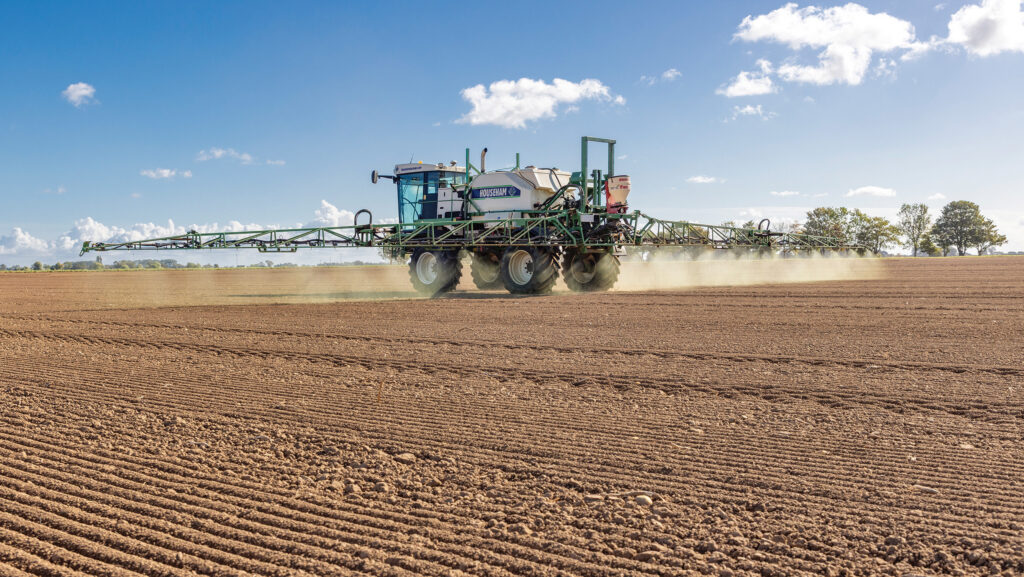
© GNP Rain is still desperately needed in parts of the South and the East, with dry conditions holding back crops and agronomists having to tweak herbicide choices and timings according to moisture.
For oilseed rape, establishment has proved very challenging and a number of crops have already been written off.
The warmer than usual temperatures across the whole UK are also seeing other pest pressures including cabbage root fly in OSR.
South
Oli Pilbeam, CCC and CLM (Kent and Sussex)
I can’t start my first Crop Watch of the season without a quick look back at last year’s results.
Wheat yields were generally 14-20% down on the five-year average on shallower soils, but at about the five-year average on more bodied and fertile soils.
Oilseed rape was generally another success, spring pulses were a disaster, and spring cereals ended up 10% below average, which considering the non-existent spring rain was a pleasant surprise.
Thankfully, we cut back spending with the minimal disease pressure.
Cashflow planning has never been more required and revisiting this fortnightly is becoming the norm.
The disastrous “agricultural bun fight” on 22 September for SFI26 has added to the financial stresses.
Thankfully, I managed to get most of my applications in and these were the easy conversations to have with clients, but where the Rural Payments Agency’s archaic software made it impossible it led to a few more difficult conversations.
Into the now – dry weather continues. At the time of writing, rain is falling. Those brave enough to drill oilseed rape into dust in mid-August generally look like they got away with the biggest punt of the season so far.
Crops planted in or around bank holiday weekend seem to have attracted the most flea-beetle pressure.
Some of these crops we have written off – it seems to be the high oleic and low linolenic acid (Holl) varieties which have significantly lacked in vigour this year.
The later-drilled crops, which went in from 6 September onwards, seem to be relatively unscathed, although in desperate need of a drink.
Wheat drilling
Wheat drilling commenced on 25 September across my walked farms. Using my traffic light system which maps low-, medium- and high-pressure ryegrass and blackgrass fields, we pick our early, middle and late drillers.
I have a tailored pre- and post-emergence spray programme. This ranges from cheaper £15/ha flufenacet-based “green” programmes through to £50-£65/ha “ambers” – typically aclonifen or cinmethylin (Luxinum Plus), and £120+/ha for the reds – typically aclonifen, cinmethylin and tri-allate (Avadex).
With the dry weather, there has been a juggle with application timings, switching to aclonifen on drier soils and coming back with cinmethylin at peri/post emergence after some rain.
As always, the beauty of not being tied to one chemical distributor is that it allows me to have a selection of Luxinum-based products either in box packs or co forms, giving access to the best chemistry at the lowest prices.
Fingers crossed for a bit more rain in the coming weeks, as we prepare for top-up herbicides and start aphid/barley yellow dwarf virus (BYDV) prevention sprays.
East
Ryan Baker, Frontier (Suffolk/Norfolk)
I think it’s fair to say that we’ve now had six months of below average rainfall. Rainfall last week was welcome and certainly freshened up both crops and seed-beds.
The outlook for the rest of October, however, looks set fair.
Compared with last autumn, oilseed rape establishment has been challenging and variable.
Those who received timely rainfall, conserved moisture and drilled earlier, now have well established crops.
Whereas those who drilled later and missed any showers are facing the greatest flea beetle pressure and now face the decision of whether to carry on with the crop.
It will be interesting to see how crops drilled towards the end of September now fare.
Myzus aphids appear very commonplace in OSR crops, but it should be remembered that a lot of varieties now carry resistance to turnip yellows virus.
It should also be noted that pyrethroid resistance in Myzus is ubiquitous. Therefore, the only option is one application of flonicamid.
Cabbage root fly
© Blackthorn Arable
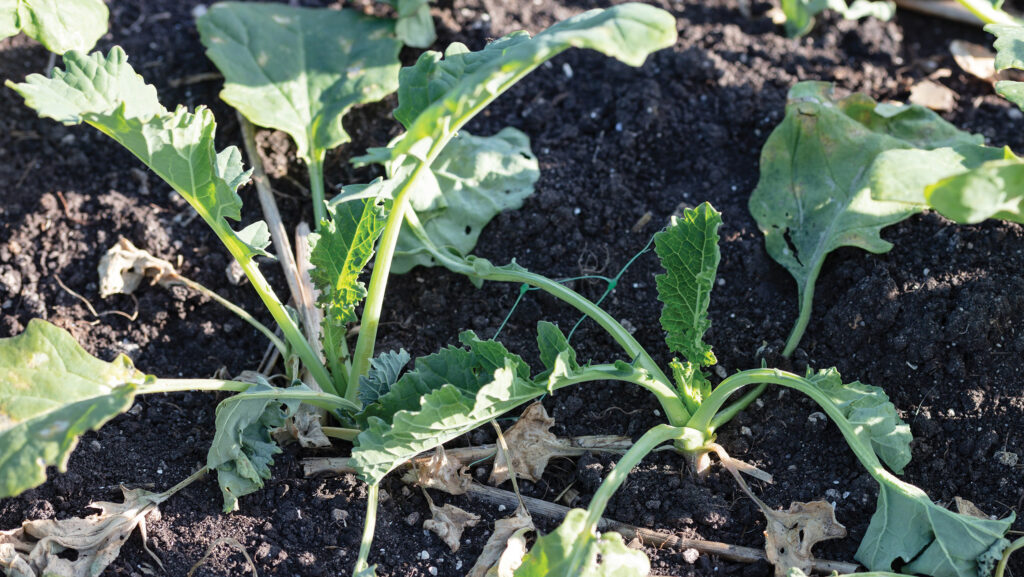
As if oilseed rape doesn’t have enough insect pest issues, cabbage root fly is also being seen.
As the days shorten and it feels more autumnal, cooler and damper conditions are more prevalent overnight, however there has been minimal slug issues in all autumn crops so far.
Cereal drilling has been progressing at pace. Growers have been broadly in two camps.
Either starting in September and pushing on with drilling or firmly holding off into October, both for moisture and for stale seed-beds.
Drier conditions always bring into question the efficacy of residual herbicides. Different actives behave differently in terms of their water solubility and soil mobility.
Tri-allate and cinmenthylin have a greater tolerance of drying seed-beds.
With high daytime temperatures, there has been a massive number of aphids in cereal crops right from emergence. It is thought that a significant percentage of aphids are carrying BYDV this season.
Whether using the new AHDB BYDV Tool or T-Sum-170 (the accumulation of 170 day degrees above a threshold of 3C from crop emergence), the indication to spray will be earlier than previous years.
If temperatures do not reduce, intervals are also likely to be tighter. This timing also brings thoughts around to top up residual herbicides; this may be with the second aphid spray this autumn if it coincides with more moisture.
Beet lifting has started and it is amazing where the yield has come from in some of the early lifted fields. The announcement last week of an agreed price for next season will be food for thought for many growers.
North
Greg Dawson, Scottish Agronomy (East Scotland)
It is always risky to comment on the British weather – someone is usually having a very different experience.
In Scotland, harvesting and ground conditions in the north and west have been markedly different to eastern and central regions.
The latter experienced a relatively dry summer and autumn punctuated by localised showers.
However, some regions saw a protracted end to cereal harvest and stop start cereal drilling.
Where conditions have allowed, drills are up to date and are waiting for potato and vegetable fields to be cleared, but there is still some work to be done where the rainfall has been most disruptive.
Warmer temperatures
One common feature has been the higher-than-average temperatures. This has driven rapid growth and development of autumn cereals and oilseeds.
It has also aided those chitting weeds in stale seed-beds and establishing green covers for Environmental Focus Areas, winter grazing or soil management plans.
The other side of the coin is that it increases the risk of insect pests in crops of cereals and stored grain.
BYDV symptoms in harvest 2026 crops were unusually high, leading to cautious monitoring of aphid activity this autumn.
Desiccation in seed potato crops has also required careful management to minimise regrowth and reduce the risk of late season aphid borne virus transmission.
Cooler night-time temperatures are welcome for those ventilating grain and will reduce energy cost pressures on potato stores when post-curing temperature pull down gets under way.
West
Dominic Edmond, Matford Arable (Devon/Cornwall)
At the end of my last report in June, I said I hoped the harvest would be reasonable and would coincide with firming prices.
Well, prices have risen since combining, but on the back of a harvest that in the end could only be described as average with enough crops yielding below average, albeit with grain quality holding up.
As with the rest of the country, we saw no rain from the first week of June through to the end of August, and with very high temperatures, crops died rather than ripened.
This meant yields were always going to suffer. On the plus side, straw, an important crop in the South West, yielded well and was generally good quality too.
Spring crops suffered badly, with yields of spring barley as low as 2.5t/ha, but probably averaging about 4t/ha particularly in the dry areas.
Where rain fell at the right time, there were some respectable yields.
Maize was disappointing, with too many crops between 10 and 15t/ha with more than enough yielding below 10t/ha, with inconsistent and in some cases, absent cobs.
Again, when rain events happened, maize crops showed what the others were missing and yielded well.
The last month has seen plenty of short-term grass being planted to try and bolster forage crops, and drilling of grass into grass to rejuvenate grass fields that have been hammered in the drought.
Since 5 October drilling of winter cereals has really got under way. Thankfully, up until that date there was a general reluctance to drill early with the memory of last year’s BYDV pressure and crops getting big and dirty over the winter.
The weather has been kind and looks good going forward, so it’s turning into the ideal October for drilling, and getting pre-emergence herbicides applied, particularly for winter barley, and most importantly applying aphicides as soon as the crop emerges.
Seed-beds are good too, with many working down easily and with diesel prices where they are, that’s no bad thing.
With predictions for increased rainfall and storms on the back of the El Nino for the autumn and early winter, there are plenty of checking weather apps and long-range forecasts to make sure we aren’t caught out.
With a bit of good fortune by the next crop watch report we should drilled up and crops sprayed.