Later-drilled oilseed rape requires tailored agronomy
 © Tim Scrivener
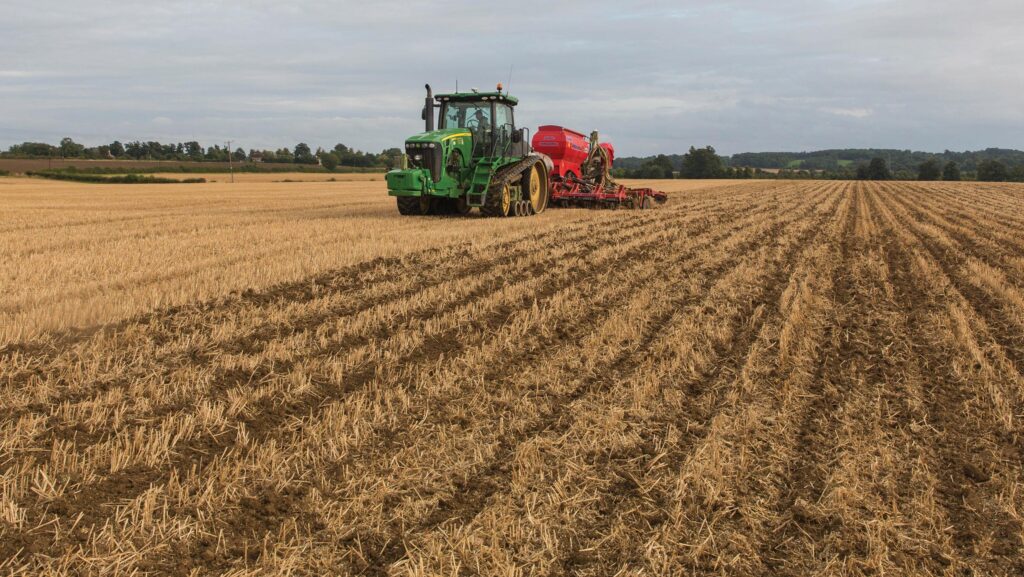
 Oilseed rape growers opting for a later drill date following the dry summer may need to adjust agronomy to compensate for the shortened growing period ahead of winter.
“If drilling later, a key objective will be to accelerate the crop’s growth, so it reaches 8-10 true leaves and has a tap root diameter of more than 8mm before winter dormancy,” explains Andrew Cromie, ProCam head of crop nutrition.
This gives the crop the best chance of having sufficient reserves to grow away in the spring, he adds.
See also: Growers to hold nerve on oilseed rape drilling until rain arrives
Growers should look to maximise nitrogen availability from the seed-bed and ensure availability of potassium, phosphate and sulphur – as well as key micronutrients to prevent nutrition limiting early growth.
“Investing in early nutrition is particularly important when drilling later as there is less time for the crop to build the biomass and root system needed to carry it through winter,” explains Toby Ward, nutrition agronomist at Origin Soil Nutrition.
Don’t cut back on P and K for too long
When costs come under scrutiny, P and K are often some of the first inputs to be cut from nutrition programmes, but extended P and K holidays can have negative impacts on nitrogen uptake.
“This is particularly relevant where greater quantities of straw are removed, as low grain prices have encouraged growers to bale straw, increasing the rate at which soil nutrient reserves are depleted,” says Toby.
“P and K application breaks can start to compound the effect, and crops may not be able to utilise nitrogen effectively,” says Toby.
Potassium supports root growth, stomatal function, water regulation and nutrient transfer.
The nutrient also plays an important role in drought tolerance and helps with water movement and efficient use of nitrogen around the plant.
An average cereal crop will take up more than 300kg/ha of potassium during peak spring growth, compared to 225kg/ha of nitrogen.
Although a proportion of K is returned to the soil as the crop senesces, an adequate supply must be available during establishment and rapid growth to achieve optimum yields.
Potassium’s role in root development
Ian Matts, co-ordinator of the PDA (Potash Development Association), notes that a key part of potash function is its role in nitrogen use efficiency and drought tolerance.
“The presence and availability of potash at establishment will be essential if crops are to build resilience ahead of any challenging spring weather patterns,” he says.
“Where soils are at or above the target index, any recent P and K application breaks are likely to have registered little impact, but it’s the consecutive nature of these that see nutrient levels slip away.
“We need to manage and maintain nutrient levels to give crops the best chance. If indices drop too much, the time and cost to build these back can be more severe.”
Growers should use soil, tissue and grain testing to make data-driven decisions, combining the available information to establish what is happening in both the soil and the plant.
At a soil potassium Index of 3 or above, there is generally no need for additional applications, while at Index 2 or below, growers should consider applying potassium, depending on the wider nutrient balance and crop requirements.
Starter fertiliser and other nutrients
Opting for a starter fertiliser can help kickstart early root development.
“Adding an early foliar phosphite treatment, at the cotyledon to 2-leaf stage, can help lateral rooting and the overall nutrient scavenging ability of the plant,” continues Andrew.
The application of fulvic and humic acids can help to ensure nutrients reach the plant in a bioavailable form.
Other key nutrients for oilseed rape during establishment and at the 2-4 leaf stage include molybdenum, which is crucial for nitrate reductase efficiency, enabling the seedling to convert absorbed nitrogen into protein more rapidly, and manganese and zinc, which support photosynthesis and root growth.
Unconsolidated seed-beds are prone to deficiency, he points out.
“Boron is also critical. Fast-growing oilseed rape consumes it rapidly, and deficiency can lead to hollow stems, vascular collapse and stem splitting.
“Apply foliar boron from the 2-4 leaf stage to maintain stem integrity,” he adds.
Toby recommends applying boron in the spring as crop demand is high during flowering, and this can match crop requirements.
“Boron is prone to leaching from soils due to its mobility in the soil solution, so applications in the spring when crop demand is at its peak can be more beneficial,” he says.
Nutrition alone cannot overcome poor soil management.
Andrew highlights the importance of achieving a soil pH of 6.5-7.0 to reduce lock-up of key macro- and micronutrients.
Growers also must ensure compaction is addressed to allow roots to access nutrition and water efficiently.
“Where possible, leveraging the benefits of organic manures is also encouraged.
“Not only can they feed plants with essential nutrition, but also improve soil biology.
“Their benefits can be further improved with the use of foliar nutrition and biostimulants,” he says.
Appetite for more oilseed rape
There is an appetite to grow more oilseed rape this autumn after a largely successful harvest this year. Weather permitting, plantings are expected to be up 10-20% on last year.
Still plenty of time to drill
Typically, growers see 15 September as the cut-off for sowing oilseed rape, but recently growers have been pushing this date further back with good results to show for it.
Drilling later misses the main cabbage stem flea beetle pressure period, and with the continued warm weather soil temperatures are looking likely to stay warmer for longer this year, meaning there is still plenty of time to get crops in the ground.