Five novel crops that could help counter climate change
Arable growers looking to diversify their cropping could start by taking a look at novel and underused crops such as lentils, millet, lupins, hemp and sunflowers to give a good return, cope with climate change and try to improve soil structure.
These crops often have low inputs and feed a potentially growing market, although those markets are small at the moment, so firm contracts are essential.
These crops may become more attractive as climate change causes drier summers, but they will all need investment in breeding, agronomy and the processing infrastructure.
See also: Grower trial aims to unlock food-grade millet production
Growers have had their fingers burned with new crops before, such as soya, which boasted an area of 3,200ha eight years ago, but now the crop area has dwindled to virtually nothing.
Poor establishment of soya crops, which are plagued by pigeons, and a slump in US soya prices caused the crop’s demise, with an answer to pigeon grazing never found and the price fall prompted by the world’s biggest buyer, China, switching to buying South American soya away from the North American crop.
So, after two dry springs and summers, some of these novel crops – often grown in much drier climates – might offer an opportunity to counter the climate change being seen in the UK.
Many of these crops can be grown and harvested using cereal-growing equipment, with the exception of hemp, which needs specialist machinery for harvest.
We look at five spring-sown crops with the help of the Novel and Underutilised Crops Network, comprising Niab, the Universities of Reading and Southampton and the James Hutton Institute in Scotland.
Lentils
This is a legume crop, so it fixes its own nitrogen from the atmosphere rather than needing expensive bagged fertiliser, and there could be a growing market for this nutritious human food.
Lentils are inexpensive to establish and have been grown by Niab since 2020, with variable results from a crop than can be drilled in April with an August/September harvest.
“In all our trials, lentils have outyielded chickpeas, and latterly have looked to give fairly stable yields of about 1.5t/ha,” says Dr Phil Howell, plant breeder at Niab.
However, the crop is very short in height and can have weak straw, so it can be difficult to harvest with the crop so close to the ground.
The main market for lentils is through Hodmedod’s, which was founded in 2012 and aims to produce minimally processed wholefoods containing beans and peas, and now a number of other crops such as lentils.
Plus points
- Supplies a high-value food market
- Crop fixes its own nitrogen
- Low-input crop
Minus points
- No UK-bred varieties
- Can be low-lying with weak straw
- Growers need a contract
Millet
The crop can be grown easily in the UK, and is drilled in early May – which can allow for the control of blackgrass. It is desiccated by the end of August to be combined in mid-September.
Red and white millet are very similar, apart from the seed colour, and the market is mainly for wild-bird seed, although other markets for human consumption are being explored.
The whole UK market is worth about 9,000t, of which 3,000t is grown in the UK and the rest imported. Soya UK provides most of the UK crop from its 60-70 contracted growers across about 1,000ha.
David McNaughton, managing director of Soya UK, says new markets for millet are being explored, such as gluten-free flour for human consumption, and the extraction of amylopectin from millet for use in the paper industry as a stiffening agent.
There is potential to replace some of the imports that come largely from Ukraine, but its big potential will be if new markets start to develop.
Plus points
- Very cheap and easy to grow
- Can be drilled late to help control blackgrass
- Mid-September harvest to allow winter wheat to follow
Minus points
- Dry seed-beds in May can cause poor establishment
- Static end market until new outlets found
- Need for a crop contract
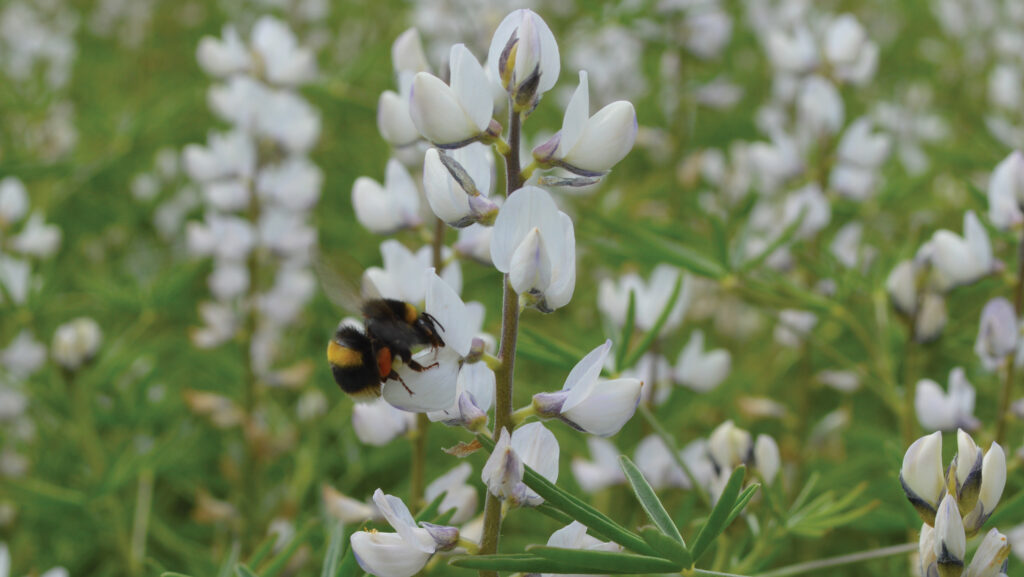
Lupins © David Jones
Lupins
Lupins have been the “next big crop” for decades, but the crop has never been grown in sufficient quantities to attract a big uptake by the large animal feed compounders.
“Lupins have good potential, but they still have a big hurdle to overcome in terms of farmer confidence,” says John Hammond, professor of crop science at Reading University.
White lupins tend to be grown in southern England on light soils, and blue lupins further north. The crop is drilled in April and harvested in August/September. The area has built up to 1,000ha and it is claimed to be easier to grow than soaya, as well as having higher yields with better gross margins.
“It is the only crop to produce soya-grade protein in the UK,” says David Naughton of Soya UK, which is the largest supplier of seed in the UK.
However, the crop has proved more popular with livestock farmers than arable growers and, when grown with spring triticale, can make very good wholecrop silage.
Plus points
- A legume that can fix its own nitrogen
- Very good at mobilising phosphates in the soil
- A home-grown 40% protein crop to rival soya
Minus points
- Still awaiting market development
- Poor acceptance by feed compounders
- Faba beans and peas better known, and more familiar

Industrial hemp © David Jones
Industrial hemp
Hemp grows well in the UK, reaching 4m some 100 days after drilling. It fits well into crop rotations and produces deep roots, which can improve soil structure.
As it is the same species as cannabis, a licence is needed to grow the crop, although its pharmaceutical properties are much reduced compared with the cannabis plant.
Oil-rich varieties can be harvested for their high-quality edible oil, while fibre-rich varieties can be used for building insulations, an alternative to chipboard,. Residual material can be used to produce peat-free compost.
The crop is drilled in late April/early May and harvested in August. Specialist equipment is used to cut the crop, which is left on the ground for retting or rotting, and is later picked up.
“It grows well in the UK with low inputs, and may only need a bit of nitrogen,” says Dr Lydia Smith, head of Niab’s Innovation Farm. However, there are only three industrial hemp processors in the country – two in Yorkshire and one in the Cotswolds.
Plus points
- Grows well with few inputs
- Drilled late and takes just 100 days to maturity
- Potentially a growing market
Minus points
- A licence to grow the crop costs £600
- Needs specialist machinery for harvest
- Only three processors in the country
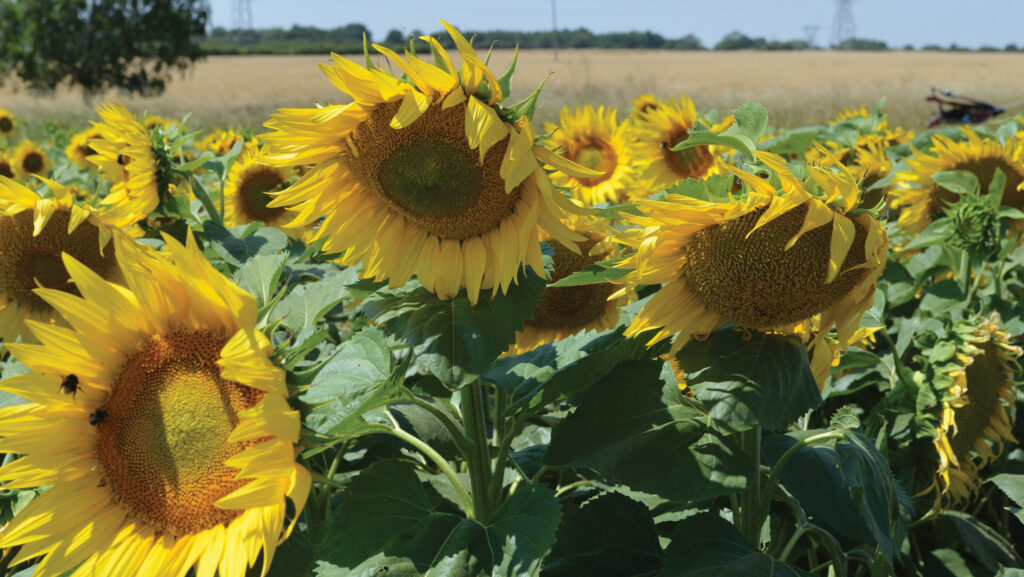
Sunflowers © David Jones
Sunflowers
Warmer summers could herald an increase in the area of sunflowers in southern and eastern England with a market for the crop in birdseed, health foods and – more long term – crushing it for oil.
The crop is often drilled in May and harvested in September, but it can be difficult to establish well and can also be tricky to harvest if the weather turns wet.
Successful growers see it as a low-input crop with only a pre-emergence herbicide, a little crop nutrition and pre-harvest desiccation needed, but the late harvest can be a problem.
The market looks limited at the moment, and contracts are advised for those looking to grow for the existing birdseed and health food market.
The crop area would have to show a big increase in the UK for one of the three crushers of oilseed rape in England to be tempted to interrupt their rapeseed crush and turn to sunflowers.
Plus points
- Good alternative to oilseed rape
- Very good for bees
- Growing health food market
Minus points
- No breeding in the UK
- Can be difficult to establish and harvest
- Unlikely to attract oilseed crushers
- The Novel and Underutilised Crops Network is publicly funded by the Biotechnology and Biological Sciences Research Council (BBSRC).