Harvest round-up: A mixed bag
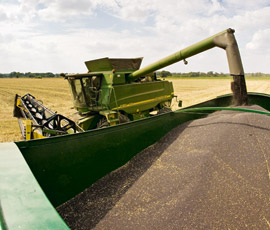
Harvest continues to generate mixed feelings among farmers, with some delighted with progress and yields, and others feeling rather despondent.
In the South of England, Clive Tory had just started combining spring barley Lower Almer Farms, Blandford, Dorset, and was excited by what was yet to come.
“We’ve just started the first field of Tipple and it looks a clean, bright sample,” he said. “We only drilled it in mid-April to replace losses of winter wheat, but it’s shot out of the ground and looks as good as anything drilled between February and March.”
Further north, Colin Rayner was a good couple of weeks ahead of schedule at Berkyn Manor Farm, Windsor, Berkshire, with his winter wheat harvest nearly finished.
The 365ha of Claire, Diego and Cocoon winter wheat had come off the field at around 15.5% moisture, and averaged 9.5t/ha.
“The wheat’s performed well in difficult conditions – although we lost about 0.2ha in each field due to flooding,” he said. “The crops drilled early and in dry conditions were the ones that survived.”
In sharp contrast, Duncan Whiteman had only just started harvest at Arlescott Farm, Telford, Shropshire, and was disappointed with winter barley yields.
So far he had cut 30ha of Retriever, which yielded an average of just 6.2t/ha at 14% moisture.
In contrast, Mascani winter oats had been the best crop so far, yielding 7.4t/ha. “The oats are only just ready, yet the crop is much better than last year,” he said. “It’s a nice dry sample and quality is good.”
Harvest was slightly further forward in Yorkshire, where Paul Temple was preparing to get started on winter wheat at Wold Farm, Driffield.
“We’ve just finished the winter barley and oilseed rape, and everything is going well,” he said.
“Considering the season we’re fairly pleased. Everything’s looking as well as can be expected and we’re keeping going when we can.”
In the Scottish Borders, Stuart Fuller-Shapcott had only cut a little winter barley at Sweethope, Kelso, and yields had been poor so far.
“You have to remember barley doesn’t like a cold wet start, which is exactly what we had,” he said. “In some cases we were using two tractors to pull one plough.”
In contrast, the 10ha of Pearl winter barley was looking reasonably good. “We nearly started on the Pearl yesterday (20 August) afternoon, but the moisture content was just slightly too high at 19%,” he added.
“To reach malting quality, we’ll be leaving it another two to three days.”