Harvest’s a mixed bag for many this year
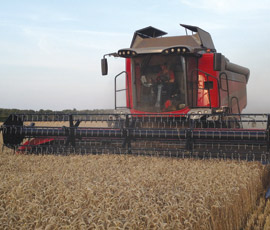
Oilseed rape is a big disappointment this year, while winter barley has done well. Olivia Cooper rounds up the latest progress
Combine drivers have made rapid progress with harvest over the past week, with about 60% now cut across the southern half of England.
Yields continue to be very variable, ranging from extremely disappointing to better than average, and anywhere in between. According to a Farmers Weekly poll, 35% of producers are having a good harvest, 20% a bad one, and 45% just average.
Progress is also mixed, with many crops being late to ripen, and farmers switching from spring barley to winter wheat and even oilseed rape. In Kent, harvest remains about two-and-a-half weeks later than normal, with about 60% of the crops now in the barn, says John Smith, director at Weald Granary.
Farmers’ commitment sheets showed a 20% reduction in cropped area, and although yields are slightly better than expected earlier in the year, overall production will be markedly down, he says. “Everyone is talking about a 12.5m tonne wheat crop, but in my view, if results elsewhere are similar to Kent, it will be more like 11.5-12m tonnes.”
HGCA Recommended List results
Early wheat results from the Recommended List trial plots show that wheat yields are slightly above the five-year mean, much better than feared back in spring.
With results in for only two sites, both in Lincolnshire, the 2013 treated mean is 10.14t/ha, compared with a five-year average of 9.94t/ha.
Updated figures for oilseed rape show a similar picture, with gross output near a four-year average. The east and west List is averaging 5.40t/ha in 2013, very close to the 5.41t/ha four-year average. On the north list, this year’s average (5.29t/ha) is slightly above the four-year mean (5.18t/ha). See next week’s Farmers Weekly for a more detailed look at the HGCA wheat RL results.
Milling wheat protein contents are slightly low, at about 12.6% – although a number of samples are below 11%. “Spring wheat quality is generally better, but of the winter varieties, Cordiale is the best, followed by Solstice, then Gallant and Crusoe.”
Further north, showers have hampered harvest progress at Cole Ambrose, Ely, Cambridgeshire, where Anthony Morbey has cut about a third of his wheat so far. Invicta feed wheat on the heavier ground yielded about 8.5-9t/ha, with Solstice on the Fens at 9-9.5t/ha. “Blackgrass was a bit of a problem on the heavier land – we just struggled to control it,” he says.
In Yorkshire, Caley Sackur is hoping to complete harvest at Lodge Farm, Tibthorpe, by the end of the week, and is pleased with above average yields. “It’s going very well,” he says. Cordiale second wheat averaged about 9.9t/ha, with Gallant first wheat coming off at 10.5t/ha.
“We’re having a good harvest – moistures have been good, too, with wheat coming off at 15.5-18.5%, barley at 17% and rapeseed at 8-8.5%.”
Crops in Fife are barely fit, where John Hutcheson is juggling spring barley, spring oats and winter wheat at Leckerstone Farm, Dunfermline. “A lot of the wheats are very poor,” he says. “As a rule I think spring crops will perform the best.”
But winter barley has done well, with Mike Cumming having the best winter barley harvest in at least six years at Lour Farms, Ladenford, Angus. Volume, Bamboo and Retriever averaged 8.9t/ha over a weighbridge, and quality is excellent, he says. “It’s the first time in six years that we haven’t had to cut winter barley in the mud.”
Harvest has also been a pleasant surprise to many farmers in the West Midlands, as yields – while not huge – have exceeded early expectations, according to Agrii agronomist Peter Jones. Although oilseed rape is the disappointment of the year, barley has done well, and wheat has recovered to average 8-8.5t/ha, with later-maturing varieties doing the best, he says.
“When everything’s done and dusted, for most farmers it won’t have been the sort of season some early headline reports might have suggested. Nor will it have been the disaster that was looking likely for many back in March either. Overall, relief is probably our overwhelming emotion just now.”

Staying sharp shouldn't be a chore