Hope for later crops in Scotland as harvest nears completion
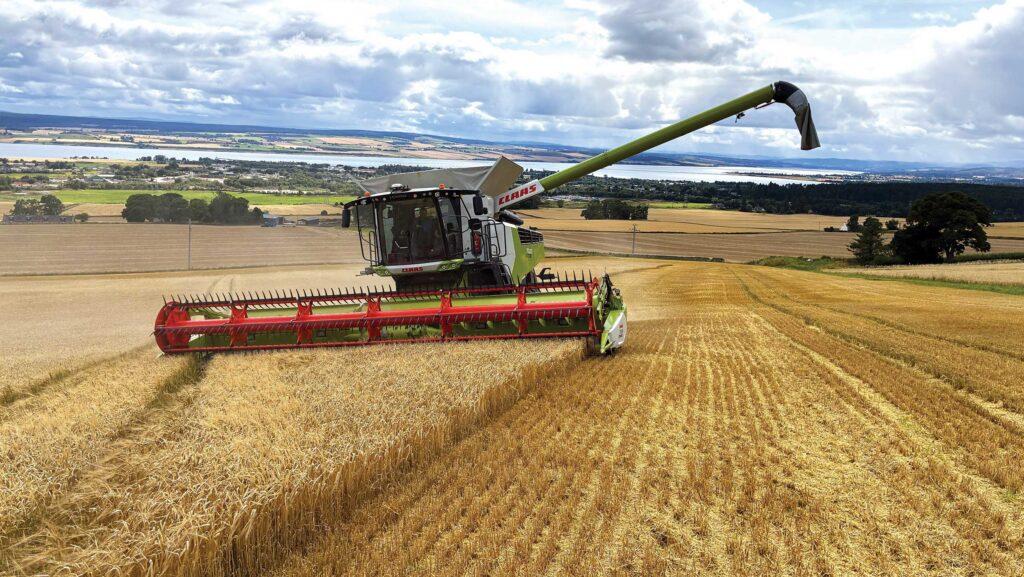 Combine harvesting in Scotland © Rognvald Bews
 Yields are down by an average of 20% this year due to the hot, dry weather.
However, cooler climates in the north of the UK have seen a benefit, with hope for later crops as harvest draws to a close.
See also: Growers advised to hold off stale seed-beds in dry fields
Cambridgeshire
“Intake for wheat and barley is around 20% down this year, which is what we anticipated,” reports Steven Atherton, chief operating officer of CamGrain.
CamGrain has received 250,000t into stores so far. About 170,000t was wheat, predominantly milling wheat which is achieving Group 1 protein levels.
“We’ve had around 60,000t of barley in, but a lot has been downgraded as it’s not reaching the nitrogen levels needed for malting,” Steven explains.
Specific weights have been in the region of 78kg/hl for wheat, with barley at 66-68kg/hl.
“Quality on the oats has been OK, with most of them making spec. So far we’ve had around 35,000-40,000t in [down about 10% on last year].”
Steven thinks oilseed rape is turning a corner. “Last year we had 7,000-8,000t in, but we’ve already had 12,500t.”
Derbyshire
Near Shardlow in Derbyshire, James Chamberlain reported a very early finish.
“We were done by the end of July, which is unheard of. Yields have not been great, which is disappointing but not surprising, given the weather.”
Crusoe and Vibe winter wheat yields were about 20-25% down and ranged from 7t/ha on lighter land to 8.5t/ha on the better ground.
Laureate spring barley grown for seed averaged 5.4t/ha, a reasonable result thanks to the moisture retentive land it was planted on.
“The oilseed rape established well and with a good canopy and roots delivered a good yield at 4.4t/ha.”
The spring linseed did not fare well, yielding just 0.8t/ha – well down on the usual average of 2.3t/ha.
“Despite good establishment in the spring, the lack of rain, scorching temperatures and wind meant it just didn’t have the yield.”
Looking ahead, there is in no rush to get the next crop in.
“We’ll wait until conditions are right for soil temperature and moisture, even if that means waiting until September.”
Northern England
Meanwhile in Northumberland, another central store is receiving 150-200 samples of malting barley and 20-30 of wheat a day.
Malting quality is improving as combines move north, with spring barley screenings much lower this year and specific weights higher.
Nitrogen is averaging 1.51% and screenings through a 2.5mm sieve 6.2%.
Wheat protein contents have been extremely variable, but specific weights have not been an issue, averaging 77kg/hl.
Screenings have been a problem in some cases where crops burned off quickly, particularly on lighter land, while yields range from 6 to 12t/ha, with second wheats suffering.
As for oats, specific weights are in the low to mid 50s, and screenings are particularly bad.
In contrast, oilseed rape has been promising, with oil contents averaging 47% and growers happy with yields.
Scotland
Further north, intake at East of Scotland Farmers started on 21 July, reports general manager Neil McInnes.
“The main challenge with this year’s winter malting barley crop was the higher than anticipated level of screenings.
“In previous years, growers grew Craft, but this year Buccaneer was the main variety, yielding an average 7.75t/ha – right on the five-year average.”
Caravelle seems to be the best two-row winter feed barley this time, although Tardis is not far behind it. Yields averaged 7.71t/ha – below the five-year average.
When it comes to oilseed rape, Aurelia is performing well, as are Avenger and Adapt, he adds.
“Yields are slightly above the five-year average at around 4.45t/ha.
“While moisture levels were below 10%, oil levels have been consistent at 45%.”
Laureate spring malting barley started to come into stores on 10 August and quality is good, with nitrogen, screenings and germination levels meeting specification.
“Yield reports seem to be above average which is encouraging.”
With broken weather forecast this week it may be a while before wheat and spring oats come in. “But reports are promising.”