

Advertiser content
North Yorks farm shares wheat and barley fungicide choice
Iblon® has become the first-choice T1 fungicide on North Yorks farm.
After two seasons investigating the performance of Bayer Crop Science’s latest fungicide active substance Iblon® (isoflucypram), George Swiers sees it becoming the basis for his future T1 applications.

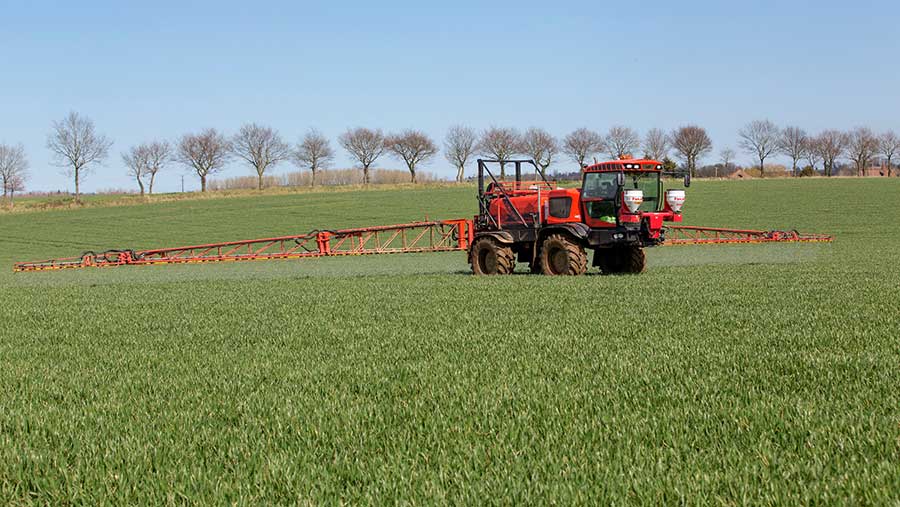
George Swiers, Arable Manager at JF Lister Farms, says high yellow rust pressure means Iblon® is the fungicide best suited to T1 on his crops © Bayer Cropscience UK Ltd
Yellow rust dominates the disease complex at JC Lister Farms, Boroughbridge, North Yorkshire with many of the forward crops or those on land adjacent to the two rivers that intersect the farm, needing a T0 comprising tebuconazole as a routine treatment.
“The 2024 season was our first opportunity to take a close look at Iblon® we applied it at T2 with pleasing results as it stood up to the yellow rust and Septoria leaf blotch pressure well,” George, the farm’s Arable Manager, says.
“For 2025 we opted to use Iblon® at T1 to better utilise its broad-spectrum activity. The emergence of Yr15, a more aggressive strain of yellow rust, and the favourable disease conditions at the start to 2026 have persuaded us that Iblon® is the best T1 fungicide for our situation,” he adds.
“It is likely that we will follow this approach again in 2026. Iblon®’s programme flexibility means we can afford to utilise as T1.
Aoife O’Driscoll, Niab Senior Specialist in Plant Pathology, considers what makes Iblon®such a compelling fungicide.
The need for robust protection
Changes to variety disease ratings, specifically for yellow rust following the emergence and subsequent rapid spread of the Yr15 strain, highlight the need for fungicides delivering robust protection at the T1 timing.
With 16 of the 35 winter wheat varieties on the AHDB 2026-27 Recommended List having a yellow rust score of 6 or lower and only one variety acknowledged as having resistance at the juvenile stage, the risk to crop performance cannot be underestimated.
Plaxium®, Bayer Crop Science’s first co-formulation fungicide to contain Iblon®, performed impressively in the AHDB fungicide trials delivering excellent control of brown rust and was comparable to other products against Septoria and was either better or equal to other products against yellow rust.
In trials by Niab and ADAS, Iblon® has performed strongly offering strong broad-spectrum control of the key foliar diseases making it well-suited to either the T1 or T2 timing depending on your priorities.
Jonathan Blake, ADAS Technical Director and Head of Crop Protection, explains how Iblon®performs against Septoria leaf blotch.
Disease control in barley
In barley, disease control is focussed on the early season, and it is important to ensure that the crop’s sink capacity is maximised to protect yield potential that can then be utilised at T2 by extending green leaf area duration that comes from disease control and the physiological benefits that some fungicides deliver.
Most crops are therefore adequately protected by fungicides at the T1 and T2 timings.
Monitoring of disease isolates ahead of the 2025 season identified a shift in sensitivity of net blotch, and, as ever, Ramularia control poses a challenge to multiple modes of action, meaning suitable mixtures will be key to guarding against selection pressure.
The sensitivity shift to triazoles and to some strobilurins and SDHIs in net blotch is especially concerning.
To overcome this, growers should mix modes of action across the programme.
Monitoring data show that the SDHI fluopyram is unaffected as are the strobilurins trifloxystrobin and pyraclostrobin, despite the widespread presence of the F129L mutation in the population that confers reduced sensitivity to other strobilurins, specifically azoxystrobin.
In practice, growers should maintain robust rates applied in mixture and ensure that fluopyram, trifloxystrobin or pyraclostrobin are incorporated into the programme.
The yield protection afforded by Iblon® was demonstrated in AHDB fungicide trials performed between 2023 and 2025 in which Iblon® (applied as Vimoy®) delivered a high level of activity against the key foliar diseases, including net blotch when applied in both a protectant scenario (2023-25) and as an eradicant (2024 and 2025).
Even greater efficacy is seen when applied in a mixture with prothioconazole, as in Ipresso® between 2021 and 2024.
© Bayer Cropscience UK Ltd
New for 2026
Iblon® containing fungicides, such as Plaxium®, Vivalis®, Vimoy®, Ipresso®, and Jessico® Fusion, can now be applied to the same field season-after-season. The change follows a positive review of new data submitted by Bayer Crop Science to CRD. The annual application limit of 75 g active substance/ha remains.
For more information visit our Iblon® Product Page
Iblon® contains isoflucypram. Jessico®Fusion contains fenpicoxamid and isoflucypram. Plaxium® contains isoflucypram, fluopyram and prothioconazole. Vivalis® and Ipresso® contain isoflucypram and prothioconazole. Iblon, Ipresso, Jessico, Plaxium and Vivalis are registered trademarks of Bayer. All other brand names used are Trademarks of other manufacturers in which proprietary rights may exist. Use plant protection products safely. Always read the label and product information before use. Pay attention to the risk indications and follow the safety precautions on the label. For further information, including contact details, visit www.cropscience.bayer.co.uk or call 0808 1969 522.
Provided by
At Bayer Crop Science, we are committed to transforming the future of UK crop production by becoming the preferred partner for agronomists, distributors, and growers. Our focus is on world-leading innovation, dedicated in-field expertise, and a tailored customer experience that consistently delivers value, trust, and results sustainably.