

Advertiser content
How IPM strategies can cut costs and protect watercourses
Integrating habitats into a farm can contribute to resilient, cost-efficient farming.
For many farms, the benefits of Integrated Pest Management (IPM) include fewer chemical inputs, natural pest control, and habitats that can reduce runoff into local rivers and landscapes.
But how does it work in practice and how can farmers implement it? Farmers Weekly reports.
Together with family-members, Patrick Barker farms 545ha at Lodge Farm in Westhorpe, Suffolk.
Their ethos is to farm as efficiently as possible in order to bring down the costs of production, whilst also minimising their impact on the natural environment.
They farm in a way that reduces inputs and focusses on soil health, and one of the tools in their toolkit is IPM which they have been putting into practice for several years.
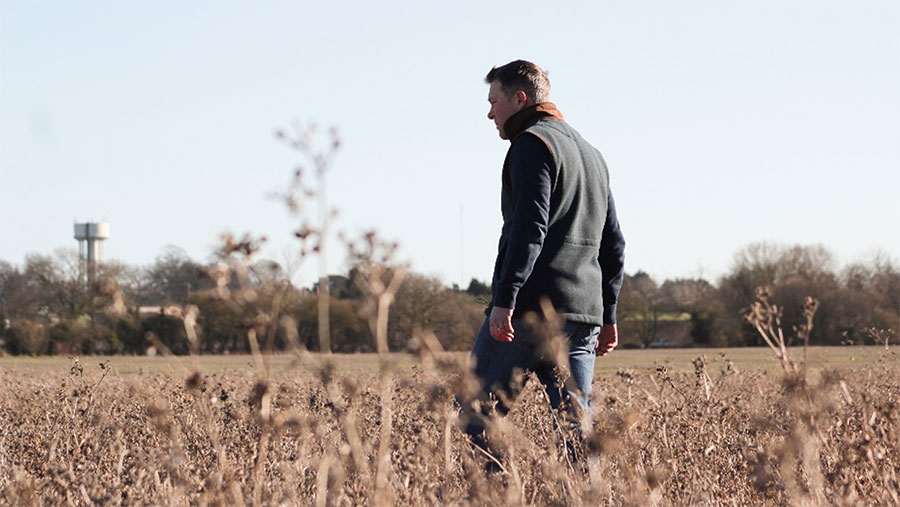
Patrick Barker © LEAF
As a former AHDB Strategic Cereal and Oilseed Farm for the East, Patrick worked with AHDB to trial flowering strips around and through their winter wheat fields as part of a research study.
These strips encouraged predatory insects such as money spiders, wasps and hoverflies.
By improving habitat across the field, not just at the edges, they created the right conditions for beneficial predatory insects to reach more of the crop and keep aphid numbers down.
The result? A reduction in insecticide use with only two applications in the last 10 years, and those for very specific pest outbreaks.
The system saves money and protects essential wildlife for food production. “Sometimes, a small reduction in crop yield outweighs the cost of input applications.” says Patrick.
The buffer strips have the additional benefit of minimising any pollution into the water courses on the farm.
Patrick is also investing in overwinter cover crops, drilled straight into stubble.
These cover crops help retain nitrogen that would otherwise leach into watercourses and improve soil structure so fields drain better and don’t sit wet.
“Overall, our farming approach means input costs are down, our margins have improved, our yield has maintained and our overall profitability is higher,” he adds.
Lodge Farm is not doing this in isolation. Patrick is one of the founders of the High Suffolk Farm Cluster, a group of 12 local farmers managing over 4,000ha who are working together to trial environmental measures, share findings and improve both business resilience and the local landscape.
Catchment Sensitive Farming
Farmers within the catchment work with Catchment Sensitive Farming (CSF) Advisers like Senior Adviser Jo Hayward.
“Lodge Farm drains into two different catchments, the River Waveney and the Little Ouse,” explains Jo.
“For the River Waveney, the main diffuse pollution issues are nitrates, phosphates, sediments and pesticides. And for the Little Ouse it’s phosphates and sediments.”
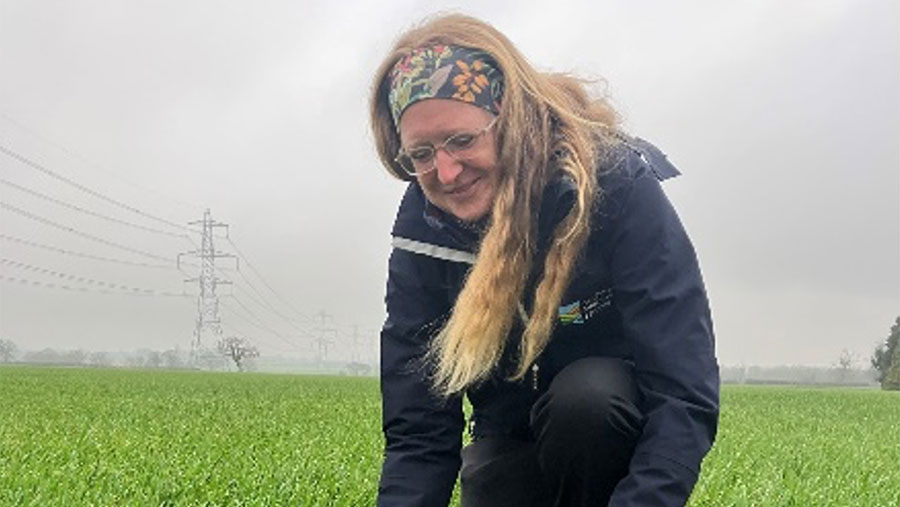
Jo Hayward © Catchment Sensitive Farming
With help from CSF, farmers are able to improve water quality. “We look at reducing diffuse pollution sources, and improving air quality, which matches nicely with what Patrick is doing on the farm,” she says.
CSF supports and encourages farmers to use field measures such as the implementation of buffer strips, flower-rich margins, pollen and nectar plots, and cover crops.
Interested in finding out more?
Catchment Sensitive Farming (CSF) provides free impartial and confidential advice to farmers and land managers across England to produce food in a way that protects water, air and soil.
The service is delivered locally through Natural England, in partnership with Defra, Environment Agency and the Forestry Commission and is made up of CSF advisers who work directly with local farmers.
For further information:
- Visit Farming for the future to hear about stories from other farmers, as well as support available.
- A new update to the free IPM Planning Tool was recently released by ADAS.
- This guidance page provides more information about how you can use IPM practices, access IPM tools and other useful resources.
Provided by
The Department for Environment, Food and Rural Affairs (Defra) is responsible for improving and protecting the environment. We aim to grow a green economy and sustain rural communities. We also support our food, farming and fishing industries.