Trial shows how to establish a cover crop before harvest
Establishing multispecies cover crops into a standing crop of wheat has shown promise in a replicated large-scale trial in Northamptonshire.
While it’s well-known that earlier establishment of cover crops is likely to result in more root and shoot biomass, it can be a struggle to achieve in years when harvest is delayed, or other logistical challenges interfere.
That was one of the reasons why Map of Ag sustainability consultant Ben Hunt chose to investigate establishing cover crops into standing wheat crops as part of his MSc in Sustainable Agriculture at Aberystwyth University.
See also: Trials reveal best ways to maximise cover crop benefits
“Post-harvest drilling of cover crops is often delayed, whether it is because harvest is still ongoing, drilling other crops, waiting for a baler contractor to finish, or because of machinery or labour availability,” he says.
There are some key biological reasons why earlier establishment is advantageous.
This includes making better use of sunlight leading to greater channelling of root exudates into the soil – to feed soil microbes and boosting pathways and stable soil organic matter storage – while potentially unlocking successful establishment of a more diverse range of cover crop species.
The case for and against establishing cover crops in standing crops |
|
|
Advantages |
Disadvantages |
|
Earlier establishment maximises solar radiation often underused in August through October |
Higher risk of partial or complete failure with increased dependency on favourable weather |
|
Mitigates wheat’s ‘selfish stage’ from around mid-flowering when the crop reduces root exudation by establishing younger, vegetative roots to take over this role |
Requires specialist equipment |
|
Avoids nitrogen immobilisation from straw break down post-harvest that can impact establishment |
Some seeds are difficult to broadcast, or achieve target seed rates |
|
Widens opportunity for using cover crops in more northerly regions |
Greater risk from herbicide toxicity |
|
Saves time and cost if combined with existing sprayer passes, and shifts workload to potentially quieter period |
Careful timing needed with some species for either establishment success or to avoid competition with combine |
|
Maximises biodiversity value, providing earlier and increased pollination services and bird food |
|
|
Source: Stuart Tabernor and Ben Hunt |
|
Investigation
To investigate whether the technique could be successful in practice, Ben teamed up with Stuart Tabernor, farm manager for the Farrington family at Bottom Farm in Hargrave, Northamptonshire.
Stuart had been interested in the idea of broadcasting cover crops into standing crops, having done something similar with oilseed rape and game covers in a previous job in the Chilterns.
“I know it can work,” Stuart says. “But we have lower rainfall than in the Chilterns so I wasn’t sure whether it would work here.”
Having been instructed by farm owner Duncan Farrington to keep costs in check, Stuart found a second-hand Techneat Outcast V2 to apply seed from a spray boom, allowing the task to combined with a spray pass.
“It’s a 24m machine, but with a three-disc system designed to be used on a 36m sprayer,” he says.
“We kept it as three because of trying to get good coverage with small seeds.”
After paying £1,500 for the second-hand machine, he’s replaced the meter unit, installed new electrics allowing an upgrade to GPS control and fitted new hydraulic hoses taking the total cost to nearer £3,500, still well below the £10,000 cost of a new machine.
Sowing times
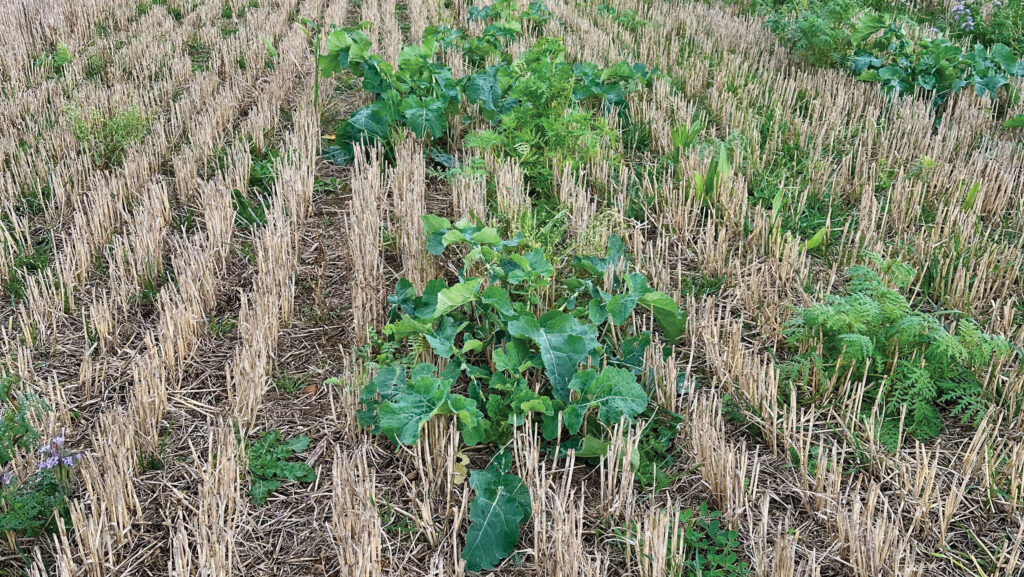
The cover crop broadcast at the T2 spray timing (23 May) was visually the poorest © MIke Abram
The trial consists of four different sowing timings in 24m tramline width strips replicated four times in different parts of the field.
The first two timings were aligned with flag leaf (23 May) and ear spray (13 June) fungicide passes in the standing wheat crop, with a third timing on 25 June that on some farms would coincide with a milky ripe foliar urea timing.
Post-harvest control plots were drilled with a 4.8m Simtech TS480-APL drill on 25 August.
Each plot was established with a 14 species diverse cover crop mix, designed with the help of Oakbank.
Brassicas, which would have been an obvious option, were not included because of the risk of contaminating the cold-pressed oilseed rape oil produced by the farm.
“They would have been a nice safety net,” Ben says.
He also avoided linseed and buckwheat as potential species that could grow tall quickly and cause problems at harvest.
Sunflowers are something they wish they hadn’t included.
Not only did they not establish well, they also stalled the Techneat applicator, which meant the intended seed rate had to be reduced from 23kg/ha to 10kg/ha.
Ultimately the lower seed rate has brought the cost down to a more manageable low £30s/ha, Ben says.
What was in the cover crop mix? |
||
|
Legumes |
Cereals |
Other |
|
Crimson clover (6.5%) |
White millet (6.5%) |
Chicory (1.3%) |
|
Berseem clover (4.3%) |
Red millet (6.5%) |
Phacelia (2.2%) |
|
Spring vetch (13.1%) |
Black oats (43.4%) |
Sunflowers (6.5%) |
|
Red Clover (2.2%) |
|
Sheep parsley (0.7%) |
|
Black Medic (1.3%) |
|
Plantain (1.3%) |
|
Lucerne (4.3%) |
|
|
| Source: Stuart Tabernor and Ben Hunt | ||
Trial results
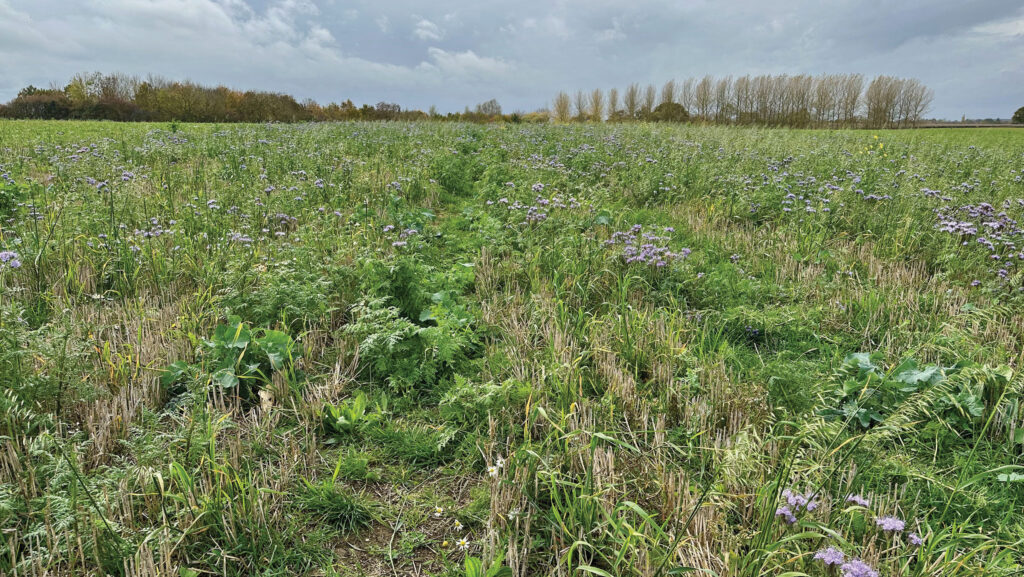
The third pass on 25 June proved to be the best in year one of the trials © Mike Abram
His hypothesis was the earliest timing would expedite ground cover and biomass.
But the results haven’t quite worked out that way with the earliest timing, actually being visually poorest, despite receiving 16mm of rain in the five days immediately after broadcasting, and a further 24.5mm a week to 10 days later.
“We got a lot of germination,” Stuart recalls. “Clovers, vetches, millets were all coming, but then we had a two-week heatwave, and it all died.”
He doesn’t know if the ground was so dry that the rain didn’t penetrate and as soon as the surface dried, they died, or because the wheat crop was so thick it stopped too much sunlight for them to survive.
“Our feeling, at least based on this one trial, is that it is too early, because we did get rain, although after was a dry spell.”
The second timing on 13 June also suffered from the dry spell in mid-June, although establishment was better, but the third pass on 25 June has proven best in year one of the trials.
“There was quite a wet period in early July with lots of small showers,” Stuart says.
“It had more sunlight [as the wheat crop canopy opened as it senesced], soil moisture and warmth, whereas the seeds sat on the surface for a couple of weeks from the ear spray timing, and I think there was predation of the seeds.”
The drilled control lagged behind the best broadcast plots until at least November.
Even if it does eventually catch up, Ben says it still means a lot of available solar radiation hasn’t been captured in August to October.
“Most of the solar radiation goodness and flowering for pollinators has already happened. There’s very little solar radiation on offer from November onwards.”
Some species established better at different timings, with clovers, chicory and plantain all surprisingly successful when broadcast.
“It opens new possibilities for farmers to exploit specific attributes of a wider set of species,” Ben says.
“There’s heaps of legumes and they’re nodulating, fixing nitrogen,” he adds. “I wasn’t sure they would work because they can be sensitive to previous herbicides.”
Black oats are much less prevalent in the plot established at ear spray timing than the milky ripe timing, while the post-harvest drilled plots have a much higher incidence of volunteer wheat.
That suggests wheat volunteers require a degree of incorporation to establish successfully, whereas they might rot or eaten when left on an undisturbed surface, Ben says.
Looking forward
The trial has led to fresh thoughts about how to maximise chances of success of using the pre-harvest broadcasting technique.
“I think to hedge against risk of failure, as we saw with the earliest timing, I’d split the timings and species,” Ben says. “What works in one season might not work the next.”
That could mean broadcasting one-third of the seed rate of species, such as clovers, chicory and plantains, that need more warmth and time to establish at the earlier timings or are more tolerant of shade.
Other species such as oats, phacelia, linseed, and buckwheat, if being used, could be broadcast closer to harvest, he says.
Content for this article was obtained during a Base-UK organised farm walk of the cover crop trials in late 2025