The role of cover crops in nitrogen management for potatoes
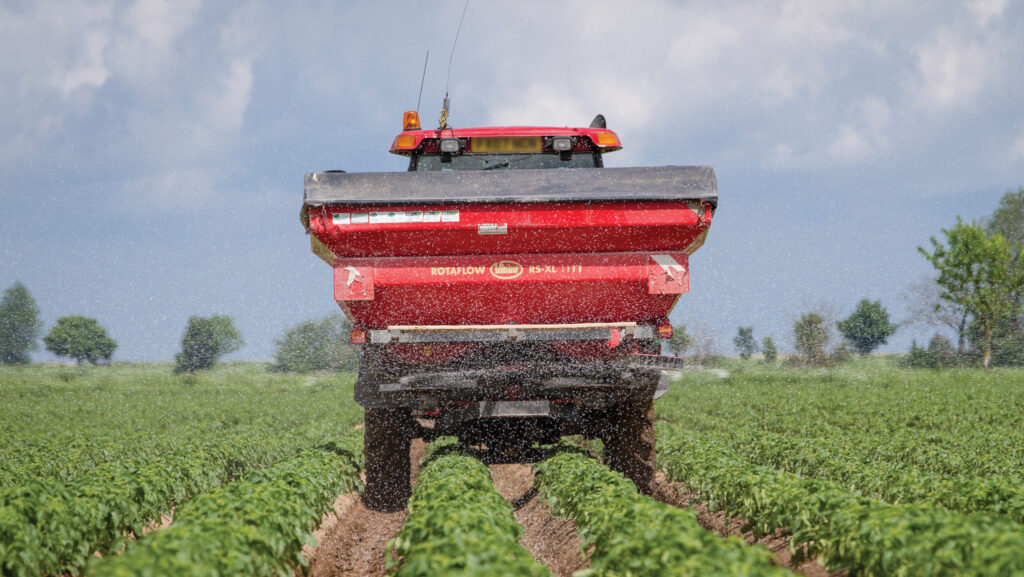 © GNP
© GNP A review into how cover crops affect nitrogen uptake in following potato crops has confirmed one thing – it is complicated.
Despite these complexities, the review also concluded that cover crops can be a very effective part of nitrogen management in potatoes.
However, success depends on early emergence, appropriate species choice and well-timed management interventions.
See also: Trial shows how to establish a cover crop before harvest
Overlooked benefit
There are many reasons potato growers plant cover crops, ranging from supply chain demands and agri-environment scheme requirements to improving soil structure.
Often overlooked is the potential benefit of nitrogen transfer to the following crop.
Recent work funded by the Cambridge University Potato Growers Research Association (Cupgra), and carried out by independent consultant Dr Marc Allison and independent potato consultant Martyn Cox, set out to better understand this process and, critically, how predictable it really is.
This is particularly important for growers as the current RB209 field assessment approach – while widely used and familiar – does not explicitly account for cover crops or their incorporation when estimating soil nitrogen supply.
Interlinked processes
Marc explains that the amount of nitrogen taken up by the following potato crop depends on several interlinked processes.
When a cover crop is destroyed and incorporated ahead of planting, it has a specific dry matter yield and nitrogen content.
Some of that nitrogen mineralises quickly, some enters the soil organic matter pool, and some may be lost through leaching or as nitrous oxide.
Over time, as organic matter is broken down by soil microorganisms, nitrogen continues to be released.
Potatoes, however, have a distinct uptake pattern. The rate of nitrogen uptake peaks relatively early in the growing cycle, typically 25-40 days after emergence.
“Ideally, we would want any nitrogen released from a cover crop to coincide with that period of rapid uptake,” Marc explains.
“But depending on the cover crop and how it is managed, nitrogen could be released before planting or later in the season when the potato crop is no longer actively taking up much nitrogen.
“In those cases, it is more likely to be lost than used.”
Key points: Potatoes, nitrogen and cover crops
- Cover crops can significantly cut nitrate losses in potato rotations, but their contribution to crop nitrogen supply is highly variable.
- Early emergence, appropriate species choice and well-timed destruction and incorporation are more important than simply establishing a cover crop.
- Nitrogen release from cover crop residues must align with the potato crop’s early peak demand if it is to be effectively utilised.
- Species type and residue characteristics strongly influence nitrogen mineralisation.
- Seasonal weather, soil texture and changes to soil structure can alter nitrogen availability independently of nitrogen released from cover crop residues.
- Decision support tools and RB209-based approaches provide partial insight only.
Better prediction
So what should potato growers and agronomists consider if they want to better understand how much nitrogen might be available to the following crop, and when?
A major influence is the species of cover crop grown and also the nature of the residues returned to the soil. While carbon-to-nitrogen (C:N) ratio can be a useful indicator within a given species, it is not the dominant factor when comparing between species.
Previous AHDB-funded work, which analysed about 300 cover crop samples, found C:N ratios ranging from 9 to 85, with an average of 24.
However, residues with similar C:N ratios can behave very differently depending on whether they are derived from legumes, brassicas or cereals.
Leguminous residues typically break down more rapidly than cereals, even where C:N ratios are similar.
Research has shown that above-ground material from leguminous and non-leguminous species may have identical C:N ratios.
But mineralisation rates can differ markedly due to differences in lignin structure and the way cellulose and hemicellulose are bound within plant tissues.
“Carbon-to-nitrogen ratio is most useful as a guide within a species,” Martyn explains.
“Two radish crops with different C:N ratios will behave differently, as will two cereal samples. But a cereal residue can behave very differently from a brassica residue with the same ratio.”
Residue chemistry, therefore, helps explain some of the observed variability in nitrogen release, although Martyn stresses that growers do not need to analyse plant chemistry in detail.
“Nitrogen uptake by the cover crop and broad species type remain the most practical and important considerations.”
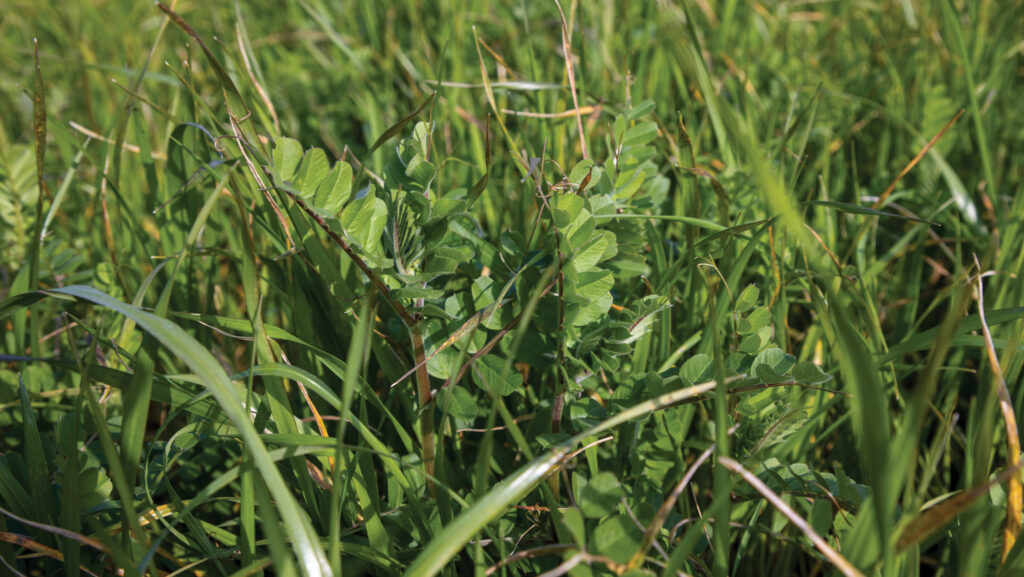
Legume residue cover crops © GNP
Variable uptake
Nitrogen uptake by cover crops is strongly influenced by species characteristics, including growth rate and rooting depth, as well as residual soil nitrogen, soil structure and weather conditions.
“Soil and rooting conditions can have an indirect effect,” Marc says.
“If a cover crop improves soil structure and rooting, the following potato crop may access more nitrogen from the soil profile, even if the cover crop itself does not release much nitrogen. That makes interpretation more difficult.”
Green area index (GAI) tools can be useful for estimating nitrogen uptake during the growing period, particularly in brassica-dominant covers.
Early in the season, a commonly used rule of thumb is about 50kg/ha of nitrogen for the first unit of GAI and about 40kg/ha for the second.
“GAI can give a reasonable estimate of how much nitrogen a brassica cover has captured,” says Martyn.
“But it does not tell you anything about residue quality or how quickly that nitrogen will be released.”
GAI-based approaches are not advised for mixed-species covers, particularly where cereals dominate, as their assumptions do not hold under those conditions.
Another limitation is that most studies report drilling date, but not emergence date.
“Emergence date is one of the key determinants of performance,” Marc says.
“You can drill early into a dry seed-bed, but if the crop does not emerge for several weeks, it is not capturing nitrogen during that period.”
While termination and incorporation dates are often reported, it is the interval between emergence and termination that largely determines nitrogen capture.
Seasonal conditions
Seasonal weather plays a major role in how much nitrogen is captured by cover crops and how much is potentially available to the following potato crop.
After a dry season, such as 2025, or following a poorly performing cash crop, substantial amounts of residual soil mineral nitrogen can remain. Cover crops can capture this nitrogen and reduce the risk of leaching.
However, cover crops also transpire water and reduce drainage through the soil profile, significantly altering nitrate movement. Studies suggest nitrate leaching reductions of about 50% or more in some situations.
Marc and Martyn point out that current nutrient planning approaches based on RB209 do not fully account for these effects, potentially leading to either over- or under-application of fertiliser nitrogen.
They also caution that repeated use of cover crops without adjusting nitrogen inputs can increase nitrogen retained within the system, shifting leaching risk later in the rotation rather than eliminating it.
“That fits with the wider European view. Cover crops modify nitrogen dynamics, but they do not solve nitrate leaching on their own unless total nitrogen inputs are also managed.”
Soil texture and organic matter influence both nitrogen uptake and mineralisation, and grazing adds another layer of complexity.
Livestock can increase nitrogen availability through dung and urine returns, but this also increases spatial variability and can create localised hotspots.
“Nitrogen loading from grazing is usually modest, but grazing can change both the timing and distribution of nitrogen release and, in some conditions, can adversely affect soil structure through shallow damage or compaction,” says Marc.
Led by Marc Allison and independent potato consultant Martyn Cox, the results were recently discussed at Cupgra’s annual conference at Robinson College, Cambridge.
Decision support tools
As part of the review, Martyn Cox examined several tools available for predicting nitrogen uptake and release from cover crops.
Non-destructive approaches such as green area index apps, Canopeo, drone normalised difference vegetation index (NDVI) or satellite imagery can provide quick estimates of nitrogen uptake for certain species, particularly brassicas early in growth.
“These tools are useful for screening, but they do not tell us anything about residue quality or predict nitrogen release,” he says.
Destructive sampling
Destructive sampling, involving cutting, weighing and laboratory analysis, remains the most accurate method of quantifying nitrogen uptake, particularly where sampling resolution is high enough to capture field variability.
However, it is labour-intensive and time-consuming.
Data from destructive sampling can be used in more detailed models such as the French Merci (Méthode d’estimation des Restitutions par les cultures intermédiaires) system, which estimates nitrogen release over time and accounts for residue characteristics.
It requires accurate biomass measurements and species separation in mixed covers.
Dutch and US-based systems
Martyn also reviewed Dutch and US systems.
The Dutch model offers robust long-term nitrogen accounting and, in limited comparisons, produced results very close to UK-derived estimates, although further testing is needed to build confidence.
The US CC-NCalc (cover crop nitrogen calculator) model has a relatively user-friendly interface and can simulate nitrogen release where good biomass data are available.
However, it relies on laboratory analysis, does not handle mixed-species covers well and is not calibrated for UK soils and rotations.
“No single tool gives you the full answer. They can all help, but they need to be used alongside good data and sound agronomic judgement,” says Martyn.