

Farmer-led trial reveals effect of cultivations on bird life
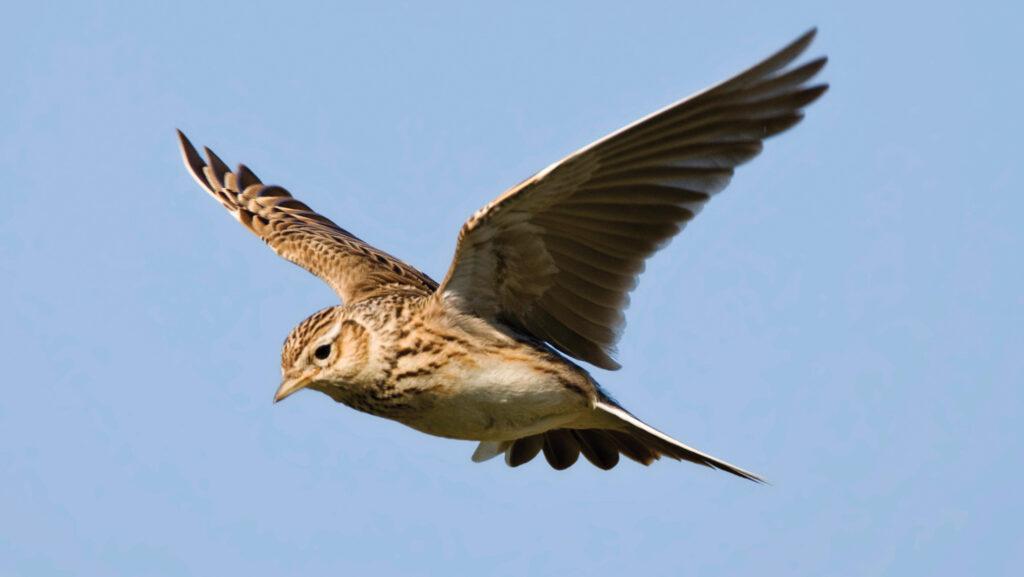 Eurasian skylark © Adobe Stock
 A trial assessing different cultivation practices on the presence of farmland bird species has revealed striking evidence how regenerative agriculture can influence bird communities.
Acoustic monitoring technology at Oli Harris’ mixed farm in Dorset recorded nearly 20,000 bird calls in just one week, across two trial sites.
The findings suggest regenerative agriculture supports a greater diversity of farmland bird species, with a higher number of conservation-priority species present.
See also: How grower varies seed rates and N to lift whole-field output
George Caterer, an ecologist at biodiversity data analysis firm Wilder Sensing, says: “Interestingly, there were 4,196 Eurasian skylark calls recorded in the regen plot compared to just 11 calls in the conventional.
“What’s striking in this trial is the difference we’ve seen in such a small area and short timescale. It highlights how different farming practices can shift entire bird communities.”
The trial
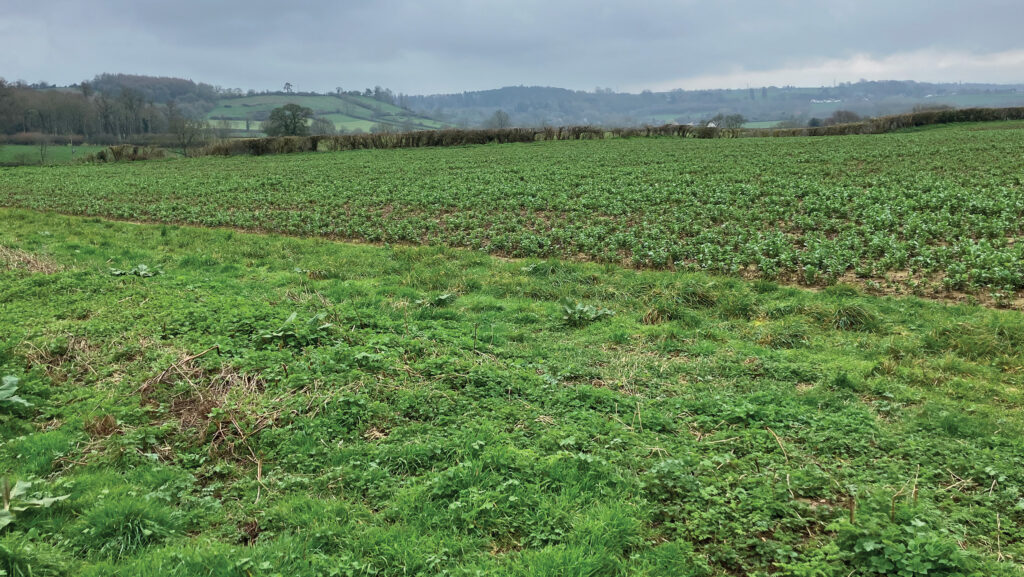
Recorder location © MAG/Emma Gillbard
Part of an Agri-techE collaboration, the trial saw two bioacoustic recorders installed in both a conventional and regeneratively farmed field, roughly half a mile apart at Oli’s farm.
The recorders operated continuously for six days, capturing bird calls across a 50m radius:
- Conventional field – ploughed and cultivated regularly for the past decade. Most recently ploughed within the eight months ahead of wheat. Formerly, land was in turf grass.
- Regenerative field – managed under no-till for six to 10 years, following wheat.
The conventionally cultivated fields were dominated by a smaller number of generalist species such as pheasants and corvids. Species richness (the number of species recorded) was similar across the two plots.
In fact, 49 species were recorded at the conventional field, with 46 species on the regenerative field. However, activity levels were very different, with a stark contrast between land management.
Wilder Sensing ecologist Cat Scutts, says: “Specialist farmland birds were far more active in the regenerative field.
“There was a higher number of conservation-priority species present. This likely reflects greater habitat complexity and food availability.”
In contrast, the bird community in the conventional field was dominated by a few generalist species.
“We recorded 1,622 Eurasian jackdaw in the conventional, compared to 43 in the regen field. The carrion crow and common raven were only present in the conventional,” she says.
Wilder sensing
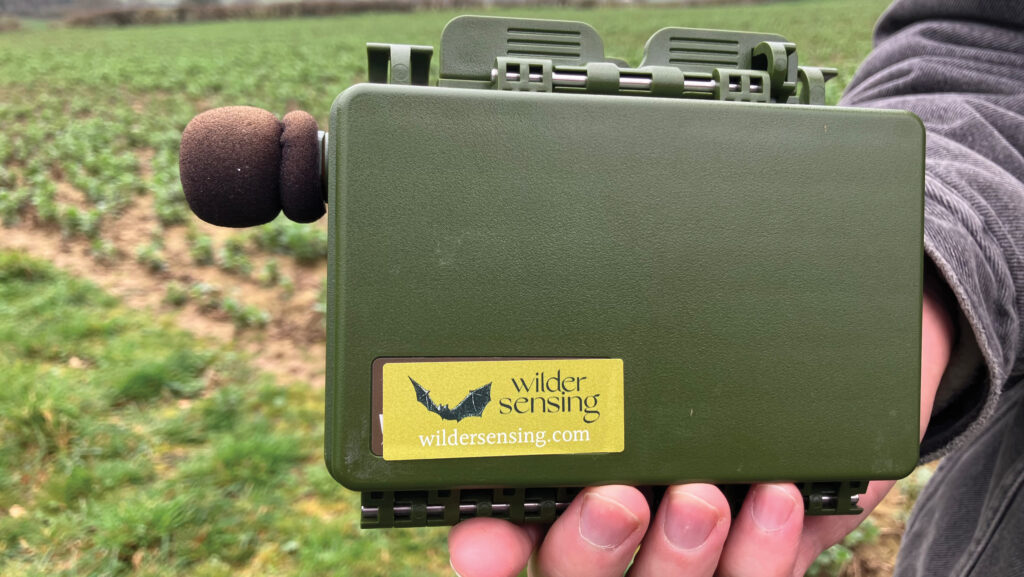
The bioacousitic recorder device costs £500 © MAG/Emma Gillbard
Wilder Sensing provides software packages that examine recordings captured by bioacoustic devices.
The AI-powered, species-recognition software analyses sound data, and presents the results on an interactive dashboard, allowing users to visualise biodiversity patterns across the landscape.
The technology draws on a database of more than 6,500 global bird species, with full identification coverage across the UK.
The continuous data recording system can detect about 30% more species activity than manual surveys.
It measures species presence rather than precise population counts – for example, it cannot distinguish whether a single bird has called five times or whether five birds have called once.
Traditional bird monitoring relies heavily on manual field surveys, typically during early morning or evening when birds are most active.
While effective, this approach can miss significant periods of activity and may be influenced by human variability.
A hardware bioacoustic recorder costs £500, and the Wilder Sensing software subscription is £650/year.
Farmer confidence
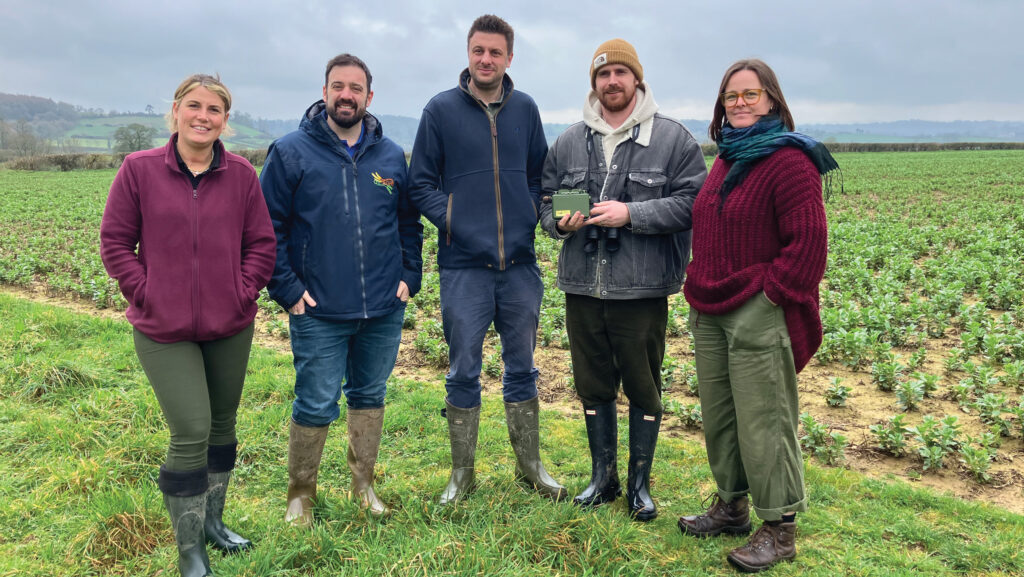
From left: Jazz Jex, Oli Harris, Todd Jex, George Caterer and Cat Scutts © MAG/Emma Gillbard
With environmental metrics becoming increasingly important in supply chains, technologies such as bioacoustic monitoring could be valuable tools for farmers seeking to measure and demonstrate biodiversity gains on their land.
The findings have given Oli confidence that he is doing the right thing, and the results have been pleasing.
“When it comes to soil health, you can easily see improvements in organic matter, earthworm counts and physical structure – but measuring beneficial changes in wildlife and biodiversity is more of a challenge,” he says.
“Now we have the technology on-farm to see these changes, it’s been great to find out what’s going on.”
Oli started strip-tillage on the farm in 2010 and moved to direct drilling two years later.
He wanted to bring machinery back in-house, rather than relying on the contractor. Soil health quickly became a passion of his, which later extended into biodiversity and birdwatching.
Baselining importance
One of Oli’s biggest regrets since changing the establishment method is not carrying out an initial soil baseline.
“We’ve seen no detriment to yield or margin since changing systems – just lifts in soil health, worm counts, and wildlife. Now the technology allows us to do environmental surveying, I was keen to find out what was happening on farm.”
As a tenant farmer, Oli believes having proof of beneficial environmental data will stand him in good stead with his landlord, and may help tenure new land in the future.
“This is a real point of interest for landlords. They are increasingly looking at farmer tenants who bring the whole package, including environmental stewardship,” he says.
The farm’s agronomists, Todd and Jazz Jex, highlight the importance of baselining data at the start of a change in farm practice, so changes can be tracked.
“Measure, monitor and manage. Baselining is an important tool to put in place. There is a lot of potential for this in the industry,” Jazz says.
“Farmland biodiversity is so important and how we’re managing our landscape is becoming ever more so.
‘With this trial, it’s been fascinating to see how practical farming methods have such an impact on surrounding bird populations,” adds Todd.
Bird calls at two different plots on the farm |
||
|
Bird species |
Conventional plot |
Regenerative plot |
|
Common buzzard |
141 |
155 |
|
Common linnet |
5 |
31 |
|
Common magpie |
1 |
1 |
|
Common moorhen |
37 |
36 |
|
Common pheasant |
1,848 |
557 |
|
Common snipe |
3 |
53 |
|
Common woodpigeon |
102 |
28 |
|
Dunnock |
80 |
8,327 |
|
Eurasian blackbird |
14 |
56 |
|
Eurasian blue tit |
29 |
38 |
|
Eurasian coot |
34 |
14 |
|
Eurasian green woodpecker |
196 |
24 |
|
Eurasian jackdaw |
1,622 |
43 |
|
Eurasian oystercatcher |
2 |
3 |
|
Eurasian siskin |
2 |
3 |
|
Eurasian skylark |
11 |
4,196 |
|
Eurasian wigeon |
3 |
3 |
|
Eurasian wren |
96 |
414 |
|
Eurasian/green-winged teal |
2 |
21 |
|
European golden plover |
1 |
2 |
|
European goldfinch |
15 |
16 |
|
European greenfinch |
7 |
15 |
|
European robin |
20 |
325 |
|
European stonechat |
1 |
14 |
|
Fieldfare |
12 |
54 |
|
Great spotted woodpecker |
40 |
2 |
|
Great tit |
25 |
12 |
|
Grey heron |
3 |
2 |
|
Long-tailed tit |
22 |
92 |
|
Mallard |
4 |
44 |
|
Meadow pipit |
3 |
16 |
|
Mistle thrush |
3 |
105 |
|
Redwing |
31 |
94 |
|
Yellowhammer |
1 |
31 |
|
Species recorded in only one trial plot |
||
|
Black-headed gull |
– |
1 |
|
Carrion crow |
11 |
– |
|
Coal tit |
– |
1 |
|
Common chaffinch |
25 |
– |
|
Common chiffchaff |
1 |
– |
|
Common greenshank |
– |
1 |
|
Common kestrel |
6 |
– |
|
Common reed bunting |
– |
1 |
|
Eurasian curlew |
– |
1 |
|
Goldcrest |
– |
2 |
|
Herring gull |
1 |
– |
|
Little grebe |
– |
1 |
|
Pied wagtail/white wagtail |
– |
10 |
|
Rook |
– |
2 |
|
Song thrush |
– |
10 |
|
Stock dove |
11 |
– |
|
Water rail |
– |
1 |
|
Total calls |
4,483 |
14,860 |
|
Source: Wilder Sensing at Oli Harris’s farm in Dorset |
||
Productive landscape event
Farmers and landowners can attend the Agri‑TechE NatureTech for Profit and Planet event on 28 April, which focuses on how technology can track ecosystem improvements.
The Environment Agency’s chief scientist, Dr Robert Bradburne, is the keynote speaker, alongside NFU chief environment adviser Diane Mitchell, Leaf chief executive David Webster, and innovators working at the intersection of agriculture, ecology, and technology.
The event takes place at Rothamsted Enterprises, in Hertfordshire. Farmers with less than 750 acres can access £50 discounted tickets. For more information visit the Agri-TechE website.

Staying sharp shouldn't be a chore
Explore more / Transition
During the series we follow our group of 16 Transition Farmers through the challenges and opportunities as they seek to improve their farm businesses.
Transition is an independent editorial initiative supported by our UK-wide network of partners, who have made it possible to bring you this series.
Visit the Transition content hub to find out more.
