Growers share insights on using Johnson-Su compost extracts
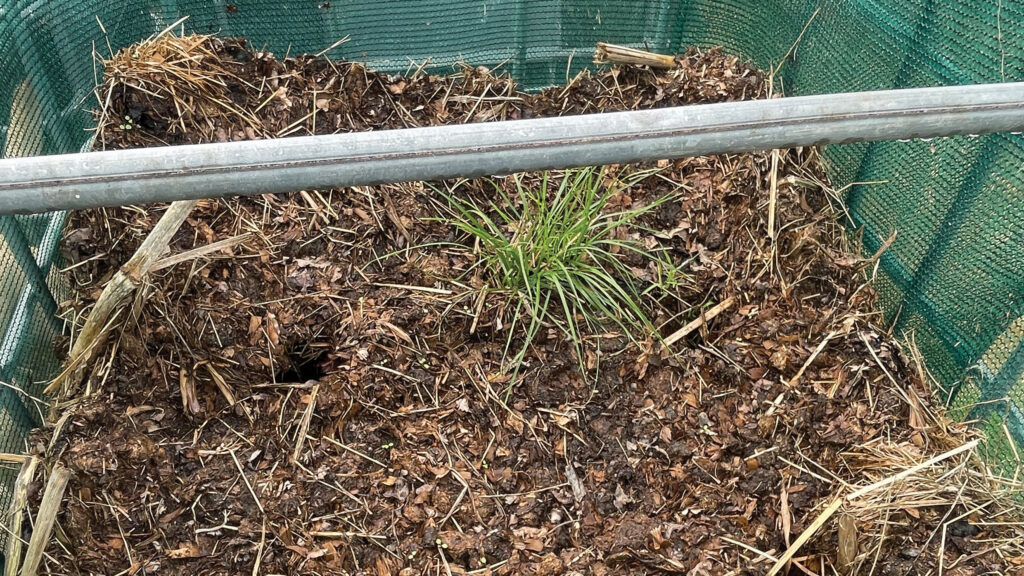 Johnson-Su compost extract © MAG/Richard Allison
 Two farmers shared their experience of feeding soils with Johnson-Su compost extracts at the recent Groundswell event, as interest in the technique for giving soil biology a helping hand continues to rise.
For Shona Russell, who works on a 600ha arable farm in Cambridgeshire, increasingly dry springs and higher costs mean that using an extract is helping to build a more resilient system – although she added that the technique is just one part of their approach.
“There’s no right way of doing this,” she stressed. “On this farm, we use IBC cages lined with bird mesh, with drainpipes then used to create five channels in a dice pattern so that every part of the compost is only 20-30cm from air.”
See also: How to build a Johnson-Su bioreactor to produce your own on-farm biology
In terms of components, Shona aims for a 50:50 C:N balance rather than the accepted 60:40 ratio.
“We don’t have access to manure on this farm so we have a higher nitrogen content. The key is to get diversity into it wherever possible.”
The contents include clover, nettles and market garden cuttings, as well as cutting from a multispecies cover crop mix. The brown components come from woodchip, leaf litter, wheat and pig droppings.
“We soak them with rainwater before filling the cages, which takes a day. The thermophilic stage happens next, during which we leave them outside, and we pull the drains out after two to three days.”
Once the temperature is 25-30C, worms are added, she reported.
“Another way of adding to it is by spore loading – so I went along the farm’s grassy tracks and picked mushrooms, adding them to the top, as well as every type of seed grown on the farm.”
This is to influence the mix and get the biological community they are aiming for, confirmed Shona. “We make two batches each year – one for autumn drilled crops and the other for spring plantings.”
Monitoring of the compost with a microscope gives her confidence in its contents and shows the diversity and abundance that can be achieved. “Generally, it’s at its peak after 13 months.”
At that stage, extraction is done using a conical tank and mesh “teabags”, which are suspended in water and agitated, with the finished product ready 60-90 minutes later.
Application is via a front tank on the farm’s Avatar drill which is fitted with a peristaltic pump, with every opportunity taken to apply the extract. This year, they plan to use 1.5-2kg/ha.
Scottish experience
Matt Griffin, of Neidpath Farms in Scotland, started addressing soil health on the upland beef and sheep farm he manages in 2021 and now has 80 Johnson-Su bioreactors operating.
Creating fungal rich compost for some of the lower land, where soils were bacteria-dominated, is done using materials such as woodchip and grass cuttings, but the challenge has been getting it applied across a big area.
“Covering lots of acres is time consuming. We used a cement mixer to take out some of the chunky stuff, but extraction processes have been key, as then it can be sprayed on,” he said.
“To do that, we built a Chaos Springs sprayer to help keep the biology alive while it’s in the tank and were towing it behind a quad bike, but that still didn’t give us the scale we were looking for.”
He is now investigating amending muckheaps with Johnson-Su and then dressing them with diverse grass species, to compare that with extraction methods.
“An extract goes a long way compared to spreading muck but it does need moisture, shade and shelter to survive.”
Trials work continues with a whole range of soil amendments so that he can see what works best.
“This is all about building resilience so that we can move forward and re-invest in the business,” he reported.