Why one landowner is opting for a biodiversity net gain scheme
 © Paul Starr
 An Essex landowner is likely to take up to 17% of his 400ha of arable out of production in favour of a biodiversity net gain scheme, while potentially producing and selling carbon credits from the rest of the farmed ground and an area of pasture in a significant change to the farm’s current business model.
The change at the 600ha Braxted Park Estate has been unlocked by being involved in a Natural Environment Investment Readiness Fund (NEIRF) project led by Essex County Council (see “What is the Natural Environment Investment Readiness Fund?”).
See also: How new tech aims to improve soil carbon measurement
What is the Natural Environment Investment Readiness Fund?
Defra and the Environment Agency’s Natural Environment Investment Readiness Fund provides grants of up to £100,000 to environmental groups, local authorities, businesses and other organisations to develop nature projects to a point where they can attract private investment.
These projects aim to demonstrate a return on the fund’s investment by capturing the value of carbon, water quality, biodiversity and other benefits provided by natural assets, with revenue generated through the sale of carbon storage, improvement in biodiversity, natural flood management benefits and reduced water treatment costs.
A report by the independent Essex Climate Action Commission for the county to reach net zero by 2050 includes a recommendation that 50% of Essex’s farmland uses sustainable land stewardship (see “What is sustainable land stewardship?”) by 2030, 75% by 2040 and 100% by 2050.
One of the council’s responses to the report has been to apply for NEIRF investment to research the potential of biodiversity net gain (BNG) and carbon credits, in conjunction with Downforce Technologies, a global provider of natural capital intelligence at scale, and nature specialist corporate finance advisers Finance Earth.
What is sustainable land stewardship?
Essex Climate Action Committee defines sustainable land stewardship as a range of farm systems and strategies applied to agriculture and land use, which have a positive environmental effect lowering global carbon emissions.
Sustainable agricultural systems exhibit the following key attributes:
- Use of efficient crop and animal varieties
- Limit external inputs
- Exploit natural biological processes
- Minimise physical and chemical technologies that have adverse impacts on the environment and human health
- Use local human resources
- Lower use of valuable resources and production of damaging resources
Downforce Technologies is providing baseline soil carbon and biodiversity measurements using its innovative big data analytics platform, while Finance Earth is exploring investment opportunities for the project, which involves four farming estates.
Historical and current information combining satellite and local geophysical and environmental data is integrated in Downforce Technologies’ virtual analytics platform to provide measurements, such as vegetation structure and cover, above-ground carbon and biomass, and soil organic carbon, at scale for the project, explains Maria Whittaker, the company’s chief development officer.
“That data is then being used by Essex County Council to understand what is possible and to help map the most efficient use of land to reach their restoration goals,” she says.
The data supports decisions around where to site BNG projects for greatest benefit and least risk, while for soil carbon it is identifying where carbon credits could be produced to offer into voluntary soil carbon trading market, Maria says.
Pilot landowner
Access to that type of information was a key part of why Braxted Park Estate owner Duncan Clark was interested in being one of the four pilot landowners in the project.
The estate effectively has two areas: a 200ha Grade II* listed park and garden behind a 4.5-mile wall and the 400ha of arable land to the north-east outside the wall, Duncan explains.
“The agricultural land is not the highest quality,” he says.
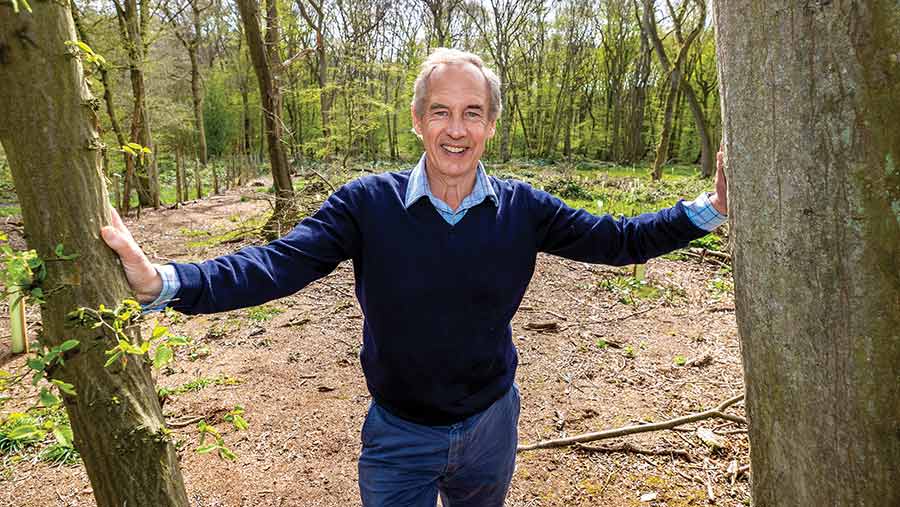
Duncan Clark © Paul Starr
For 10 years in the 1990s, the entire area was in the set-aside scheme – “something of a local scandal,” Duncan says – and then in a Countryside Stewardship scheme for another 10 years before being “dragged back into intensive arable farming” in 2014 by the termination of the stewardship scheme.
“But when we did that, I refused to give up all the biodiversity gains we had made on about 40ha of the 400. We had rewilded by accident, but it was incredible what had happened – turtle doves, nightingales, oak trees planted by jays and squirrels, red-listed flora and fauna and beautiful scrub and mature canopy.”
With a history of managing land – “by benign neglect”, he jokingly calls it – for environmental gains such as those required for BNG projects, he jumped at the chance at being a pilot farm in the project.
“It’s marginal land,” he says. “I’ve got first-mover advantage and the numbers [developers] are talking about are, for us, much better than growing wheat, at least for now.
“When wheat is £300/t and yields high, it will be tougher, but I don’t buy the sustainability of those high prices, and I love BNG because I don’t have to pay contractors, buy fertiliser or worry about weather. And I’m doing more for turtle doves, nightingales, rare flora and fauna, so it’s a win-win.
“Farm clusters, like the one I’m setting up, will be the key to getting scale,” he adds.
Private money
One major difference, unlike with set-aside and Countryside Stewardship schemes, is he is no longer taking taxpayer money, he points out. “This time it is the private sector.”
About 70ha of the current arable area has been identified by Duncan’s legacy advisers Bidwells’ analysis as suitable for BNG offsets. The area will be locked into the scheme for 30 years.
Management costs should be relatively low – any scheme he enters will be for “benign neglect, because I’m good at it”, rather than, for instance, planting delicate pollen and nectar mixes on the heavy clay land.
© Paul Starr
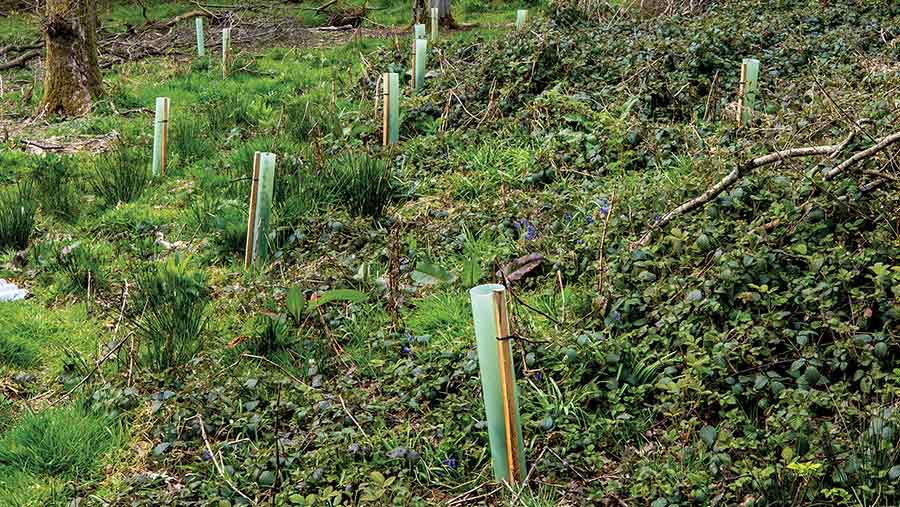
“I’m a great believer in reforestation by nature because I’ve done it. Thick blackthorn establishes for the first 10 years, then out pop the oak plants and the next thing you have a canopy that kills the blackthorn, and finally you have a wood or scrubland that is very attractive to certain red-listed species. This needs management but it’s low cost, straightforward and very rewarding.”
Roughly another 70ha, mostly pasture, has been identified as most suitable for producing carbon credits, despite that area having some of the highest levels of soil carbon on the estate, according to Downforce Technologies’ analysis.
“It was more of a pragmatic decision,” explains George Hewson, UK country manager for Downforce Technologies.
“It will be allowed to go into natural regeneration scrubland to increase the carbon, so it’s better to be land that Duncan is not particularly wedded to being under agricultural production.”
Carbon programme
As part of the NEIRF project, Downforce Technologies is road-testing its own carbon programme, Maria says.
For this project, the credits will be sold as offsets, with the idea of building opportunities to sell credits locally in Essex. In other projects, the firm is developing carbon inset programmes reducing emissions in supply chains.
“It’s a voluntary 25-year programme,” Maria says. “The programme is outcomes-based, so you sell the extra carbon you deliver using a mean of six years of baseline data and comparing it with the average of the last three years of data to make sure you are sequestering that carbon in the soil.
“You don’t need to sample your soils, and with our data analytics platform, we can provide granular insights into soil organic carbon levels and variability, down to 10sq m detail, every 10 days since the beginning of 2017. Our unique capability lies in analysing historical and spatial distributions to an exceptional degree of detail,” she explains.
The programme could also be extended to include the arable area on the farm, with changes in farming practices or agronomy resulting in increased soil carbon.
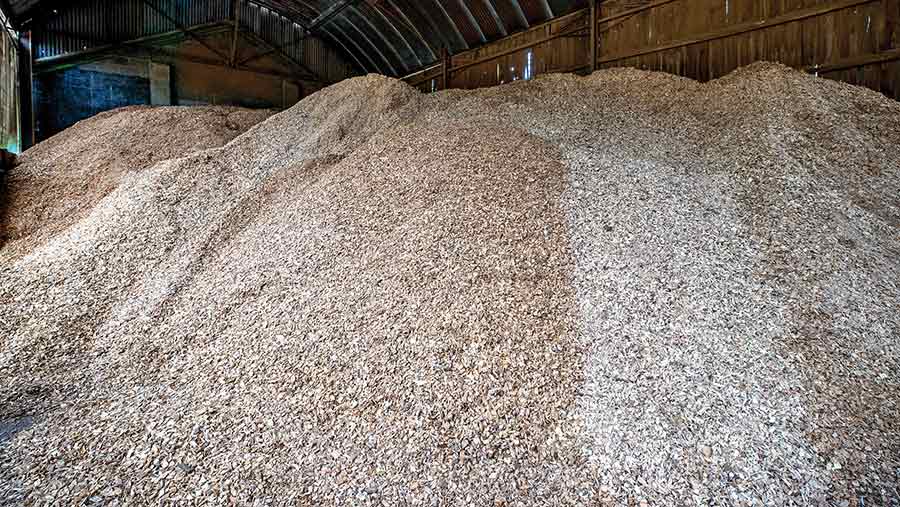
Woodchip store © Paul Starr
The in-depth analysis by Downforce Technologies in other projects is providing evidence of how rotation or certain farming practices, for example, can increase and decrease soil carbon.
“The accuracy and validity of your baseline data are of utmost importance,” Maria says. “If you have the right information, you can build rotations that are more productive for carbon, as well as yield.”
That’s important, Duncan acknowledges. “It would increase the amount of land I can commit to producing carbon credits, but is somewhat dependent on the extent I can convince my contractor to farm it in that manner and for that purpose. It’s not an either-or decision like BNG.”
Individually, BNG credits are worth much more, he says. “We haven’t signed a contract yet, but in theory the uplift is something like six credits per hectare, and I’ve heard numbers anywhere between £10,000 and £30,000 for a credit, so it is potentially big money,” he concludes.