

Advertiser content
New oilseed rape choice shows early promise in Northumberland
Changing from a trusted variety to a new one can sometimes require a leap of faith, but for Northumberland farmer Andrew Reed, of East Ancroft Farm, it is a move that seems to be paying off.
This season, Mr Reed, who farms 800 ha of mixed cropping across four farms near Berwick-upon-Tweed, swapped from proven oilseed rape variety, Aurelia, to Recommended List newcomer LG Adapt, sowing 100 ha after winter barley last August.
“Aurelia has been a superb variety for us over the past three years, but when the seed wasn’t available from our usual source last autumn, we decided to give LG Adapt a go on the advice of our agronomist, and data from Limagrain trial sites.
“I was looking for the next step forward in varieties, and so far, it all looks fantastic. It established really well, and has come through the winter and spring looking clean and superb. If anyone has a better 200-acre block of oilseed rape, I will shake their hand.
“I’m really looking forward to harvest,” he continues. “Last year’s Aurelia, which was grown on a heavier block of land, came in at 5.5 t/ha, so hopefully we can get close to, or exceed that.
“Oilseed rape looks like it could be the breadwinner this harvest, followed by first wheats.”
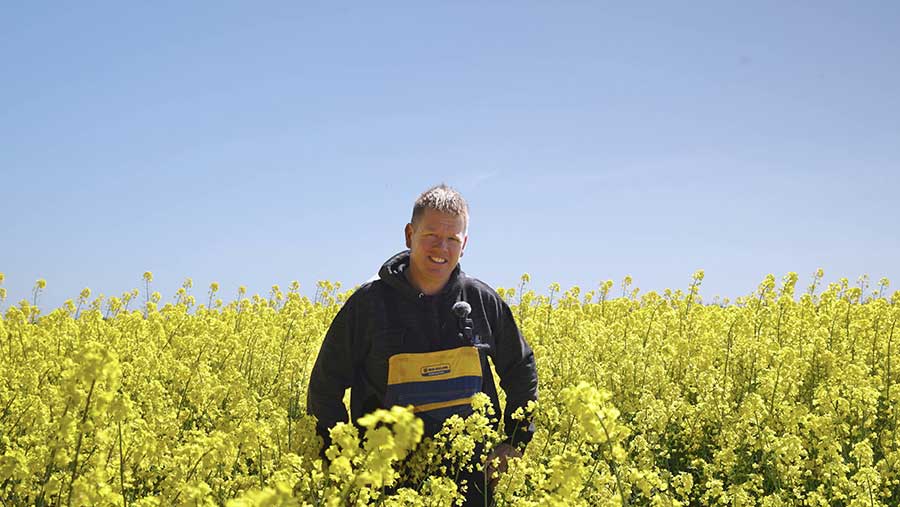
Andrew Reed in his crop of LG Adapt © Limagrain Field Seeds UK
Looking beyond yield
While yield potential is obviously a big driver when choosing any new variety, LG Adapt sits among the best at 106% on the 2026/27 AHDB Recommended List, other factors are also important to Mr Reed.
Disease resistance is one of those, and here too this variety scores well, with good stem health, and turnip yellows virus (TuYV) resistance.
Mr Reed says no fungicide was needed last autumn, while this spring, variety received two main fungicides, one with additional growth regulation and foliar micronutrients at stem extension in March, and another at mid-flowering in late April.
Mr Reed also values the new variety’s pod shatter resistance, which can be a particularly valuable trait when growing oilseed rape on some of the more exposed fields close to the east coast, where significant issues with seed loss due to windy conditions were experienced six years ago.
Desiccation is also carried out with a trailed sprayer that lacks the ground clearance of a self-propelled machine, so pod shatter resistance should help to limit any tramline losses too, he notes.

Aurelia © Limagrain Field Seeds UK
LG Adapt at East Ancroft Farm
- 100 ha sown after winter barley on 10-20 August
- Seed broadcast behind a Simba SL cultivator, then rolled
- Liquid starter fertiliser also applied
- Autumn – herbicides applied in September and October, plus insecticide, and micronutrients
- Spring – two fungicides applied at stem extension and mid-flowering, plus foliar micronutrients with the earlier spray
- Variable P&K applied early March
- 245 kg N/ha applied in three splits
LG Adapt
- High-yielding hybrid oilseed rape variety (106)
- Highest oil content on the Recommended List 2026/27 (47%)
- Consistently strong performance across all regions and seasons
- Good resistance to stem based diseases
- TuYV (turnip yellows virus) resistance
- Pod shatter resistance
Provided by
Farmer‑owned global seed specialist delivering high‑performing, reliable crop varieties and expert support, combining UK breeding excellence with worldwide research to help farmers grow profitably and sustainably.