OSR revival gathers pace as growers expand acreage
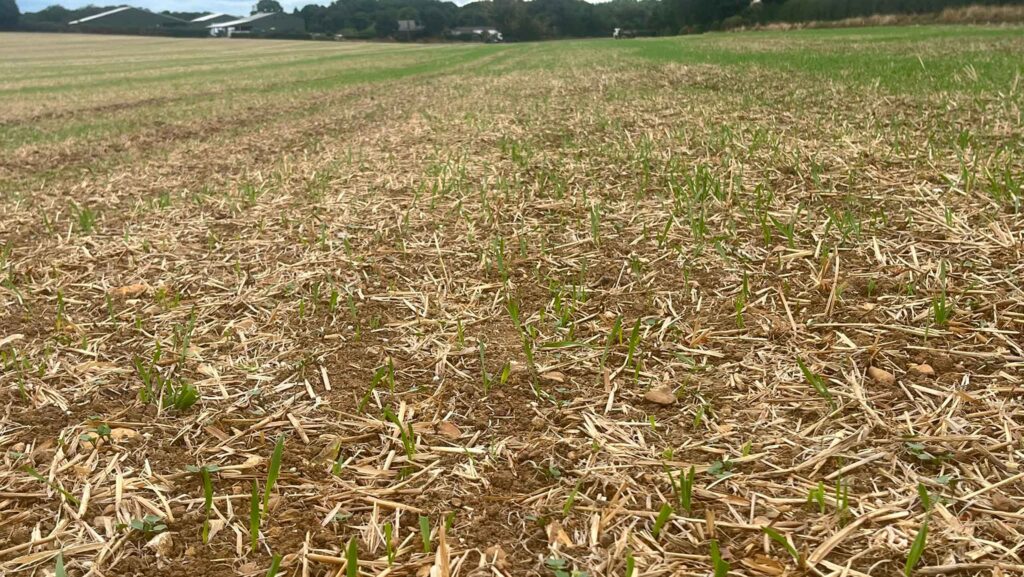 Winter oilseed rape plants poke through the winter barley volunteers at Will Dickinson's farm in Hertfordshire © Will Dickinson
 The oilseed rape acreage is expected to rise again this autumn, with growers showing renewed confidence in the crop after it delivered one of the more positive outcomes in a challenging harvest season.
The recovery follows a 49% year-on-year increase in the GB oilseed rape area for the 2026 harvest, to an estimated 358,000ha, according to the AHDB’s Planting and Variety Survey.
Industry experts expect a further 10-15% increase for harvest 2027 as growers respond to stronger margins, improving yields and better management of cabbage stem flea beetle (CSFB).
See also: Growers to hold nerve on oilseed rape drilling until rain arrives
Jamie Burrows, chairman of the NFU’s Combinable Crops Board, is receiving reports of significant increases in OSR plantings, including one 4,050ha farm drilling about 38% of its area to the crop.
“Some people are doubling or even tripling their oilseed rape area this autumn,” he said.
“Not only is it the most profitable crop the past couple of seasons, it has also become relatively cheaper to grow.”
Mr Burrows farms at Sandcross Farming in partnership with Will Dickinson in Hertfordshire. At the farm, based near Welywn Garden City, 40ha of OSR has been planted for the second consecutive autumn.
But dry conditions mean growers must prioritise soil moisture rather than drill by the calendar, Mr Burrows said. “Farmers need to make sure the moisture is there. It won’t grow if it doesn’t get the moisture.”
Record average yield
United Oilseeds is forecasting the UK’s average OSR yield to exceed 4t/ha this harvest for the first time, compared with a 10-year average of about 3.3t/ha.
The farm had received only 25-35mm of rain in the previous three weeks, with moisture penetrating to about 10cm. As a result, after the prolonged dry spell, winter barley volunteers have emerged at the same time as the rapeseed.
The crop has so far escaped CSFB damage, despite Rothamsted Research testing showing that about 80% of flea beetles are resistant to pyrethroid insecticides.
“We have got to manage our insects and pests, rather than relying on the chemicals,” Mr Dickinson said.
Digestate had also had a “really positive effect” on flea beetle numbers, he added.
Last season’s OSR yielded 3.13t/ha, while deteriorating cereal margins have strengthened its appeal.
“OSR used to be a very risky crop to grow because of the trees and pigeon pressure,” Mr Dickinson said.
“But with margins in cereal crops being so negative, it has become something we felt we could try again.”
Flea beetles ‘present’
Jock Willmott, partner and agronomist at Ceres Rural, said flea beetle pressure was evident on emerging OSR crops as far north as North Yorkshire.
“It seems to be there. Soils are so warm and have some moisture. This year, you can see adult shot-holing in emerging plants. We weren’t really expecting it,” he added.
Mr Willmott said farmers who grew OSR last year would “likely grow a bit more this autumn”.
“I think the general area will go up, but by how much I’m not sure. It’s still slightly early days,” he said.
But he added: “They will not abuse it. They will understand there’s still a risk.”
The potential rise in production could eventually weigh on prices, although domestic demand remains strong.
“There is a market for oilseed rape to displace imports and improve our own exports,” one industry expert said. “But if everyone grows it, there is a risk of flooding the market.”
Mr Dickinson added: “UK OSR is grown without neonics, but the same cannot be said for any imports.”