

How a passion for nature turned into thriving bird food business
When Lincolnshire farmer Nicholas Watts first began surveying bird populations, little did he know this was the first stepping stone to a thriving bird food business.
Originally, the farm was a traditional fen farm, growing cereals and root crops, but for nearly three decades it has also been home to Vine House Farm Bird Foods, processing 1,500t of bird seed each year.
Nicholas has long had a passion for nature. Surveying local bird populations over the decades, he believes the decline in many farmland birds is closely connected to a decline in food supply.
Most insects are plant specific. Without specific species present, there is no habitat for insects to reproduce, and without insects there is less food for birds.
See also: Why straw length and brightness matters to Lincs grower
“The tortoiseshell butterfly will only lay its eggs on nettles, the cabbage white will only lay its eggs on brassicas, and the Knotgrass beetle will only lay its eggs on Knotgrass – and if these are not present, adults will not lay eggs.
“Some birds rely on insects, while others depend on seeds. It’s likely herbicides have done more damage to our insects than insecticides have,” says Nicholas.
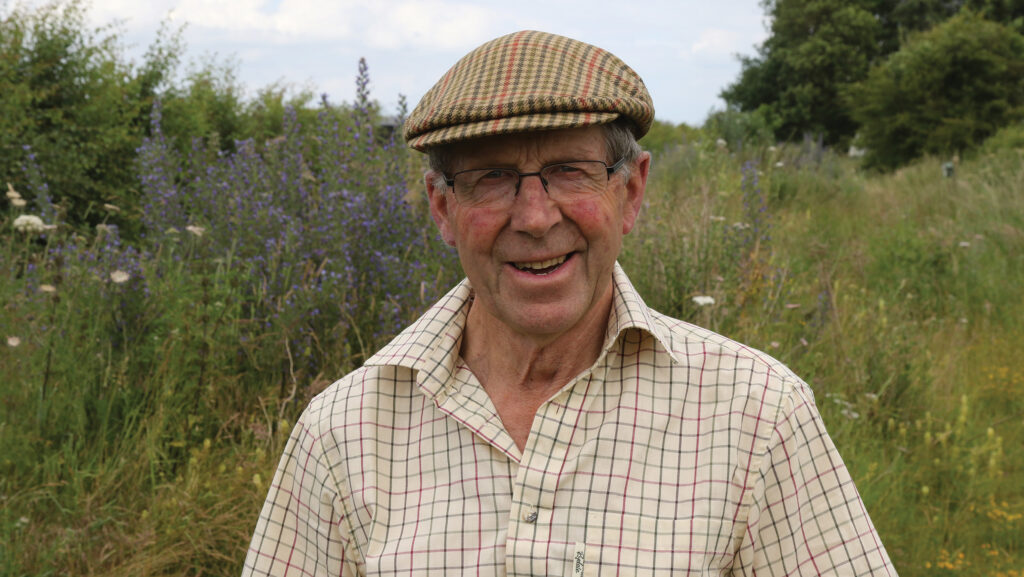
Nicholas Watts © Vine House Farm
A spectacle of farm birds
Noticing the worrying trend of declining bird numbers, Nicholas decided to start feeding birds through the winter to help them when natural food was scarce.
To his surprise, a remarkable number of birds started flocking to the farm in what he describes as “a spectacle”.
Keen to share this with the wider public, the farm hosted an open day, and naturally visitors began asking where they could buy bird seed.
“Visitors were asking to buy bird food and I hadn’t really thought about that, so I sold them some oilseed rape.”
Organic and no-till
Nicholas and Robert turned to organic farming on one of the farms in the hope to eliminate herbicide use and bring bird activity back to the farm.
However, Nicholas realised more frequent cultivations were preventing invertebrate population numbers from flourishing, so they have since established a no-till system across another farm, which has shown signs of bird numbers increasing.
Bird food business
The following year, the same thing happened, which ignited the development of Vine House Farm Bird Foods.
Today, a total of 400 acres (160ha) of bird seed is grown on the farm of which 100 acres (40ha) is sunflowers, alongside red millet, white millet and canary seed.
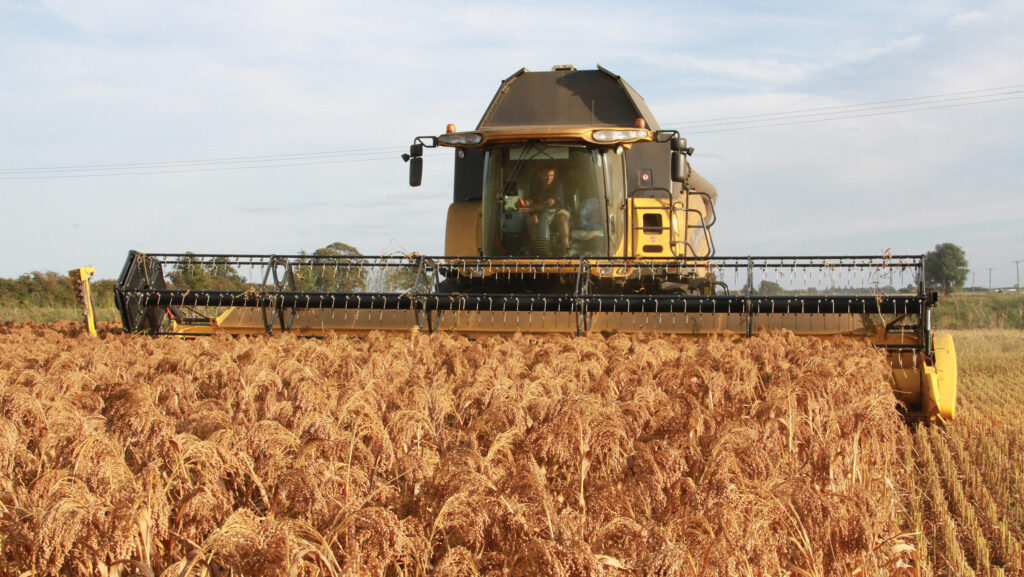
Harvesting millet © Vine House Farm
Nicholas’ son-in-law, Robert Golland, joined the business in 2001 as farm manager and also farms with wildlife firmly in mind.
The wider farm business has since expanded to 4,000 acres (1600ha), growing wheat, spring barley, spring oats, potatoes, sugar beet, oilseed rape, linseed and beans.
The bird seed crops are spring planted, helping to spread the farm’s workload and, importantly, assisting with grassweed control within the rotation.
Sunflowers, millet and canary seed are relatively low-input crops, with no fungicide, insecticide or fertiliser requirements – just a herbicide and glyphosate spray ahead of harvest.
The farm is close to the northern limit for commercial sunflower production, and demand far exceeds the area it can grow itself, with some sunflower seed having to be imported.
Crops are harvested in September with a Draper header, which Robert notes can be a challenge.
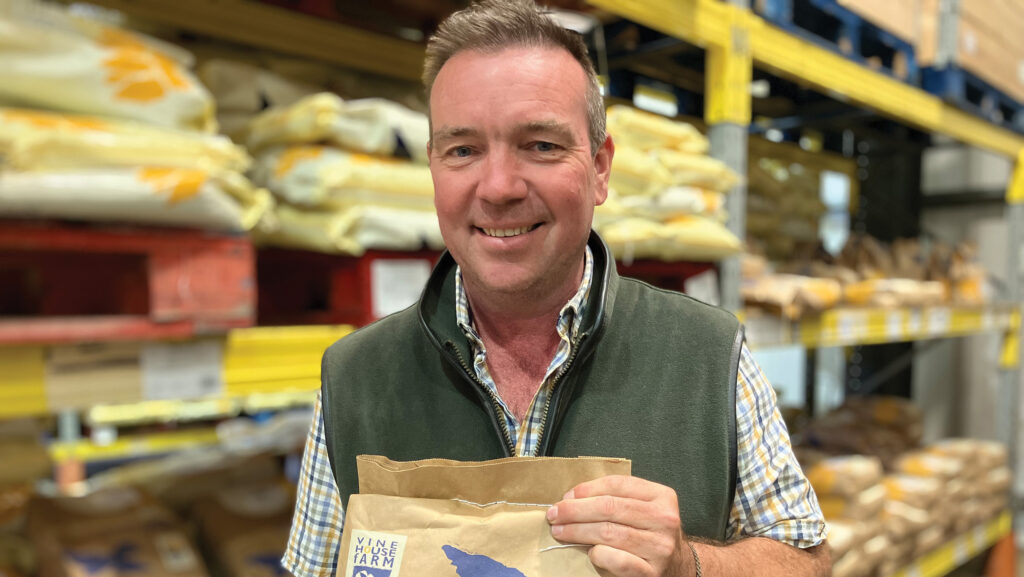
Robert Golland © MAG/Emma Gillbard
“We’ve started harvesting the bird seed but yields are two-thirds of our usual target.
“Crops have been hit hard by the drought and yields are poor. It’s a difficult time,” he says.
Mixing and bagging plant
Once processed, the seed is moved across the yard to the mixing and bagging plant, where it is prepared for sale.
The business produces 20kg bags as well as smaller 3-6kg packs, with individual seed types and around 10 different mixes available.
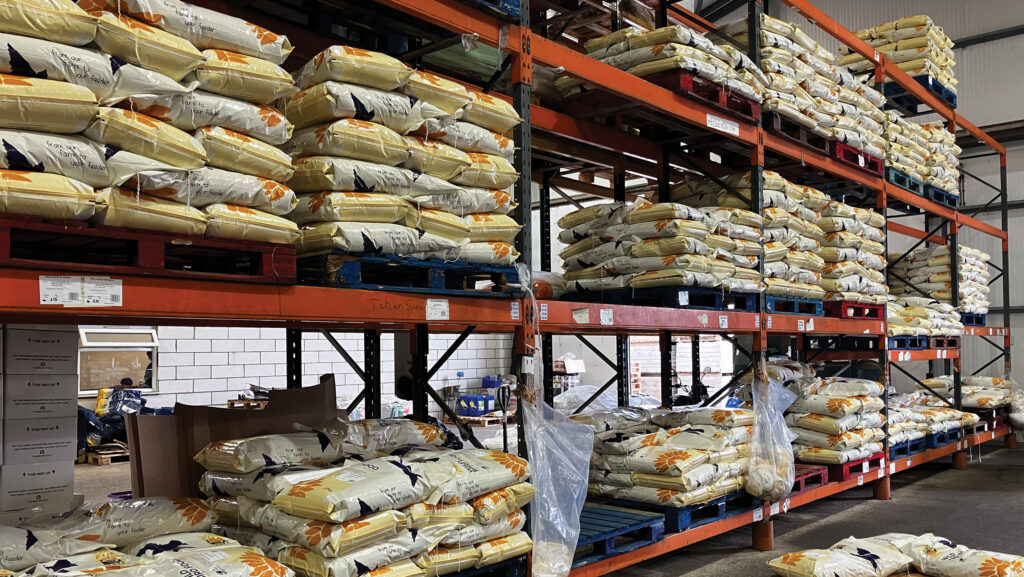
Bagged bird seed © MAG/Emma Gillbard
Most of the sales are made online, selling across the UK, alongside sales from the on-site farm shop and café.
The farm has also invested in renewable energy and waste reduction.
Heat for the packing and bagging shed is powered using waste oil from tractors, while waste heat from the potato store is also used. Wind turbines are also installed on the farm.
New processing and cleaning facility
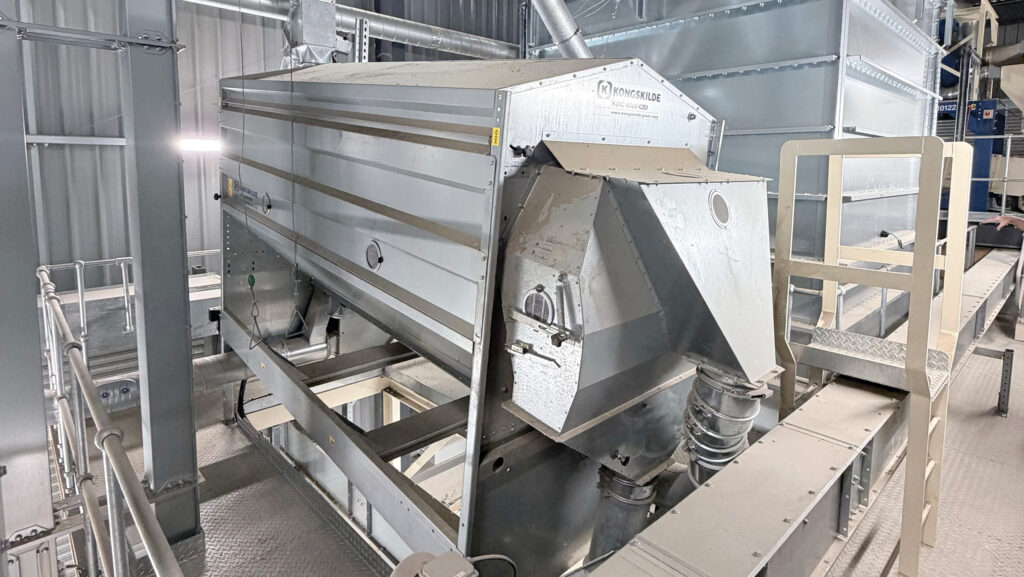
Processing plant © MAG/Emma Gillbard
A major investment into a new drying, cleaning and storage facility for bird seed has been completed at Vine House Farm.
Seeds were previously stored in a dated building with underfloor drying with a small cleaning plant.
“We needed to upgrade the facility so we could produce cleaner samples before they were used for bird seed and create a better working environment for the plant operators,” says Robert.
Working closely with grain systems integrator McArthur BDC, the new facility incorporates a Kongskilde rotary pre-cleaner, a Mecmar batch dryer, Skandia Elevator handling kit, and a JK Machinery vibrating sieve cleaner.
The plant is fully automated and controlled via a touchscreen panel located in the plant room.
Six storage bunkers, each capable of holding 200t, provide space for different seed types.
“The design and installation were complex as bird seed varies considerably in size, shape and characteristics.
“Weather also dramatically affects the condition of harvested crops,” says Scott McArthur, project division director at McArthur BDC.
The Mecmar dryer replaced underfloor drying as seeds are often harvested late in the season when underfloor drying becomes challenging as the cold, humid conditions reduce drying efficiency.
The investment has enabled them to expand the area of bird seed grown.
“Our future plans are to increase acreage of seeds so we can also market products externally not just used within the business.”
Commitment to conservation
Nicholas’ commitment to conservation was recognised in 2006, when he was appointed an MBE for services to farming and conservation in Lincolnshire.
His work has extended beyond Vine House Farm, with research and trials shared with farmers and conservation organisations.
His work on harvesting oilseed rape, for example, has contributed to advice subsequently distributed nationally by the RSPB.
For farmers wanting to support birds through the summer, Nicholas believes the answer is to create areas where spraying does not take place, allowing plants and insects to flourish.
Staying sharp shouldn't be a chore
Explore more / Transition
During the series we follow our group of 16 Transition Farmers through the challenges and opportunities as they seek to improve their farm businesses.
Transition is an independent editorial initiative supported by our UK-wide network of partners, who have made it possible to bring you this series.
Visit the Transition content hub to find out more.
