How grower plans to store 5,000t of potato in tough season
 © Chris Rawson/UPL
Soaring spot potato prices are providing some comfort for growers after two years of difficult trading, but the legacy of this summer’s weather challenges means storing crops will require careful management.
That’s the challenge Cambridgeshire grower Steve Edgley is taking on for up to 5,000t of potatoes, across five different store types.
The Edgley family grow 200ha of potatoes, predominantly for the fresh-bag fish and chip shop market. Steve’s partner, Rachel, leads grading, their son Luke looks after seed, planting and lifting, while Steve manages storage and sales.

Stephen Edgley © Chris Rawson/UPL
Steve sells potatoes year round, suppling “green-top” harvested crop from June to October, while the rest of the year’s potatoes come from stored supplies.
About one-quarter of potatoes are sold on contracts for risk management, and the rest is sold to the highest bidder in the free-buy market.
See also: GB Potatoes at four: What are the challenges and priorities?
Water constraints
About 75% of this year’s crops were irrigated, which mitigated some of the challenging weather, although water availability became an issue on some fields, particularly where middle-level commissioners shut off or restricted flow through sluice gates within the system.
“The smaller drains weren’t getting the refresher water, so the ditches were drying up,” says Steve.
Even so, the combination of irrigation and careful nutrient management helped keep crops green and growing during the summer drought, helping to maximise the efficacy of maleic hydrazide applications.
“Everything we think is going into store will get maleic hydrazide. It went on in good conditions. The store will show me whether it has worked,” he says.
Given the summer temperatures, Steve is concerned whether potatoes will store for the long term. His immediate worry was that, with the weather turning, he was relying solely on chemical desiccation after being unwilling to risk putting a wheel in the row to flail.
“In such a stressful year, the crop doesn’t take the chemical as well, which has a knock-on effect on getting skin set,” he explains.
“The cooler weather is helping, and the recent rain should help with better lifting conditions, reducing the amount of clod damage and bruising.”
Harvested potatoes are evaluated for size and dry matter to determine which will need moving first, with smaller and low-dry-matter potatoes that are at more risk of bruising loaded first.
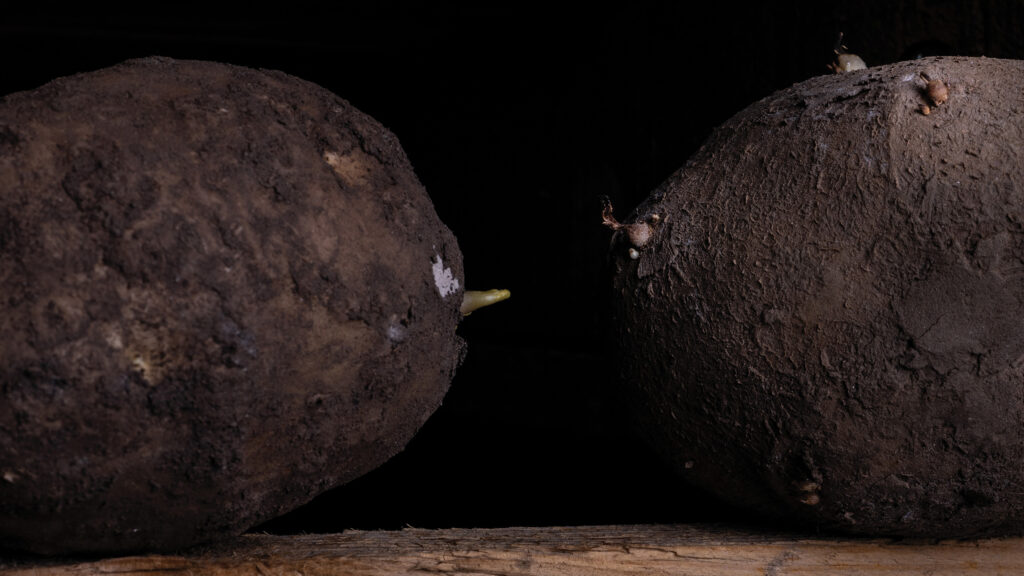
Untreated (left) versus Argos-treated (right) potatoes © Chris Rawson/UPL
Crop storage
Early graded-out crops are stored in two 500t bulk stores. Other than maleic hydrazide, these are not treated with any sprout suppressant.
“They’ll normally hold until February,” says Steve.
Two ambient-air 1,500t box stores and a refrigerated 1,000t store are used for longer-term storage at temperatures of about 9C. These will be treated with 1,4-dimethylnaptheline (DMN) as soon as the crop is cured and dried, with further treatments made every four to five weeks, depending on what is seen in store.
“We check regularly. It will highlight whether maleic hydrazide has worked, because combined with DMN it should hold them. But if we have smaller potatoes that didn’t take in maleic hydrazide well, we will have to retreat slightly quicker,” he says.
While DMN will be used for as long as possible, its 30-day holding period means that when Steve expects a store to start being unloaded, he will stop using it and switch to Argos (orange oil) or mint oil, which have much shorter holding periods.
“We’ve had good results with both,” he says. “But the longer-lasting smell of mint oil can mask the odour of something going wrong in the store. We’re probably now 90% Argos and 10% mint oil.”

Argos-treated potatoes © Chris Rawson/UPL
Loading 400-500t of potatoes a week from a store means it takes about a month to fully empty a 1,500t box store. During that period, Argos is used as and when necessary if sprouting is seen during grading out, Steve says.
“It’s keeping an eye on the potatoes. If we see movement, we use Argos,” he concludes.
Potato pricing roller coaster
Like many in the potato industry, Cambridgeshire grower Steve Edgley’s business suffered badly during the Covid pandemic, with fish and chip shop trade particularly hard hit.
After carefully assessing the market, and with other growers cutting back or leaving potatoes altogether, the family decided to go the other way: increasing the area grown by 60ha to 160ha and investing in a four-row harvester.
“That paid off for two to three years,” he says. Then, as others saw the potential in potatoes, the market became oversupplied, and like many growers, Steve has had two seasons when he had to dump potatoes rather than sell everything.
“What kept us alive was our contracts,” he adds. “Last year we had 66% on a contract at £350/t, when the free-buy market averaged £110-£120/t.”
With this year’s contracts reduced to £300/t, based on last year’s free-buy prices, he has reduced the amount on contract, which looks like a good decision, with average free-buy prices in September at about £360-£380/t.
© Chris Rawson/UPL
Steve has been able to top that, thanks to building good relationships and a reputation for consistent top-quality supplies to regular customers, achieving up to £450/t for his green-top early-lifted crops.
“I need a premium, as I start lifting at a lower yield. Green top averages about 40t/ha, whereas if I keep them for storing it would be 45-50t/ha, depending on what has been affected by heat and non-irrigation.”
Surprisingly, perhaps, he doesn’t particularly want prices to keep increasing dramatically over the storage season. In fact, in an ideal world he’d like to see prices drop initially to under £300/t to help justify his contracts before slowly ramping up to about £500/t at the end of the storage season.
“It would be easy to just want the price to keep going from here, but that’s no good for the industry. If it’s £450/t now, that means it is £600/t after Christmas and £700/t or £800/t by the end of the season.
“The chip shops won’t stand that, and it will mean more chip shops close, while the ones that remain will reduce portion sizes and put prices up, meaning consumers won’t get as much for their money.
“We saw that in Covid. It was a double whammy, and shops that were taking 40-50 bags a week were only taking 20 bags.”