

How McCain is using a demo farm to reach its regen targets
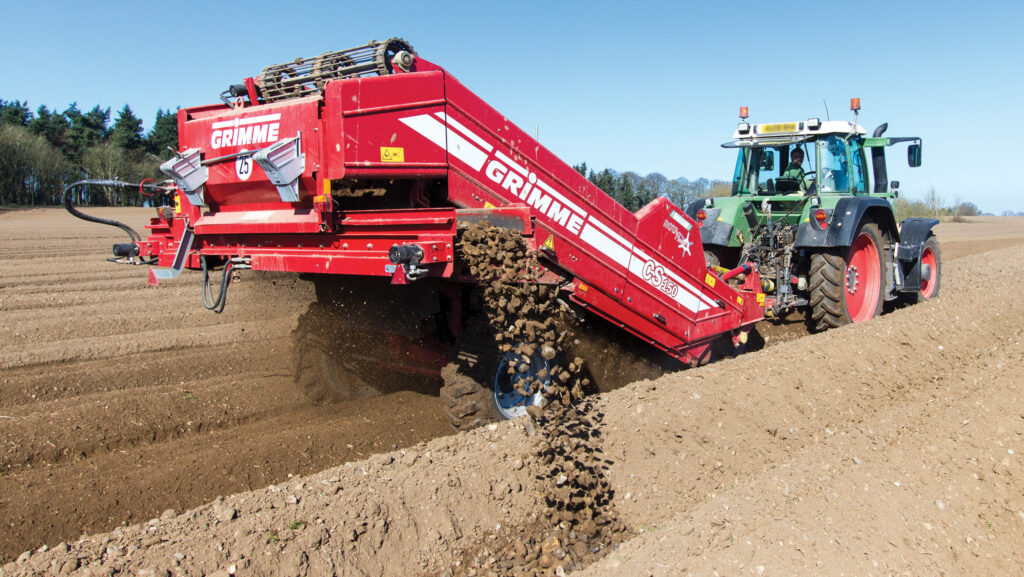 Destoning and potato planting © GNP
 A farm in Yorkshire is the home of the third global “Farm of the Future” launched by prepared potato product manufacturer McCain, following others in Canada and South Africa.
The initiative is part of McCain’s drive to accelerate adoption of regenerative farming practices within its grower base, explains James Young, vice-president of agriculture for McCain in Great Britain and Ireland.
See also: The role of cover crops in nitrogen management for potatoes
McCain made a pledge in 2019 that 100% of its potatoes would be sourced from farms meeting the “onboarding” base level of its regenerative agriculture framework by 2030. It hoped 50% would be at the “engaged” level.
The most recent global survey by McCain stated 69% of its grower base had “onboarded”, while 44% were “engaged”.
The level of onboarded decreased in the past year by 2%, partly due to an increase in potato area.
The use of soil-applied pesticides in North America meant some growers were above the 2,500 environment impact quotient (EIQ) measure for crop protection products threshold. McCain wants its growers to be under two years after being onboarded.
EIQ scores are calculated from measuring a product’s risk to farmworkers, consumers and the environment.
UK progress
In the UK, progress towards the McCain regen target has been faster, with 86% in the last survey at the “engaged” level or better, James says.
“While the last few might be challenging with different soil types and farming systems, it is great progress that has come through trials and expertise shared with our growers, as well as what they have done themselves.”
That progress is a key reason for introducing a “Farm of the Future” into the UK.
“We’ve set up these farms to trial and research regenerative agricultural practices to be able to share learnings with our growers and scale up transition,” James says.
Agronomic focus on four key areas for improvement
- Soil organic matter through continuous cover crops and circular manure-based nutrients
- Carbon sequestration driven by reduced tillage and controlled traffic farming
- Biodiversity through expanded diverse rotations
- Reduced synthetic fertiliser and pesticide reliance increasing input efficiency
The farm McCain is using in the UK is the research farm owned by the University of Leeds.
“We’ve signed an 18-year farm business tenancy to lease the 202ha arable part of the farm from the university, while the university retains the National Pig Centre unit for its advanced research.”
The long-term agreement is a crucial factor.
“While potatoes are obviously our primary raw material, the intention is very much to look at regenerative farming on a whole-farm basis rather than just potatoes, so we were keen for multiple rotations around the farm.”
A contractor has previously grown potatoes on the farm where the soil type ranges from sandy loam to clay loam.
Stone content varies from 13% to 20%, while there is good irrigation infrastructure, he says.
James is particularly excited about the opportunity to pilot a circular nutrient system, in partnership with the pig unit, using pig manure to enrich soils, reduce waste and investigate whether mixed farming systems can improve soil health. “It could be a win-win,” he says.
Existing trials
Existing regenerative farming trials set up by the university will be blended into some of the research plans from McCain.
“The work they’ve already done was a big part of our decision to take on the farm, and we’re pleased that we’re able to work in partnership with Leeds on some of the trials and research on the farm.”
Detailed research plans for the “Farm of the Future” are still being developed, but the aim is to advance the core principles of regenerative agriculture, James says.
Cover crops have been planted before this year’s potato crops, with McCain already applying learnings about species mixes from its Canadian “Farm of the Future” to UK operations.
The farm will also experiment with growing flowering plants near the potatoes that attract pollinators and beneficial insects.
A key aim will be to address the cultivation challenge within potatoes.
“The machinery that we’re using to plant this year’s potato crop is leading the way with minimal cultivations, which doesn’t often go hand-in-hand with potatoes,” James says.
Learnings from the Innovate UK and Defra’s Farming Innovation Programme-funded Potato-Lite (low intensity tillage enhancement) project, which is piloting new approaches to tillage, will be incorporated into McCain’s farm in Yorkshire.
“Some of the advances that have been made in that project will form part of the plan for this year’s trials,” James says.
One-pass establishment
That includes using a one-pass establishment system, while work will also look at methods of reducing cultivation passes, reduced destoning and zero destoning impacts.
“In the longer term, we will look to test alternative fuel sources.”
Assessments from the trials will compare emissions data from different systems or treatments, studies of species numbers from biodiversity plots and detailed baselining for soil health metrics, as well as yield and quality, which is a prerequisite for successful adoption on farm, James stresses.
“We also have some softer objectives to gauge success of the farm, such as pick up and uptake from our contract growers, as shown by our annual survey of where growers are on the regenerative agriculture framework,” he says.
Findings will be published annually and integrated into guidance provided to growers, where consistent agronomic and economic benefits have been demonstrated, while demonstration days and farmer meetings will be used to communicate results.
McCain regenerative agricultural framework
- Onboarding
- Participated in McCain regenerative agriculture training
- Met requirements for at least one engaged indicator (see “McCain’s seven key indicators for engaged requirement”, below)
- Completed a soil health baseline assessment
- Engaged
- Implemented at least five of the seven indicators including required elements (armouring soils and crop diversity)
- Advanced
- Advance progress in each indicator, including increasing number of species grown and reaching 5% of non-cultivated land dedicated to natural habitats
- Leading
- Increased soil protection, minimised tillage
- Increased soil organic matter
- 30% of potato crop nutrients from organic sources
- An expectation that growers should be able to reduce GHG emissions by at least 25%
McCain’s seven key indicators for engaged requirement
- Armoured soils, preferably with living plants – 90 days/year
- Enhanced crop diversity – Four crops species grown including a grass
- Minimised soil disturbance – Reduced tillage by one event in potatoes and adopt conservation tillage in other crops
- Reduced toxicity of pesticides – < 800 environment impact quotient score/ha
- Enhanced farm and ecosystem diversity – 1% non-cultivated land dedicated to natural habitat
- Reduced agrochemical impact and optimised water use – All inputs applied based on expert advice or decision support system
- Increased soil organic matter – Target determined by local expertise

Staying sharp shouldn't be a chore
Explore more / Transition
Follow the experiences of our 16 Transition Farmers and access in-depth supplements, expert webinars, live events and practical content covering the challenges and opportunities facing farm businesses.
Transition is an independent editorial initiative supported by our UK-wide network of partners.
Explore the Transition hub for the latest insights, resources and events.
