How bicropping helps with weed control in pulses
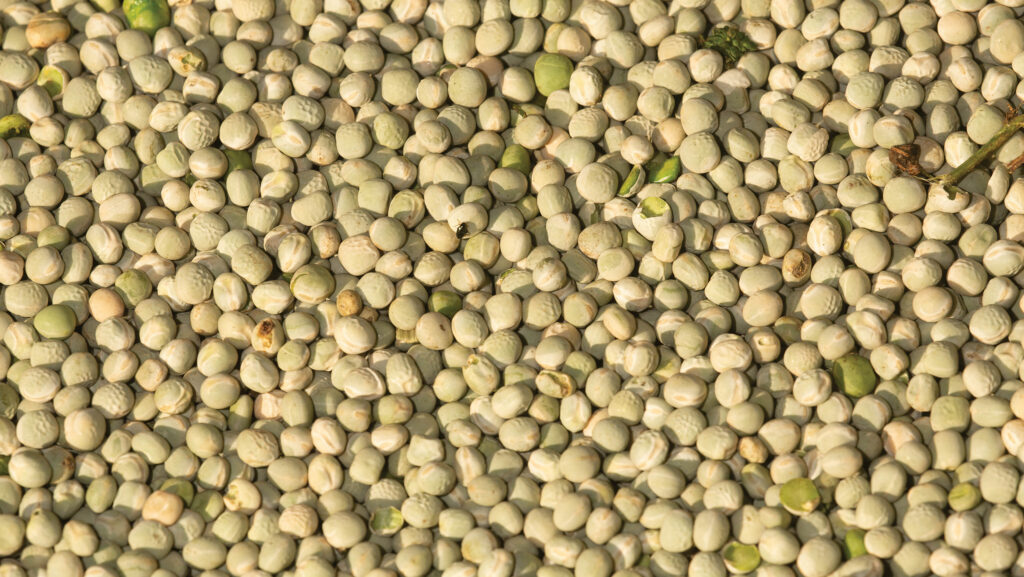 Peas © Tim Scrivener
Growing two crops in the same field at the same time has proved to be a valuable tool for managing weeds in pulses for one organic arable farmer.
Matt England, who crops 1,100ha of light, sandy loam soils on the Fring Estate in Norfolk, says that the cereals help suppress weeds through increased crop competition.
See also: Intercropping trials show boosted protein levels with low N
Why grow pulses
He explains that farming organically on light, sandy soils is a challenge, as nutrients are easily leached.
Soils also don’t hold on to organic matter or nitrogen for particularly long. Pulses are, therefore, a key part of the rotation.
The rotation starts with outdoor pigs followed by either wheat or spring barley depending on when the pigs are taken off, then oats, rye and the intercrop, when there is not much nutrition left in the soil before going back to pigs.
However, the problem for Matt is that legume monocrops get swamped with weeds, which is one of the reasons he is looking at intercropping.
“It’s mainly fat hen and thistle. The pulses are too open and you see the weeds come in.
“Adding 40kg/ha of barley does a good job controlling weeds by having a more competitive crop,” he says.
Intercropping trials
Over the years he has tried various combinations including oats/beans, barley/peas and wheat/beans at differing seed rates (see table), as part of an Innovative Farmers field lab (see below).
What is the leguminose project?
The aim of the project is to increase the uptake of cereal/pulse intercropping and involves a partnership of 17 organisations from around Europe with 180 on-farm Living Labs across Europe, Egypt and Pakistan.
Trials in the UK are being run in collaboration with the University of Reading and the Soil Association, as an Innovative Farmers field lab.
Matt England was one of the farmers involved in the Innovative Farmers field lab.
This project is funded by Horizon Europe with UK funding provided by UKRI.
Matt sums up the results to date as “encouraging, but variable.” Four out of the six comparisons improved the gross margin.
Results of five years of intercropping trials at Fring Estate |
||||||
|
Year |
Crop |
Seed rate (kg/ha) |
Monocrop yield (t/ha) |
Intercrop yield (t/ha) |
Gross margin difference (£/ha) |
Change |
|
2022 |
Spring oats and spring beans |
100/210 |
3.1 |
4.4 |
+£78 |
+10% |
|
2023 |
Spring oats and spring beans |
25/230 |
2.25 |
2.96 |
+£28 |
+6% |
|
2023 |
Spring oats and peas |
25/180 |
2.25 |
1.75 |
-£185 |
-42% |
|
2024 |
Winter oats and beans |
160/210 |
4.88 |
5.4 |
+£70 |
+7% |
|
2024 |
Spring barley and peas |
40/160 |
3.92 |
4.55 |
+£1,270 |
+167% |
|
2025 |
Winter wheat and beans |
100/100 |
6.56 |
6.2 |
-£215 |
-10% |
What was learned?
The combined crop has to either match or outperform the monocrop.
He points to 2024 as the standout year with peas sold to Hodmedods for the human market and the rest barley.
“We got 3.5t/ha of peas and they went for a good premium. They actually outperformed every crop on the farm that year,” he says.
“Peas and barley have been one of our most profitable crops if we get the peas right, but that is very dependent on the spring conditions.”
He explains that where there is a nice wet, dull spring, the peas really like it.
“But we have been missing that in the past couple of years, with very dry springs and challenging conditions for establishing spring crops.”
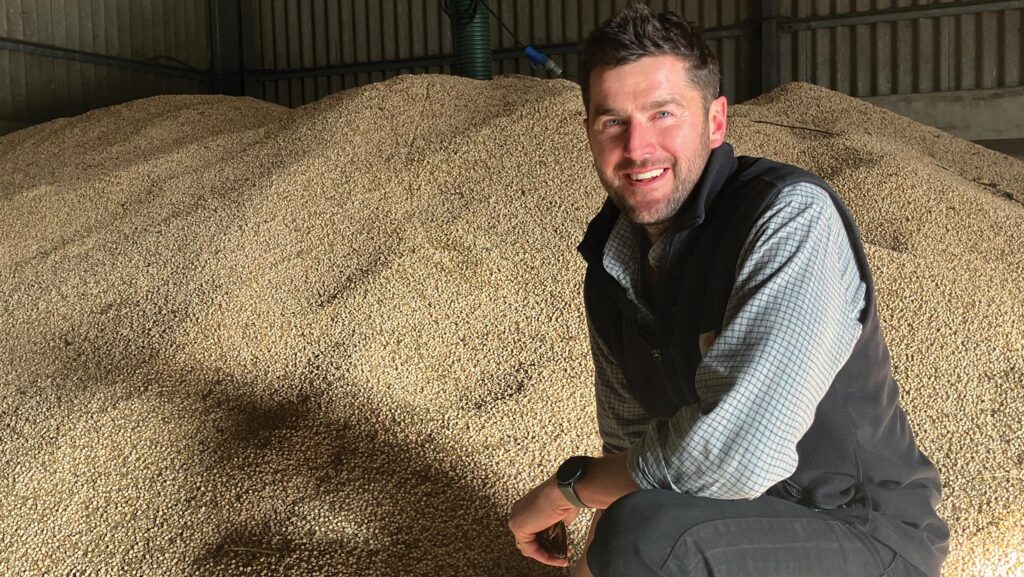
Matt England © MAG/Emma Gillbard
Not always a higher margin
However, while he has been generally getting a 5-10% higher yield than a monocrop when growing two crops together, it doesn’t always equate to a higher gross margin, “so there is more work to do on that”.
Species balance, output split and market value all decide whether it brings an economic return, he says.
On seed rates, over the years he has found some seasons where the legumes do better and in others the cereal does better.
He now opts for a 50:50 mix, and then whichever crop has more favourable weather will do better.
Living mulches
Matt has also tried living mulches and he found they can be successfully established and has managed to get some relatively decent oat crops behind them.
However, he has found with the recent dry springs, having clover in the field with the cash crop has sucked out a lot of soil moisture.
“I think the competition for moisture has been too strong, resulting in a 30% yield penalty with the living mulches, which is probably too high.”
He adds that it equates to £140/ha reduction in net margin.
However, you also need to consider the fertility building benefits of a living mulch, which is something that needs to be factored in when looking at the economic results of both the intercropping and living mulches.
Looking ahead
Bicropping is something that Matt is sticking with. However, the issue is how to deal with the harvested crop, because not many places will take the combined crop, he explains.
In addition, “the human market is where you can really earn the money from with bicrops”.
He has an old Turner dresser which can process 2-3t/hour.
“This is fine when trialling 5-10ha. However, if we want to ramp up the area, we have to look at ways to increase separation capacity.”
Matt has just bought a new dresser with a much larger table. He plans to keep trying different combinations.
“You can feel like you have got it right one year and then the next year will be completely different. So we will keep trialling different things and see what works over a number of years.”
Leguminose project findings
University of Reading trials
- Intercropping resulted in higher yields, higher wheat protein and higher total protein yield, compared to monocultures in unfertilised plots.
- Intercropping did not always benefit yields or grain protein content in fertilised plots. Results were different in different years.
- The benefits of intercropping diminished as fertiliser rates increased.
- Applying 75% of the recommended (RB209) rate of nitrogen (37.5% for a 50/50 intercrop) seems to be optimal for fertilising an intercrop and subsequent legacy for the following crop.
Other findings
- Climate resilience Data suggests intercropping provides better resilience during dry years (2025/2026) compared to wet years (2024), where monocrop yields are already high.
- Pest and disease There is evidence that intercropping reduces disease infestation, such as rust and net blotch, by disrupting pathogen spread. It also promotes beneficial insects that help control aphid populations.
New tool
- A new decision support tool called Leguminos Farming Software allows farmers to run “what-if” simulations regarding seed rates and weather.