Think of grass as a crop to boost yield and feed value
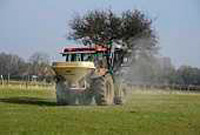
Livestock producers need to start thinking of grass as a crop to increase yields and feed value, according to Yara’s Mark Tucker speaking at an on-farm meeting organised by Keenan.
He said with grass worth £340/t in terms of milk value, it was important to look at ways to improve grass efficiency, and efficient nitrogen use was one way he suggested to improve yields and quality.
“Nitrogen is the building block to yield and quantity and this is why farmers need to think about the value of the product being produced relative to the product being bought.”
But hurling an endless amount of nitrogen on to grass wasn’t the solution to efficient growth, he said. “N response trials show nitrogen application rate will have an effect on potential milk production up to a certain point, with 120-140kg/ha shown to be the optimum rate.”
And the type of nitrogen is also important, he said. “When using urea, in some cases, up to 50% can be lost to emissions compared to ammonium nitrate, as an example, and this must be factored in when calculating requirements for grass crops. Nitrate-based products are more efficient than urea.”
However, in order to get the best from nitrogen other components are needed – with sulphur a critical component. “Sulphur is the building block of protein aiding in nitrogen use efficiency, but even so, it is still under applied.”
Mr Tucker explained how sulphur could increase grass energy (ME) values by 5-10% which at a milk price of 25p/litre equates to an extra 476-953 litres/ha and in terms of income an extra £120-238/ha. “Sulphur can also increase yield response by 10-17% and that’s worth between £86-98/ha.”
Phosphate and potash are also major nutrients and important for plant growth and development. “Phosphate is the energy source for growth and development; it’s like the petrol in a car. But because phosphate availability is related to soil temperature, levels could currently be low because of low soil temperature, so it’s important to check levels. Potash is also important because it is the transport of other nutrients and water around the plant,” he added.
Selenium is also an important element and although it is not an important nutrient for grass growth, it is essential for the animal, with 90% of grass samples sent to labs below required levels, commented Mr Tucker.
However, farmers could be doing everything right and applying correct amounts of fertiliser, but when spreaders aren’t calibrated correctly, the knock-on effects could be significant.
“Poor spreading has been shown to have an impact on the ME in grass silage. This reduction in ME could be translated in to a loss of milk of 44 litres/cow over a typical 200-day cycle. And assuming a milk price of 25p/litre, this equates to a loss of £11 a cow or £1650 for a typical 150-cow herd,” he said.
Before spreading, Mr Tucker suggested testing the accuracy of the spreader and fertiliser. “Give the spreader an MOT, get fertiliser analysed, do in field tray tests and pattern evaluations and get a printed confirmation of test data. At just £190 for a full check, it offers cheap insurance to ensure the farmers gets the best from his fertiliser.”

Staying sharp shouldn't be a chore