New wheat variety shows resilience over a testing season
 © David Jones
 The new winter wheat feed variety Challenger is set to be in high demand for this autumn’s drilling season due to its resilient qualities and good agronomics seen on farm.
The variety has a better resistance rating than many others against yellow rust, helped by the absence of the Yr15 gene, and it is one of the highest yielding winter wheats in untreated trials, a useful attribute when cost pressures are rising.
Stuart Rowley, managing director of his family-owned seed and grain merchant Mortimers in East Yorkshire, is keen to offer the variety to wheat growers in his area.
See also: ‘Compromised’ winter wheat varieties join latest Recommended List
“Challenger ticks a lot of boxes for us with four key attributes that our growers look for in a variety in this area,” he says. These are:
- Orange wheat blossom midge resistance, which is desirable on the Yorkshire Wolds
- Can be drilled early
- Performs well as a second wheat
- Good grain quality in terms of a high specific weight.
“Farmers are looking for robustness in varieties that can give good all-round performance on farm. A variety with good grain quality is important for us as we are often involved with trading grain from the customers we sell seed to,” he says.
Stuart and his wife Lucy run the family company, based in Driffield, which supplies seed and trades grain across Yorkshire and into north Lincolnshire.
Challenger entered the AHDB Recommended List last December with a fungicide-treated yield of 107%, just behind top-yielder Aintree at 110%, but has the third-highest yield in untreated trials at 93%, just behind Defiance on 95% and Arlington on 94%.
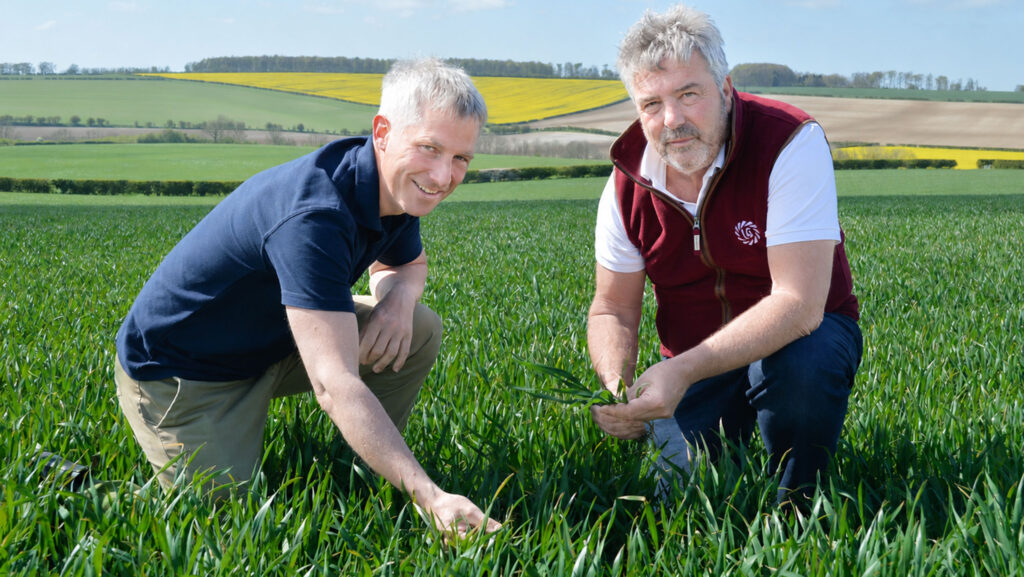
Stuart Rowley of Mortimers (left) and Ron Granger of Limagrain in a field of Challenger © David Jones
Flexibility
One of Challenger’s key attributes is the flexibility of its performance across all farm situations, especially in terms of a wide drilling window and across different soil types and regions.
Its yellow rust resistance rating is a 7 on a 1-9 scale – where 1 is very susceptible and 9 shows good resistance – better than many but it may still require monitoring and treating with fungicides appropriately.
Seed of the Limagrain-bred variety will be limited this autumn, and there is likely to be enough to drill 2-3% of the winter wheat certified seed area, while Defiance, another new variety from the same breeder, will be more widely available and able to supply 8-9% of the market. Both varieties do not have the Yr15 gene.
In early spring 2025, it was noticed that a mutation of an existing yellow rust race had overcome the Yr15 yellow rust resistance gene, which resulted in the resistance rating of top feed varieties such as Champion, Beowulf, Dawsum and Typhoon falling sharply.
Mortimers is keen to have Challenger as part of the mix of varieties it can offer growers this autumn, and believes supplies of the seed will be tight.
For autumn 2025 drilling, there was a limited choice of varieties with sufficient seed available without the Yr15 gene, especially in feed wheat sector, which was a market dominated by Dawsum, Champion and Beowulf.
But this autumn, there are more varieties offering better yellow rust resistance and seed availability, led by hard feed wheats Challenger and Defiance, but also new soft feed wheat Sparkler, as well as existing soft feed wheats Hexton and Zealum.
Grower experience
East Yorkshire grower Matt Stephenson, of R Stephenson and Sons, is growing 31.4ha of Challenger seed for Mortimers, and he is pleased with the variety on his 440ha family farm at Goodmanham Grange, just north-east of Market Weighton on light chalky Wold soil.
Looking at the seed crop, grown in an eight-year rotation, in late April at the T1 spraying stage, the wheat crop had strongly tillered and was showing promise when considering that it had been drilled at a lower-than-desirable seed rate.
Ron Granger, arable technical manager at Limagrain, points out that Challenger has a good pedigree with Skyscraper, Insitor and Gravity in its parentage. The variety has the characteristics and speed of development of Insitor.
“This is a wheat that anybody can grow as it has many of the desirable attributes considered of high importance for a good cross-farm performance.
“It is a safe wheat with good grain quality and could eventually take a significant chunk of the market,” he says.
Challenger has proved consistent in yield terms across the past three harvests and across all areas of the UK, with a particularly good performance in the North, which was an attribute that attracted Mortimers to the variety.
As well as a yellow rust resistance score of 7, it has a 6.1 for septoria, 5 for brown rust and a good 7 for fusarium.
“It is not the cleanest variety, but it would appear to show a robustness of performance, as suggested by its high untreated yield,” says Ron.
The variety is tall strawed, and scores good 7s for resistance to lodging with and without using a plant growth regulator.
Ron points out that taller-strawed varieties tend to perform better in drier seasons as they finish better and achieve better specific weights.
Challenger also offers a wide drilling window as the variety has the agronomic characteristics for early drilling, backed up by the high yield potential achieved in early drilled AHDB RL trials.
Of the Limagrain varieties, Ron suggests Typhoon as the very early driller, Challenger to be drilled in the second week of September onwards, while Defiance suits the later drilling slot from the last week of September.
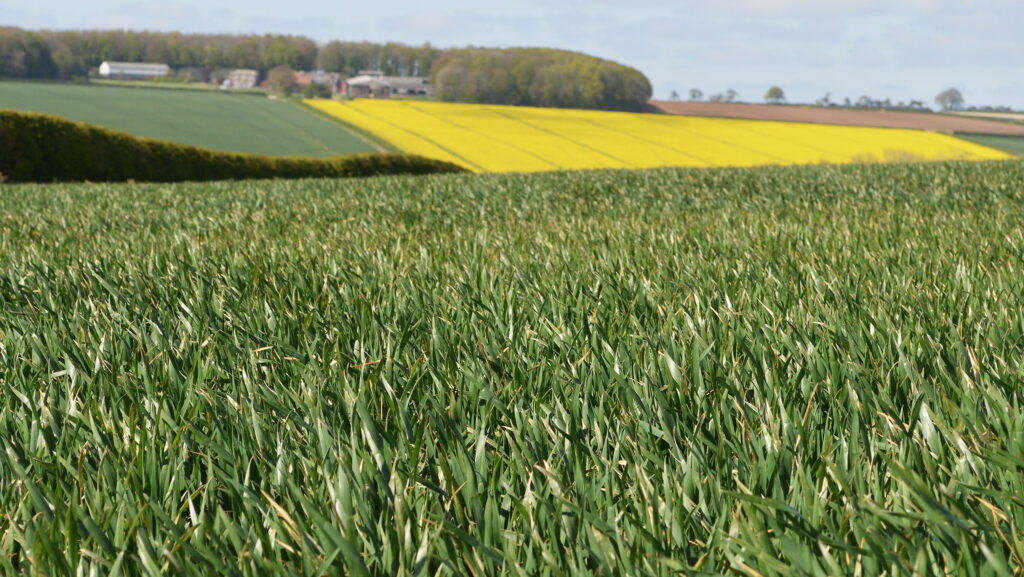
Challenger winter wheat growing on the Yorkshire Wolds in April © David Jones
Second wheats
In terms of crop rotations, Challenger and Defiance show good performance as second wheats. “That is where growers have the opportunity to potentially raise income,” says Ron.
It shows good performance across all soil types with a preference for light/medium soils, while it has a high specific weight of 78.6kg/hl, ahead of Champion and Beowulf, in line with Scope and Insitor, and just behind top performer Dawsum at 79.6kg/hl.
“Challenger shows a good specific weight with the ability to finish its grain like Skyscraper,” says Ron.
It also has a high Hagberg, and this combined with its high specific weight may offer opportunities in difficult seasons for it to be blended with quality milling wheats.
Some key feed winter wheat varieties |
||||||
| Variety | Challenger | Defiance | Aintree | Dawsum | Champion | Beowulf |
| Fungicide-treated yield | 107% | 109% | 110% | 102% | 106% | 104% |
| Non-fungicide yield | 93% | 95% | 85% | 86% | 82% | 83% |
| Yellow rust resistance | 7 | 8 | 3 | 5 (9)* | 4 (8)* | 4 (9)* |
| Septoria | 6.1 | 6.3 | 6.3 | 6.2 | 7.2 | 6.4 |
| Brown rust | 5 | 5 | 5 | 7 | 5 | 5 |
| Lodging without PRG** | 7 | 7 | 7 | 8 | 7 | 8 |
| Lodging with PRG** | 7 | 5 | 7 | 7 | 6 | 7 |
| Specific weight (kg/hl) | 78.6 | 77 | 78.7 | 79.6 | 75.3 | 78.3 |
| Note: *Yellow rust resistance rating in brackets indicates the rating the previous year and shows how some varieties’ ratings were dramatically lowered due to the presence of the Yr15 gene and their subsequent susceptibility to yellow rust. **Plant growth regulator. | ||||||
Trade talk
Challenger has attracted positive comments from the seed trade due to its good yield and disease resistance package, with particular interest likely to come from light land growers and those in the north of England.
John Miles, seed technical manager at seed supplier Agrii, is impressed with the new variety as it looks good on light land and in the second wheat position, and the variety sold out with his company a number of months ago.
“It was my pick of the new varieties on the new Recommended List as it was the most technically sound,” he says.
Its slow early growth habit means it can be sown early, and he points out the variety looks similar to the light land specialist variety Insitor.
Defiance he see as more of a mainstream variety for slightly later drilling with growers needing to look after its straw.
Kirsty Richards, national technical manager for seeds at fellow seed supplier Frontier, is also keen on Challenger, with the variety likely to sell out at her company.
“Challenger looks like a traditional wheat with stiff tall straw and good headline untreated yield, and its resilience will make it part of the mix of varieties this autumn,” she says.
It will be particularly attractive for light land growers with its good yield performance on those soils, and is also attractive due to its stiff straw and good specific weight.
Defiance also looks a good variety, and the two could be grown in tandem, with Challenger as an early driller and Defiance kept back for October sowings, she says.