Why new bread wheat is becoming millers’ favourite
 © David Jones
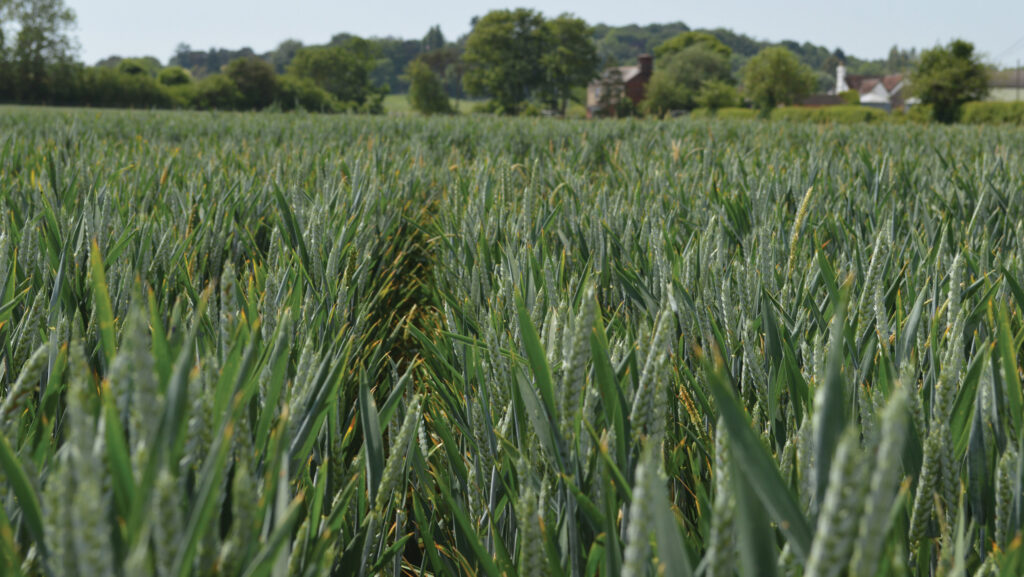
 Bedfordshire wheat grower Peter Sinnott is impressed with the yield and quality of new milling variety Vibe, and is looking to increase his area if results from the combine match his expectations this summer.
Last season, a small area of 20ha yielded more than 10t/ha and easily met milling specifications. He is hoping for the same from this season’s enlarged 68ha area and to make it a mainstay variety on his farm.
The variety has caught the eye of milling wheat growers as well as leading millers, with the highest protein content on the AHDB Recommended List (RL). It has also produced some of the cleanest milling wheats across central England.
See also: New wheat variety shows resilience over a testing season
Key varieties
Peter focuses on milling winter wheats, as there is a ready local market in the area, and he sees Group 1 Vibe and Group 2 Arnie as likely to be his key milling wheat varieties for the future.
“If it comes off the combine with a good yield and good protein that matches or exceeds existing milling wheats on the farm, we will be switching to Vibe,” he says.
Vibe passed the test in a difficult 2024-25 season, when Peter’s crop struggled in a wet autumn and dry spring establishing poorly, but in a generally poor-yielding season it gave a good yield of 10-10.5t/ha using 250kg/ha of nitrogen.
Peter says he could never get top yields from older milling variety Crusoe, so he was interested in Vibe as it beat Crusoe as the highest-protein wheat on the RL with a better yield, and it could now well replace Extase on the farm.
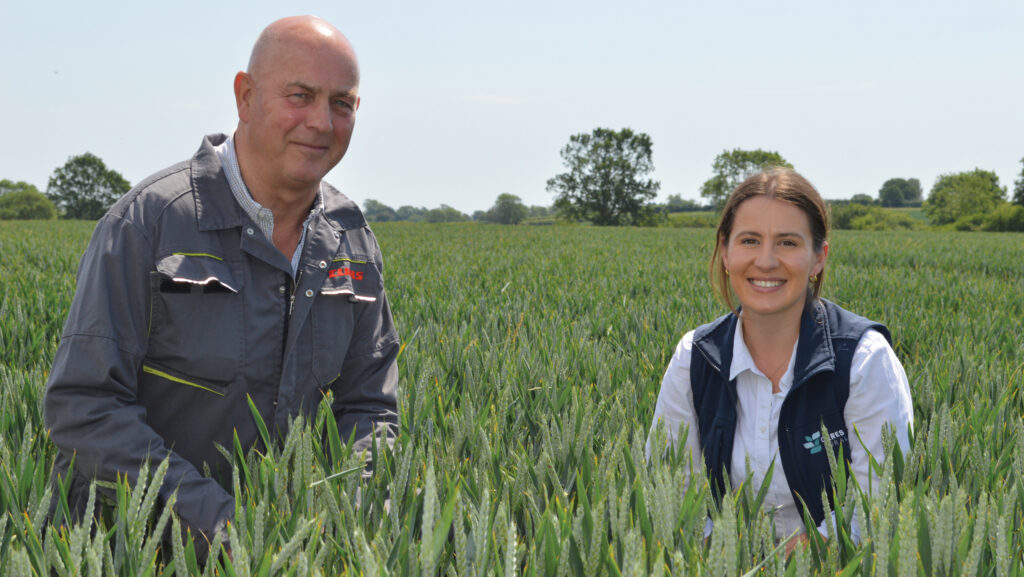
Peter Sinnott (left) and Louise Penn © David Jones
High protein content
Vibe shows a protein content of 13.4% when grown as a milling wheat in the RL. It is ahead of previous leader Crusoe on 13.3% and ahead of other millers such as Skyfall, Cheer and Illustrious, and nearly a percentage point ahead of Zyatt and newcomer Arlington on 12.5%.
Peter’s 2025 harvest crop of Vibe easily met industry milling specification of 13% protein, 250 hagberg and specific weight of 76kg/hl when grown as a first wheat, and was snapped up by a big milling group.
The Sinnotts farm 400ha of predominantly arable cropping on silty clay land, growing first and second wheats with break crops of winter beans and environmental schemes at Hayfield Farm, near Milton Keynes.
This season, Peter is growing 200ha of milling wheats consisting of Extase, Arnie and Vibe. He has a ready market nearby from large milling customers such as Heygates, Hovis and Whitworths.
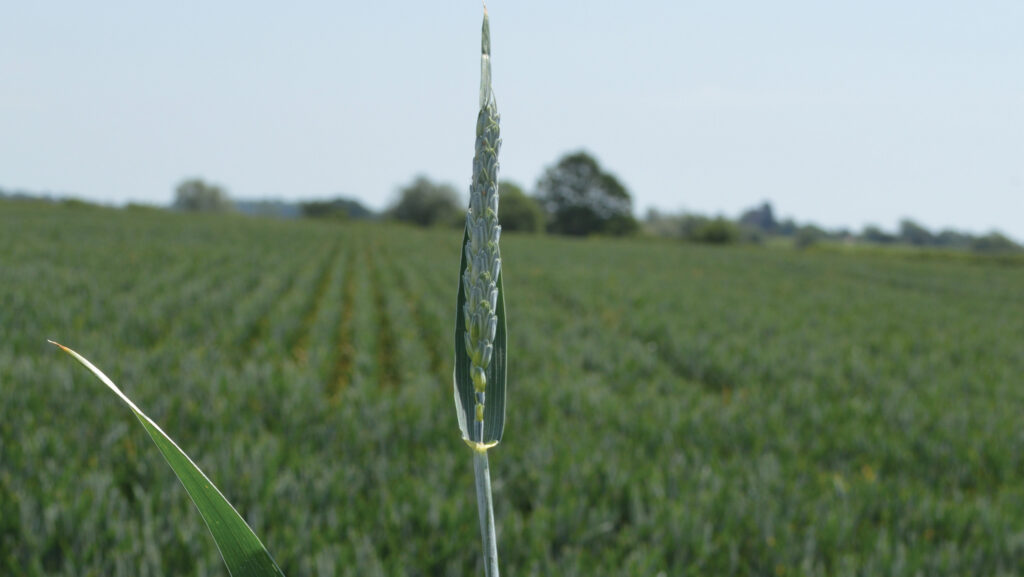
His 68ha of Vibe, again grown as a first wheat, got off to a racing start, with the crop direct-drilled into a sprayed-off catch crop about 10 days earlier than normal, on 24 September, with a 12m Horsch Avatar disc drill.
© David Jones
Yellow rust resistance
His agronomist, Louise Penn, from advisory group Ceres Rural, says Vibe crops have looked generally clean of disease this season, which is especially encouraging when yellow rust has been a particular problem for many growers.
“Vibe crops across my client farmers have looked cleaner than other milling varieties at every spray timing,” she says.
The variety has a resistance score of 8 for yellow rust on an AHDB RL 1-9 scale, where 1 is very susceptible and 9 shows good resistance. It also has a brown rust score of 6 and septoria score of 6.5.
As a fairly clean milling variety, fungicide costs have been kept down to £110/ha this season, with Louise looking to match the spend to the potential of the crop.
There was a minimal spend at T0, with the azole tebuconazole used to protect against yellow rust, while some tall and forward crops were treated with the plant growth regulator Moddus (trinexapac-ethyl).
An economical T1 fungicide of Ascra (SDHIs bixafen and fluopyram plus azole prothioconazole) with the strobilurin Amistar (azoxystrobin) was applied, along with Moddus and chlormequat. Catchy, uncertain weather in May prompted a more substantial T2 application of Univoq (fenpicoxamid and prothioconazole) plus Amistar.
This proved a wise move, as there was only 21.5mm of rain between March and April and the majority of spring rain came in May, with nearly 50mm. A later T3 ear spray of prothioconazole and tebuconazole was applied to protect against fusarium and rust.
Louise points out the high cost of fertiliser and red diesel may cause some growers to question the wisdom of growing milling wheats next season, but she suggests the best land is still likely to go into milling wheat, with more marginal land into other crops.
A miller’s tale
Vibe is set to be the leading Group 1 milling winter wheat variety to be drilled this autumn as wheat growers move to more disease-resistant and stable varieties.
Older varieties such as Skyfall and Zyatt have poor resistance to yellow rust, and Crusoe is susceptible to brown rust, so there is more interest in newer ones like Cheer, Vibe and the latest new variety, Arlington.
George Mason, senior executive at one of Britain’s biggest millers, Heygates, is encouraged by what he has seen of Vibe, and points out that the variety is doing well in terms of increasing its market share.
“We have not seen a lot of Vibe from the 2025 harvest, but we look forward to buying it this coming harvest,” he says.
Breeder’s view
Vibe held on to its high resistance score for yellow rust, despite many other varieties with the YR15 gene, seeing their resistance scores fall sharply.
KWS-bred Vibe, without the YR15 gene, entered the AHDB’s Recommended List (RL) in December 2024, and now in its second year of listing, its yellow rust resistance score of 8 is unchanged.
Matt Bull, KWS UK agroservice manager, says Vibe is not rated as resistant to yellow rust at the seedling stage, but has never been classified as such, so his advice is the same as last year – keep aware, monitor crops and adopt a “see it-spray it” approach.
Although the variety has good adult plant resistance, yellow rust is a dynamic pathogen and adult plant resistance cannot be solely relied on for yellow rust control. An integrated approach should be taken to protect the genetics, he says.
“It has the best yellow rust resistance rating of all varieties in the Group 1 segment of the RL, alongside best-in-class protein yield, so it should prove popular with both growers and end users,” he adds.
Three newest Group 1 milling wheat varieties |
|||
| Varieties | Arlington | Vibe | Cheer |
| Fungicide-treated yield (%) | 99 | 97 | 96 |
| Non-fungicide yield (%) | 94 | 88 | 81 |
| Yellow rust resistance | 7 | 8 | 6 |
| Brown rust resistance | 6 | 8 | 6 |
| Septoria | 7.0 | 6.5 | 6.1 |
| Protein (%) | 12.5 | 13.4 | 12.8 |
| Hagberg | 309 | 294 | 306 |
| Specific weight (kg/hl) | 78.9 | 78.6 | 79.7 |