

Actions four farmers have taken to mitigate extreme weather
Extended dry periods, storms, flooding and higher temperatures all occur more frequently, disrupting business.
As the risks become clear an increasing number of farmers and growers are taking action to make their businesses more resilient.
See also: How a soil focus returned Northumberland farm to profit
Here we ask four farmers how they have responded to challenges from storms, high temperatures, drought and flooding and ask experts for tips.
Storms
Deepdale Farm, Burnham Deepdale, Norfolk

Anna Biesty © Deepdale Farm
Disaster struck Deepdale Farm after rain lashed the 300ha arable unit throughout the winter of 2019.
For decades the farm had been run conventionally, growing root crops on some large sloping fields.
The rain had been relentless through the winter and continued into 2020 so the ground was saturated, says farm manager Anna Biesty.
Then a deluge hit us and the soil simply couldn’t hold on anymore; it just started to move, she says.
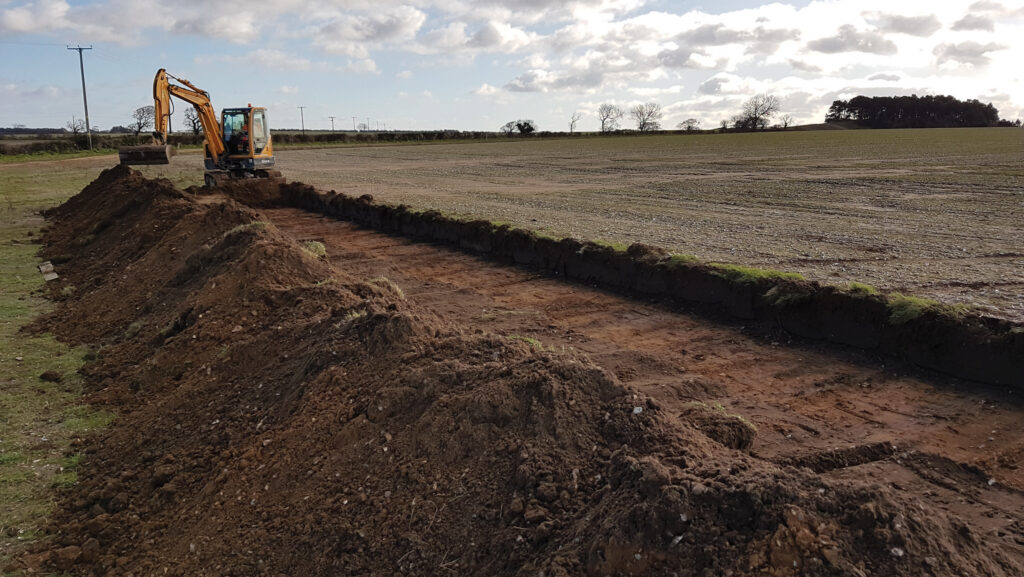
One of the biggest fields was an uninterrupted slope, 1km long, that ran down towards the local village and flowing water quickly carved snaking gulleys 2ft deep and 3ft wide.
The mud and water was a threat to the river Burn, a chalk stream that flows into habitat-rich salt marsh, so Norfolk Rivers Trust (NRT) intervened to minimise the impacts.
© Deepdale Farm
The Trust’s emergency team responded quickly, arriving with excavators and earth-movers to build banks across the field and a soakaway to contain some of the water.
But the damage and ongoing vulnerability, made it clear decisive action was needed to ensure it could never happen again.
The biggest decision was to take 60% of the farmed area out of production and put it into a Countryside Stewardship Scheme agreement.
“It sounds drastic but we needed breathing space and an income to work out a more resilient strategy,” says Anna.
To help ensure the agreement was approved, the farm switched to organic production. Working with Norfolk Farming and Wildlife Advisory Group (Fwag) we designed a mid-tier CSS agreement that started in Jan 2021, says Anna.
Options chosen included wild birdseed mixes and flower-rich margins and plots. Meanwhile, NRT extended its support by funding hedge and woodland planting, cover crops and wild flowers.
It also carried out soil testing and surface flow and erosion mapping.
Other measures introduced were beetle banks across the sloping fields and hedgerow planting to reduce run-off while ditches and bunds were created to direct water from future downpours.
Fields were split into 5ha plots and beetle banks created, although the divisions weren’t made permanent to allow flexibility for future strategies.
A test of the work came when extreme rainfall hit the farm again in late 2023.
“Roads and villages around us were flooded in places but I could walk the fields without getting my boots muddy – it was a stark contrast to 2020,” Anna says.
The stewardship agreement was rolled over but will end in 2027.
After six years, the soil will have been brought back into a resilient state and the cropping will be extended to cover 85-90% of the original land area.
Cover crops, margins and beetle banks will remain, to ensure flood risks are minimised.
Mental resilience
Anna, a Nature Friendly Farming Network champion, suggests working together with other farmers has been key to her own resilience.
Anna and her siblings took over the farm in difficult circumstances, shortly after their father had died.
“We are part of the North Norfolk Coast Cluster Group and have had huge support from Fwag and NRT in remodelling our farm.
“I would urge anyone concerned about their farm’s future to work together to help share the mental stresses and strains,” Anna says.
Flood
Shanaghan Farm, County Down, Northern Ireland
Louise Skelly © NFFN
Louise Skelly manages Shanaghan Farm, a 40ha sheep unit in County Down where she has lived for the past 40 years.
The farm is a moderate-sized unit among NI’s much smaller average farm size, points out Louise.
Over that time, and particularly in recent years, she has witnessed an increase in flooding with extreme events occurring more frequently.
Parts of the farm have flooded for the first time, since I’ve been here, she says.
In 2023 some areas were underwater to depths of more than five feet, even the gates were submerged, she says. And between August and December that year the farm was flooded 13 times.
“There was no denying it, the flooding was definitely getting worse and adding extra difficulty to running a grass-based system,” says Louise.
“We rely heavily on our grazing. Concentrate is only fed in small amounts as a booster to ewes carrying twins or triplets and to ensure ewes have good quality colostrum.
“The main driver for our strategy is to produce 100% grass-fed lambs and when the flooding started to encroach we had to take action,” she says.
One way was to improve soil drainage and aeration by reducing compaction.
Key to that, was using lighter machinery and switching to RTVs for some fieldwork with weed control via weed wiper rather than a boom sprayer.
A shift to mob grazing is also a key strategy. Electric fencing and portable water troughs have been introduced and sheep are moved daily, on rotation.
This reduces pressure on the soil and grass, allowing it to recover more quickly and produce stronger root structures, explains Louise.
Ploughing has been dropped in preference to over-sowing leys. This again reduces the machinery tonnage.
It also creates a wider variety mix with diverse root lengths to produce a better soil profile.
Longer-rooted grass varieties were also introduced to absorb and hold more water while creating a better structure deeper down.
As an NFFN member this goes hand-in-hand with a policy to cut artificial fertiliser use and a switch to sources that add organic matter and nutrients like seaweed to improve the soil microbiology and its ability to drain and retain water.
A further move to improve resilience has been tree planting with more than 3,000 strategically sited to help drainage, reduce erosion and retain moisture.
Flood-tolerant tree species like willow and alder have been planted along river banks to cut erosion while rowans, oak and crab apple improve micronutrients and soil structure around fields.
For the same reason, the farm’s hedgerows have been allowed to grow higher and broader.
It all helps improve the soil condition which is visibly improving, says Louise.
Drought
Elveden Farms, Suffolk
Andrew Blenkiron © Elveden Farms
In one of the UK’s driest areas on light soil, water is an issue and climate change a growing threat.
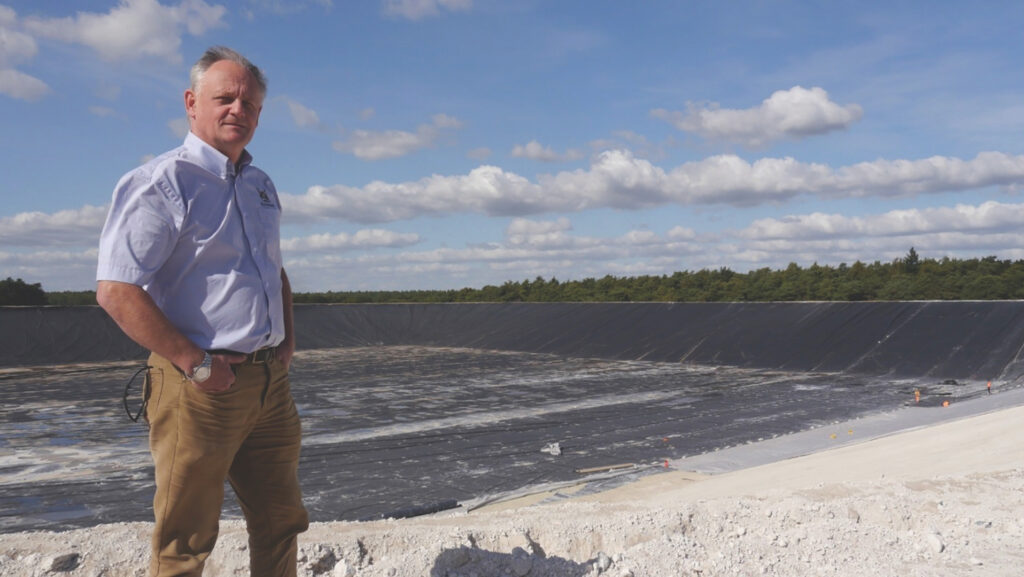
Andrew Blenkiron runs the 4,500ha Elveden Farms in Suffolk which grows root crops and cereals. The farm is on a Breckland sandy soil with a chalk base.
“It can grow anything and we could harvest any single day of the year, providing there is enough water in the growing season,” says Andrew.
Water supply is via abstraction licences for 2.8m cu m drawn from the river Lark and nine boreholes.
The estate also had two existing reservoirs to retain and supply water. But, even with this combined resource, the increasingly extreme weather and tighter abstraction rules were seen as a threat.
“The weather has definitely changed. We face more frequent rainfall extremes with 30mm plus in a day and more periods where monthly rainfall is negligible,” says Andrew.
Increasingly there are extended dry periods and higher temperatures putting pressure on crop growth.
And, for a number of years, Environment Agency policy appears to have been shifting towards reducing abstraction licences which could also threaten production, he adds.
It was clear we had to build more resilience into our setup and funding was sought for a third reservoir, says Andrew.
The third 500,000cu m reservoir was completed last year with 30% of the cost provided by a Defra grant.
The reservoir is filled from the river when flow rates are high enough, explains Andrew, who notes that this valuable resource would otherwise have been lost to the sea.
“We have made ourselves more resilient and done our bit to reduce urban flooding downstream,” he says.
Attention has now turned to a pipework upgrade for the 180-mile long network that supports the irrigation systems.
Other efficiency upgrades introduced, include soil moisture sensors to provide real-time data for software that controls pumps and irrigators, ensuring rates are optimised.
Power for some of the pumps is provided by solar panels sited close to the boreholes.
There’s also a significant number of panels on store roofs and proposals for a floating array on one of the reservoirs.
Other initiatives include joining forces with local farmers and Water Resources East in research trials aimed at delivering even greater efficiency of water use.
Heat
White House Farm, Ashford, Kent
Peter Sargent © Michael Sargent
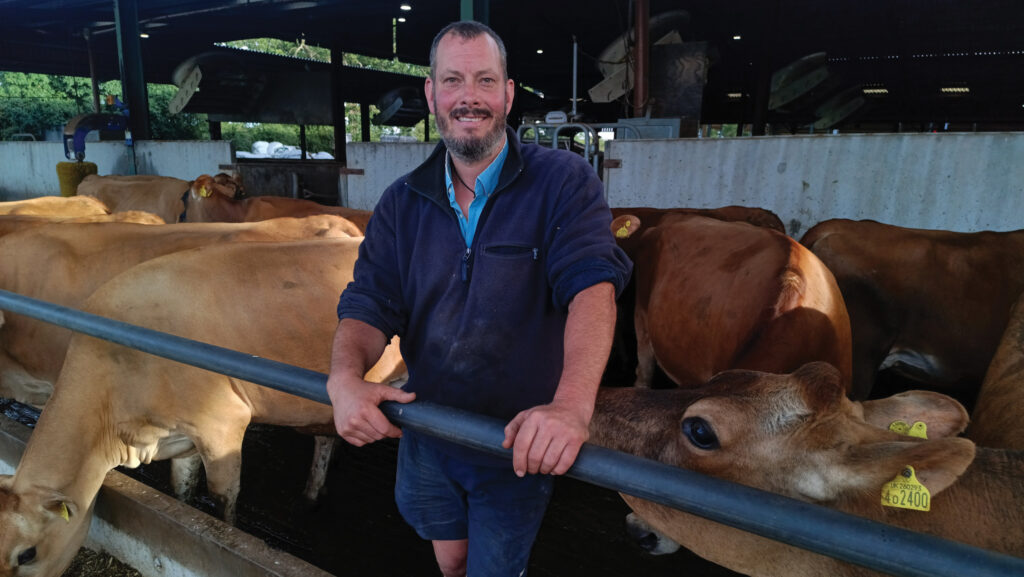
Higher temperatures and more frequent spells of hot weather have prompted action on a Kent dairy farm. White House Farm Near Ashford, is managed by Peter Sargent in partnership with his parents Michael and Rosemary.
The 210-pedigree Jersey milkers calve all year round with Angus genetics used to produce a beef finisher herd.
While dry cows, calves and beef cattle, graze across the 222ha platform, milkers have been moved indoors, year round.
The move wasn’t specifically due to the changing climate explains Peter, although grass growth and quality on the Wealden clay was increasingly under pressure because of weather extremes.
The main reasons were to maximise the efficiency of the farm’s robot milkers and improve yields with higher quality forage.
But hot weather periods have become more extended and frequent, with temperatures inside the housing often above 30C.
The flush-wash and separator also added to the humidity levels inside the housing.
“The knock-on effect during the hot weather, was lower fertility, and an increase in lameness, mastitis and yield drops,” reports Peter.
Cows were spending more time on their feet and grouping up in the alleyways while flies were an increasing nuisance, he says.
“We had to do something to better control the environment so made use of the Farming Equipment and Technology Fund to support the purchase of six 72in VES-Artex fans and two 50in blast fans.”
The six VES-Artex fans have been mounted 1.5m above the cubicle runs while the blast fans are sited directly in front of the robot milkers.
Further support was sourced via a CSS capital grant to construct a roof over the feed barriers to maintain quality. The effect of the changes has been significant.
“Fans operate from 20C and in the past two heatwaves we have seen less standing and no grouping at all.
“Even with the outside temperature at 34C cows are content and not showing any signs of stress,” Peter says.
“There has been no significant drop in milk yield, feed intakes have been maintained and lameness has declined because cows spend less time on their feet,” he adds.
Another benefit has been a reduction in flies, particularly outside the robot milkers where the blast fans have all but eliminated the problem.
“Ultimately we have far greater control over the conditions in the shed so welfare and production have benefitted,” Peter concludes.
Dairy hot weather advice
Hot weather is a major concern for dairy cows because health, welfare and production can all suffer if strategic changes are not made to mitigate the risk, says consultant Ben Watts at Kite Consulting.
A dairy cow may start to suffer heat stress in temperatures of just 20C but there are a lot of things that we can do to help, says Ben.
There is a wide range of fan types but whatever the type, the aim is to increase air movement over the cows to allow them to dissipate heat from their body surfaces, says Ben.
Soakers, to spray water over the cows in collecting yards, are another efficient method of dissipating heat from body surfaces through evaporation. But there is a cautionary word.
“High humidity is also a factor in heat stress, making it more difficult for animals to breathe.
“Therefore, soakers must be used in conjunction with a fan and professional advice,” says Ben.
There are a number of management strategies that can also be employed.
For example, where fans are used the cows can be housed comfortably during the day and allowed out at night to graze.
Ration tweaks can help to ease the effects of heat, too, Ben adds.
Panting and drooling reduce the amount of saliva reaching the rumen so acidosis risks increase.
It is advisable to buffer rations with buffers like sodium bicarbonate, acid buff, magnesium oxide (a rumen alkaliser) and limestone flour, he suggests. Heat stressed cows also suffer mineral losses so amino acid additives like
Betaine will help cells regulate and retain water, limiting gut inflammation and helping to protect liver function, Ben says.
How water companies are helping
Farmers and water companies like Anglian Water are increasingly working together to combat the effects of flooding and sudden heavy rainfall.
One of the key changes we are seeing is increasing levels of nitrates in surface water and this is a big problem, says Chris Hewis Anglian Water Services catchment adviser.
“We don’t yet know whether the increase is due to more intense rainfall from urban or farm run-off but whatever the source turns out to be, it is major, developing issue.”
Surface water containing a high concentration of nitrates can’t be put into large drinking water reservoirs as the cost of removal treatment is prohibitive, meaning this water is lost from the system and allowed to go out to sea.
From farming’s perspective, these lost nutrients are a wasted investment so we have a common goal – to withhold these nutrients from water by improving the resilience of the soil, says Chris.
Anglian Water offers advice and funding to support farmers to transition to soils with higher organic matter content and better microbiology to help retain the nutrients in the field.
Soil scanning and mapping, cover crop planting, soil sensor installation or making the transition to strip tillage are examples of projects which have attracted up to £7,500 support through Anglian Water’s Farm Innovation Grant, when available in key areas.
The main focus is improving soil health to help retain moisture and reduce erosion.
But Anglian Water is also encouraging the construction of landscape features, points out Chris.
These include scrapes, to interrupt the water movement from fields and on-farm ponds and reservoirs to manage flows and act as storage.
Further help
- Catchment Sensitive Farming Offers free advice for farmers on water issues
- Anglian Water Offers advice and grants to help improve water quality
- Water Resources East Has published a comprehensive guide to reservoir development
- Rabi Provides health and wellbeing support in England and Wales 0800 188 4444
- Rsabi Offers health and wellbeing support in Scotland 0808 1234 555

Explore more / Transition
During the series we follow our group of 16 Transition Farmers through the challenges and opportunities as they seek to improve their farm businesses.
Transition is an independent editorial initiative supported by our UK-wide network of partners, who have made it possible to bring you this series.
Visit the Transition content hub to find out more.
