

Advertiser content
How SFI can turn no-till into a £100,000 a year income stream
In the years since Basic Payment Scheme claims ended, plenty of arable businesses have been asking the same question: what’s the most practical replacement income that doesn’t fight the day job?
For a growing number, the answer is to build a “stack” of actions around a lower-disturbance establishment system within the Sustainable Farming Incentive 2026 (SFI26) with agreements totalling up to a maximum value of £100,000 per year.
Meet farmers who are making it pay
SOH1 – No-till farming: £73/ha/year
This is the action that most directly rewards a low disturbance, direct drilling no-tillage approach.
As well as this SFI payment and the environmental benefits of no-till, the economic benefits of cutting cultivations include reductions in fuel, machinery and labour costs and increased operational flexibility.
These benefits combined help business resilience when weather is unpredictable and geopolitics are uncertain.
As this is the principal payment, there is a large need for a no-till system to be reliable and consistently deliver results.
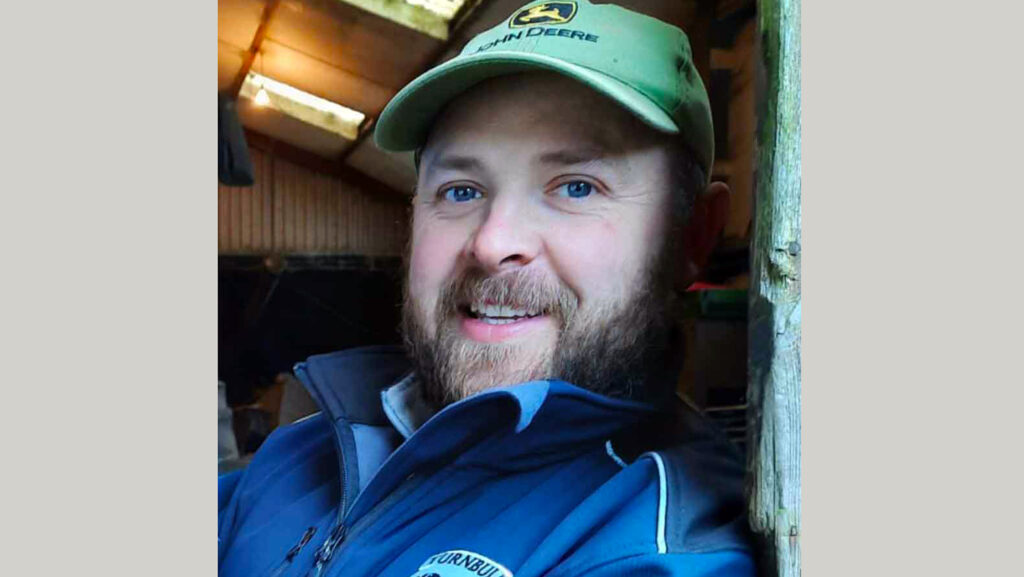
Yorkshire farm manager, Wayne Turnbull: income from SOH1
On the Yorkshire Wolds, farm manager Wayne Turnbull moved away from plough-based crop establishment in 2017 and switched to direct drilling.
He has applied for a 45ha block under SFI2025 under the No-Till SOH1 category based on the 3c crop rotation over five years, cover crops playing a vital part.
Wayne is establishing these using a 4.8m Claydon mounted drill whose consistent establishment and low running costs he favours. Payments are estimated at a total of £72,690 over five years.
Other revenue examples
The rotational earners: cover and catch crops
Once the establishment approach is sorted, the next “natural fit” for many no-till rotations is the cover/catch crop element — partly for soil protection and biology, and partly because SFI actions can support the cost of doing it well.
- SOH3 – Catch crop (multi-species summer-sown cover crop): £163/ha/year
Sow June–August, leave for 8 weeks - CSAM2 – Multi-species winter cover crop: £129/ha/year
Sow September, leave over the winter months - CSAM3 – Herbal leys (£224/ha/year)
These actions won’t suit every rotation every year, but they can be the difference between a cover crop being “nice to do” and one being consistently implemented at the right time with the right mix.
In addition to a 70% reduction in fuel usage since changing from conventional establishment to direct drilling, Rick Davies, rates the options and flexibility of his current seeding system which enables him to drill for different SFI incomes.
This season, his Claydon Evolution toolbar and front hopper drilled wheat with peas as a CIPM3 companion crop in the autumn, both via the main leading tine pipework, and the preceding spring drilled barley with CSAM3 grass cover, the latter over the rear levelling boards, both for SFI.
The add-ons: companions and insecticide avoidance
Sitting alongside the covers conversation are two further payments:
- CIPM3 – Companion crop: £55/ha/year
- CIPM4 – No insecticide: £45/ha/year
The key with “add-ons” is not to chase complexity for its own sake. The best-performing SFI agreements are usually the ones built around what the farm can deliver repeatedly — with a simple record-keeping routine and a rotation that supports the actions rather than working against them.
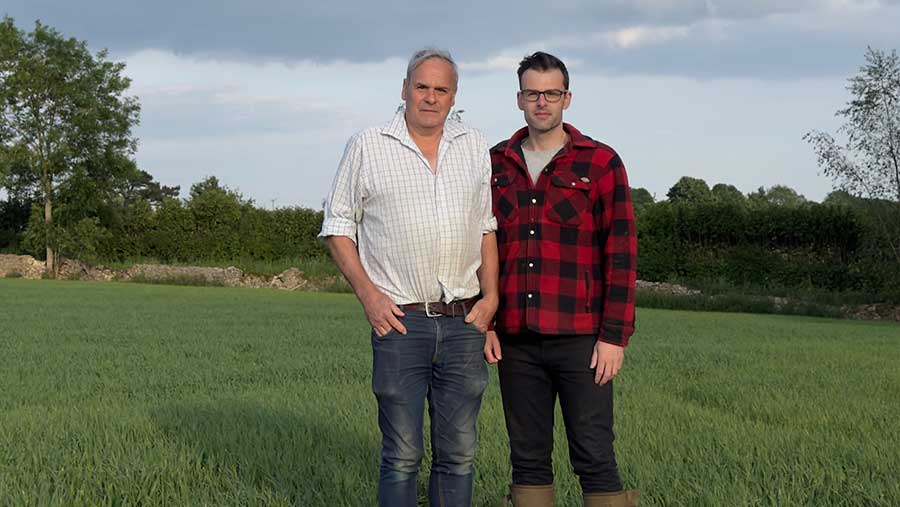
Cotswolds farmers Martin and Tim Williams
Martin and Tim Williams operate a mixed farm in the Cotswolds. Since moving from conventional to direct drilling crop establishment, fuel usage has been cut by nearly 80% and crop yields have also improved.
Having the ability to direct drill in days rather than weeks has also opened up opportunities for SFI income streams.
“The Claydon drill has revolutionised how we establish herbal leys, allowing us to drill an SFI mix immediately after harvest when the soil is warm, claim the payment for that and use the forage to help feed our cattle going into winter.
“This is in addition to the payment we claim for no-till drilling. The Claydon has been a game changer and its ability to establish crops so quickly has allowed us to generate additional income from both SFI option payments and other farming enterprises, for instance re-establishing a cattle enterprise on the farm.”
The farm traditionally drills winter cereal crops in October and November, but for the next three years will only be growing spring barley which should average six tonnes per hectare.
This will qualify for the ‘no pesticides’ SFI payment as the pest risk is predominantly from the winter wheat.
Making it “deliverable”: the six questions to ask before you pick actions
If you’re planning SFI26 around a no-till system, six practical questions can keep the agreement grounded:
1. Can we reliably hit the drilling windows?
SFI cover crop actions (e.g., CSAM2 winter cover crop) require you to establish a multi-species cover crop early enough to build biomass and roots before growth slows before winter.
Summer covers have a defined window (and need rapid growth). SOH3 expects a multi-species cover to be established in the summer months using a rapid growing seed mix. Waiting too long compresses that window and reduces the chance of a decent stand.
Cover crops must be “doable” in tight windows and are only valuable if they establish well.
A practical, single pass direct drilling system where farmers can quickly and easily change between different seeding set-ups will help to keep operations simple and on track with deadlines.
The ability of a system to work with difficult soil conditions brought on by the vagaries of more extreme weather is also key in meeting action aims and evidence requirements.
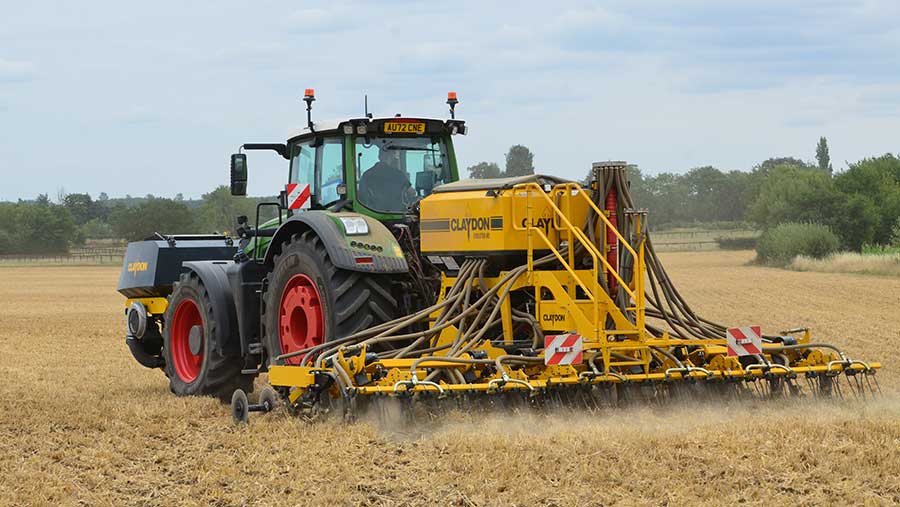
Claydon Evolution M6 and front hopper drilling cover crops into stubble after harvest July 2025
2. Can we get reliable and consistent crop emergence?
Cover crops need to establish well to get the full “below ground” benefit for soil fertility.
If a cover is slow/patchy, benefits are lost (weed suppression, nutrient capture, soil protection). If it’s established too late and then struggles, there could be more bare ground and extra spring management headaches.
Consider field conditions, for example, in an extended dry season, stiffer, harder soils post-harvest will benefit from a drill which is capable of penetrating soil, creating tilth and providing an environment in which seeds have good soil contact with access to moisture in unmoved soil.
This will help promote reliable and consistent germination.
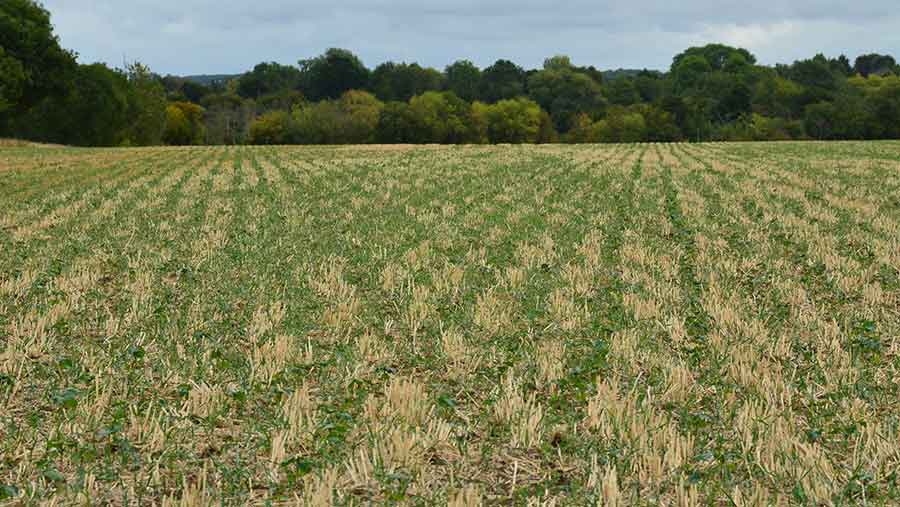
A cover crop emerging strongly days after Claydon drilling direct into stubble and chopped straw following spring oats
In wetter seasons in heavier soils, care should be taken not to smear seeding slots with the direct drill but instead loosen earth to create drainage channels so water flows away from the seed.
Lighter soils may also benefit from a drill which can aerate and loosen in cases where fields have slumped. Fast and consistent crop emergence will help prepare better conditions for the next crop.
3. Do we have the drilling flexibility for companion cropping?
CIPM3 requires the establishment of a companion crop growing with the main crop (it doesn’t have to be present for the full growing period if managed to achieve the aim).
Drills which are flexible and practical to set up will have the ability to place multiple seed types in different locations in one pass through a variety of split or hopper options.
One-pass direct drilling companion bean with winter wheat for SFI CIPM3
4. Can our system simplify “stacking” a rotation-led agreement
SFI26 includes the soil-health actions many direct drilling systems commonly use — SOH1 (£73/ha), SOH3 (£163/ha) and CSAM2 (£129/ha) are explicitly listed in Defra’s SFI26 details.
The practical advantage of a direct drill is that it can help you run those actions without adding extra cultivation steps, which is often where agreements fall down.
5. Do we have a simple evidence routine?
SFI is deliver-and-evidence. Taking photos, keeping seed invoices, field records and a consistent approach reduce stressful admin later.
6. Are we choosing actions that help the farming system — not complicate it?
Drilling systems needs to be robust, reliable and practical to ensure reduced costs are achieved while payments are received for a successful rotational plan.
The real benefit of direct drilling with SFI is that it opens up additional income streams at the same time as reducing the cost and time of establishing crops and improving soil health.
So what could it add up to?
The fourth generation farmers at the Claydon farm in Suffolk stack their operations across a three-year rotation agreement for their 255 ha they have set aside for SFI.
Income actions are SOH3 Catch Crop at £163/ha, CIPM3 Companion Crop at £55/ha, CSAM2 Cover Crop at £129/ha and CIPM4 at £45/ha.
Total SFI income is an annual £88,995 (an average of £349/ha per year across 255 hectares).
For a leaflet detailing the breakdown of SFI actions at the Claydon Farm, request from marketing@claydondrill.com
Machinery: a timely extra — FETF 2026
While SFI is fundamentally a revenue scheme (paid actions on land), some farms will also be weighing up capital investment to support a lower-disturbance system.
A separate, smaller “icing on the cake” route is the Farming Equipment and Technology Fund (FETF) 2026, which includes a published productivity item for a direct drill (FETF44).
Defra’s item list shows a maximum grant amount of £15,067, visit Defra’s website for Ts&Cs.
Funds are also available for stubble rakes and air seeders, complementary machines for direct drilling systems.
Want to see what SFI26 could look like on your farm?
Speak to us about your rotation and drilling dates. We’ll help you sense-check which actions fit, what evidence you’ll need, and how to keep the plan practical.
Call us on 01440 820327 or email marketing@claydondrill.com for a call-back request.
Find out more about Claydon and SFI income.
Provided by
Establishing a better way