

Swinney pledges steady support for Scottish agriculture
 © Adobe Stock
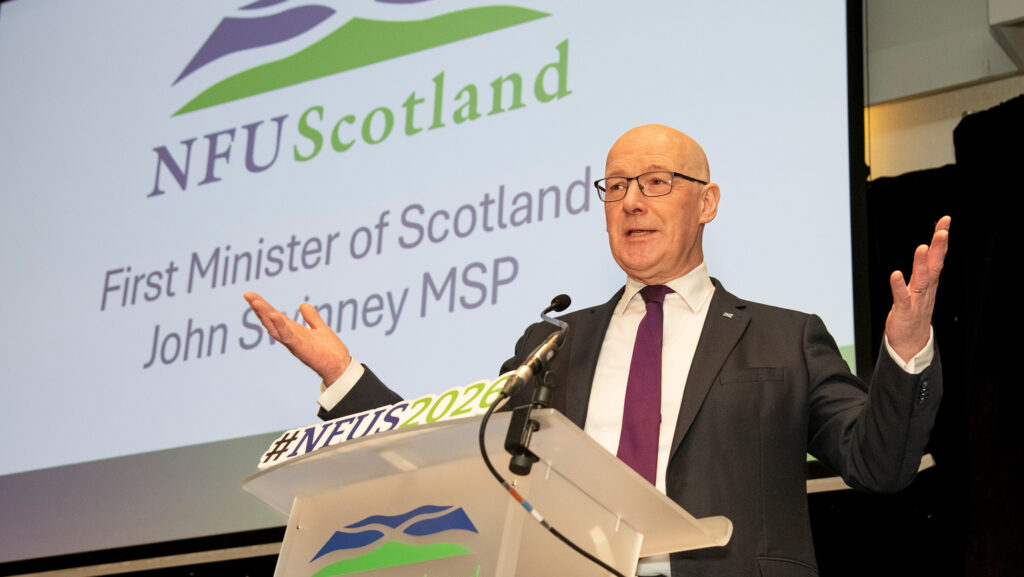
 Scotland’s first minister John Swinney used his address to the NFU Scotland conference to underline a long-term commitment to direct support for Scottish agriculture.
Against a backdrop of volatile weather, market shocks and wider geopolitical uncertainty, Mr Swinney stressed that Scottish farming and crofting needed confidence to plan and invest.
Central to that, he said, was the continuation of direct payments as the backbone of support.
See also: NFUS launches manifesto as ‘fragmented’ election looms
John Swinney © NFU Scotland
“That’s why we’re committed to maintaining and improving direct support, both now and in the future,” he told delegates.
He confirmed that at least 70% of future farm funding would continue to be delivered through direct payments.
‘No big bang’
Mr Swinney sought to reassure farmers anxious about reform.
“I want to reassure you that in the process of taking forward that agenda, there will be no big-bang moments or cliff edges,” he said.
Instead, change would come through “an ongoing, rolling process”, developed with the sector and designed to protect stability while moving towards sustainability.
That approach by the SNP-ruled Scottish government is underpinned by multi-year certainty.
Mr Swinney highlighted a “clear line of sight” to funding until 2030 and beyond, giving businesses the confidence to make long-term decisions.
“If you’re an active farmer or crofter, we are determined to back you,” he said.
Alongside direct support, the first minister pointed to capital investment as a key enabler of resilience and productivity.
He confirmed continued backing for the Future Farming Investment Scheme.
This includes a £14.25m commitment for a second round, ensuring more farms and crofts can invest in equipment, infrastructure and technology.
The scheme sits within more than £660m of support for agriculture in the latest Scottish Budget, announced on 13 January.
Mr Swinney described it as “the most generous and substantial package of support for agriculture anywhere in the UK”.
His message broadened out to the wider supply chain, with funding for food and drink processing, small producers, livestock support and animal health.
But the core theme remained consistent – continuity over disruption.
“The government in Scotland will not turn its back on our farmers and crofters,” he said.
He closed with a personal pledge to the sector and the next generation.
“Walking with you is my pledge as we navigate the period ahead,” Mr Swinney told the conference.
He added that Scottish agriculture would have “the support of the Scottish government that I lead”.
Reaction
NFU Scotland president Andrew Connon welcomed the long-term funding commitment, which he said would offer stability to Scottish farming.
“We will continue to ask for a multi-year, long-term investment for Scottish agriculture, bearing in mind the fantastic return for the economy,” he added.
However, speaking from the floor, farmer Lorraine Luescher, from Langholm, Scottish Borders, pointed out that the £660m annual budget for Scottish agriculture was less than 1% of the Scottish government’s total budget and represents a real-terms cut in funding.
“Is this fair or is agriculture an easy target for cuts?” she asked.
Funding announcements and figures
- More than £660m total agricultural support in the Scottish Budget
- At least 70% of funding to be delivered through direct payments
- £14.25m for a second round of the Future Farming Investment Scheme
- £9m food and drink capital support, plus £9m resource spending
- £100m+ through Less Favoured Area Support Scheme and voluntary coupled support for cattle and sheep
- £24m+ for animal health and biosecurity
- £5m Agri-Environment Climate Scheme 2025 funding (total £343m delivered since 2015)
- £1.5m capital funding for small producers (tripled investment)
- £1m Agritourism Investment Scheme
- £20m for a new Rural and Islands Housing Grant Scheme over four years
- £400,000 investment this year to abattoirs to support small-scale, private kills
- £75,000 for Rsabi in this current financial year (£715,000 since 2020)
- £25,000 to Farmstrong Scotland this year, doubled to £50,000 in the next financial year
Explore more / Transition
During the series we follow our group of 16 Transition Farmers through the challenges and opportunities as they seek to improve their farm businesses.
Transition is an independent editorial initiative supported by our UK-wide network of partners, who have made it possible to bring you this series.
Visit the Transition content hub to find out more.
