Nuffield Bullock Award: Green care champion scoops top spot
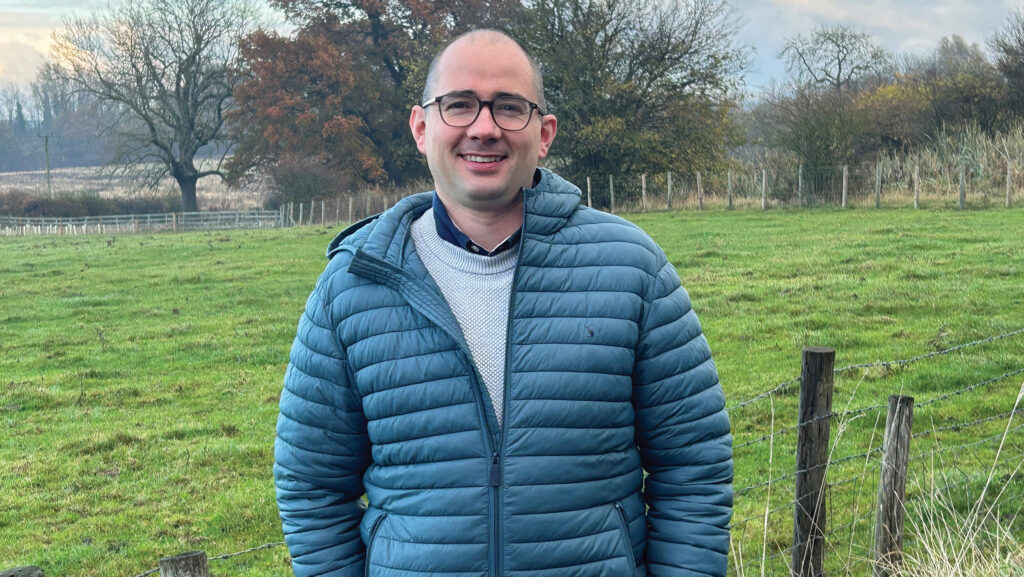 Robin Asquith © Robin Asquith
Robin Asquith, a director at a charity that gives adults with disabilities a range of opportunities to experience the countryside and nature, is this year’s recipient of the Bullock Award.
The award, named in honour of Steven Bullock, a former director of Nuffield Farming Scholarships, is given annually to the scholar who best used the experience of their travels in the subsequent decade.
See also: Benefits of social farming and how farmers can get involved
Robin conducted a scholarship tour in 2016 to study the role UK agriculture can play in delivering social care, with visits to the Netherlands and Italy.
Since then he has devoted his career to putting the principles he researched into practice and says the evidence and confidence Nuffield gave him is now helping shape how several organisations think about land, care and opportunity.
Charity role
He has worked for a decade with the Camphill Village Trust, a charity that delivers support in rural settings to adults with learning disabilities, autism and mental health needs, and now holds the role of director of skills, opportunities and land.
The trust provides its beneficiaries with a range of options, from day visits to residential supported living, enabling them to live healthier, more active and independent lives.
The award judges felt Robin deserved recognition for his tireless work in helping his own organisation but also to grow and professionalise the wider green care movement.
Bullock Award judges
- Stephen Fell Former chairman, Nuffield UK and Leaf
- Meryl Ward MBE Former chairwoman of Lincolnshire Rural Support Network and AHDB Pork, current chairwoman of Lincolnshire Rural and Agricultural Chaplaincy
- Andrew Meredith Editor, Farmers Weekly
This is a drive among social care practitioners to deliver support in a natural environment and with nature-based activities, including farming and food production but also environmental and wildlife conservation.
At Camphill Village Trust, Robin leads a team that last year delivered more than 77,000 support sessions across 10 locations and he says that the sheer amount the trust is delivering is the achievement he is most proud of.
“What matters most to me is the change I see in people. Soft skills often get overlooked, but they’re the things that make the biggest difference.
“On our farms and gardens, I’ve seen people we support grow in confidence, communication, teamwork, and resilience; some have even moved on to paid employment,” he said.
“I’ve seen people who were isolated find a place where they belong.”
Merging the softer side of support with formal research that validates the benefits of social care within a natural setting is also something Robin has championed.
Wider reach
As a trustee of the North York Moors Trust, he helped develop and deliver the Natural Health Service pilot, a structured 10-week nature-based intervention that aimed to quantify the value of a structured nature‑based activity for older adults.
Participants were surveyed before and after the programme, reporting higher scores after for mental, social and physical wellbeing, and lower scores for feelings of loneliness.
The strength of the pilot secured another £550,000 to scale the programme, which shows the value of what has been built, Robin said.
Future research will hopefully reveal in more detail how green care can deliver beneficial impacts beyond those associated with general time spent in nature.
His Nuffield scholarship taught him the value of positive risk-taking and “confidence, resilience and the belief that I could take on something bigger than I ever thought possible,” he said.
Finalists
Neil McGowan
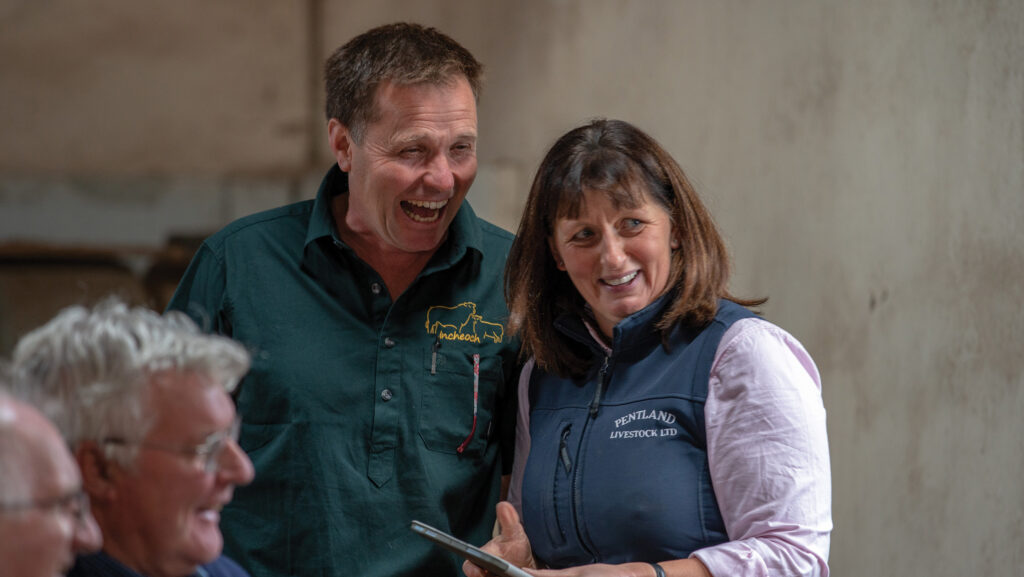
Neil and Debbie McGowan © Neil McGowan
Perthshire livestock farmer Neil McGowan’s Nuffield report gets right to the heart of the key issue occupying the thoughts of every producer of breeding livestock – selecting for efficiency.
The third-generation farmer credits his scholarship with giving him the confidence to take Incheoch, an upland family farm already turning out pedigree sheep and cattle away from a business focused on producing for the show ring.
Instead, he and the team started selecting the Lleyn sheep and Luing, Angus and Simmental cattle for functional breeding traits such as birthing ease and performance on forage so that they were better suited to the land and a low input system.
On-farm sales
It also meant a change in the way stock was sold, with a switch from selling through the livestock market to the now renowned on-farm “Working Genes” sale which sees bulls and rams sold to remote and in-person buyers through a silent bidding process.
Neil, who with his wife Debbie scooped the 2020 Farmers Weekly Sheep Farmer of the Year award, said the on-farm sale works as animals bred to suit an upland grass-based system became too small to look right in the mart.
“It came to a real head with the Simmentals when at one point we found ourselves in Stirling mart and the bull we needed to buy to sell bulls back to the market was not the same bull we needed to buy to suit the cows on our farm.
“The theatre of that collective bull sale is not based on commercial reality.”
Yet those are precisely the traits that have won the business a following among like-minded breeders on pasture-based systems.
Customers for the farm’s livestock are spread from the south of England to Orkney and 70% of the rams sold at the most recent sale went to repeat buyers.
His goal for the future is to keep working towards breeding efficient livestock that can thrive in a pasture-based system.
Anna Jones
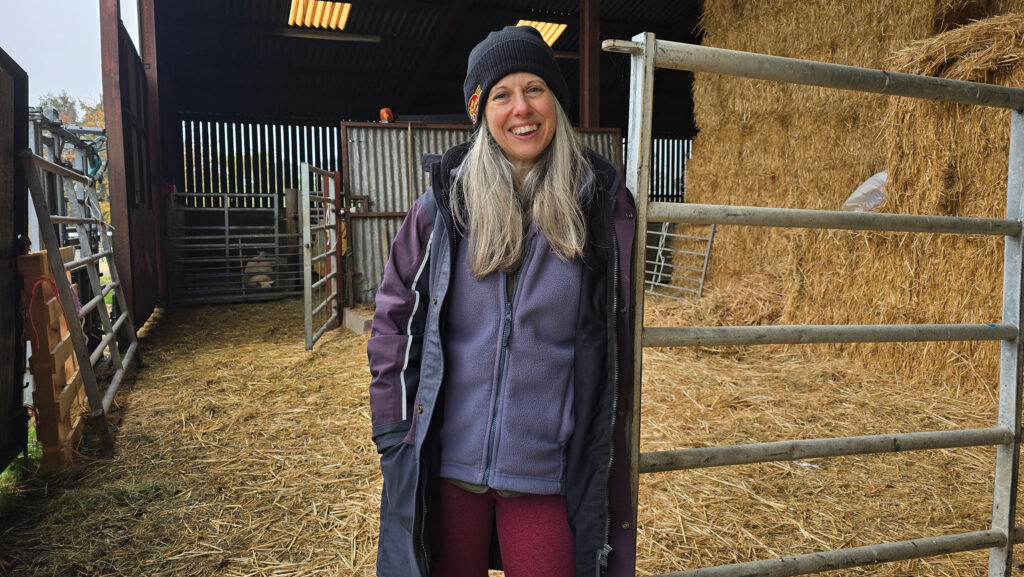
Anna Jones © Anna Jones
For BBC journalist Anna Jones, it was interviewing Nuffield scholar Tanya Robbins that led to her starting her own Nuffield journey to study how the mainstream media portrays farming to the public.
Anna, then a producer and director on Countryfile, concluded in the report that the disconnect between the media and farming was genuine, with the former guilty of urban bias that sometimes spilled over into bias against intensive and large-scale farming.
Meanwhile, farmers felt unfairly attacked by this, giving rise to a deep distrust of the media and a failure on occasion to separate criticism from legitimate challenge.
However, she concluded this disconnect was surmountable, and, as someone who had grown up on a farm but was comfortable in a newsroom, she was ideally placed to do something to help remedy it.
“I think Nuffield saw something in me that I hadn’t seen myself,” she said.
“By the end of my Nuffield I was this square peg in a round hole. I couldn’t just go back to the BBC and sit down and shut up.”
Change of role
Anna quit her BBC staff job in 2018 to devote her time to founding Just Farmers, a non-profit organisation with a mission to help train farmers to tell their stories and the media to find them.
Since then 13 groups of farmers have been put through media training workshops led by her and other journalists to give them the confidence to engage with journalists.
They are then put on a directory of contacts that the media can access, saving time-poor journalists having to hunt out their own contacts – or rely on non-farming voices to tell a farming story.
By July of this year there had been 2,500 recorded media connections made, with 503 members of the media using the website to reach one or more of the 156 trained-up farmers and growers.
Just Farmers is also now supported by two part-time employees, a chief operating officer and a media manager.
Alongside supporting its continued development, Anna intends in future to spend more time on her original passion of storytelling and documentary making.