

Advice on protecting dairy staff from workplace dangers
 © Tim Scrivener
 Dairy farmers may have a legal responsibility to protect their workers – family and staff – but everyone on farm has a collective responsibility for health and safety.
Rather than relying on a strategy of enforcing health and safety policies, farm owners would be better to foster a positive farm culture around workplace safety, says Andrew Palmer.
See also: Why it is important to do a staff learning review
As Lantra’s industry partner for land, food and farming, Andrew says most health and safety issues are linked to livestock handling or being struck by machinery.
Some are genuine accidents, but he questions how many could be prevented with a bit more training and awareness.
Regular health planning visits with the vet can tackle vaccination and hygiene routines to protect against zoonotic diseases, so, apart from orf and ringworm, he says he hears of few cases of zoonoses.
Duty of care means enforcing safety policies
The farm risk assessments needed to meet insurance requirements can help farm owners to develop their own specific written safety policies and detailed standard operating procedures (SOPs).
However, Andrew points out it is then up to the farmer, family workers and farm staff to make sure they are carried out to an agreed standard.
“An owner can think things are being done one way, and it is actually another, with potential for accidents to happen,” he explains. “There might be shortcuts or time pressures, so people don’t follow policies and SOPs to the letter.”
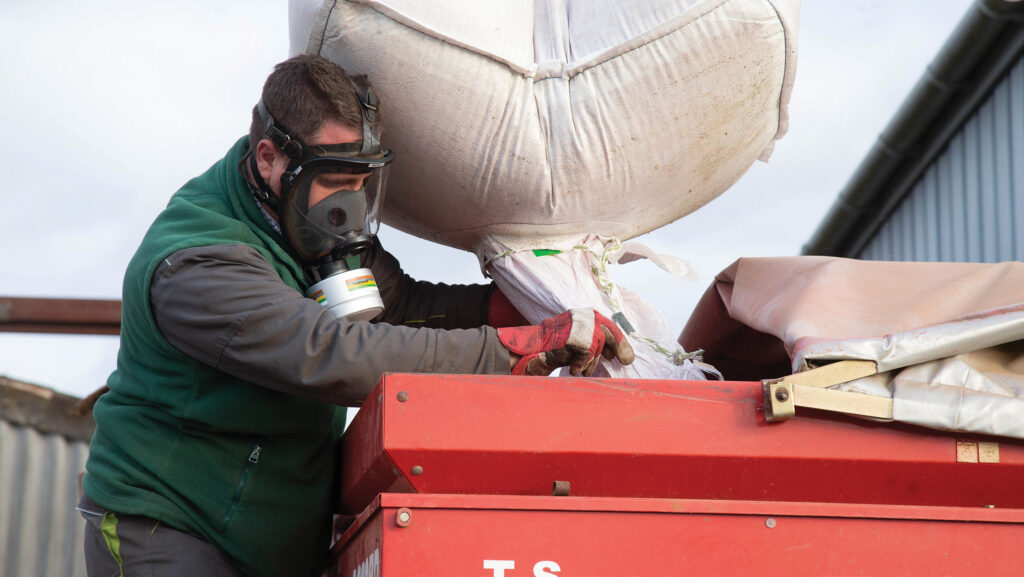
Similarly, a farmer’s duty of care to provide protection – gloves, ear defenders or goggles – is undermined when an employee does not use them.
That is why it is important to explain the reasons for having PPE and be quite clear about the potential consequences, whether that is a serious accident or a zoonotic disease.
“Farmers are accountable for the actions of their staff, and you not only have to provide the gear, but also enforce wearing it,” he says.
© Tim Scrivener
Health and safety should be on every team meeting agenda
To start getting buy-in from everyone on farm, Andrew thinks workplace health and safety must be on the agenda at every team meeting – not just at the end under “any other business”.
“It should be routine and addressed properly,” he stresses. In addition, he suggests using a whiteboard for staff to list equipment that needs to be fixed.
This ensures there is a focus on safety from using tools and machinery at work. Listing items for repair puts them up front, to be formally discussed with the farm owner.
“It is a cost to fix things, but it is much cheaper than a court case or fine after an accident [from using broken equipment]. Liability is on the owner if staff are using unsafe equipment,” he explains.
Staff should also have the confidence to report near-misses (accidents that failed to happen) at team meetings, but Andrew accepts it first requires an environment of trust between farmer and farm staff.
“People should feel free to raise concerns if you have created a safe culture on farm,” he points out.
Tech advances make workwear more appealing
Finding ways to prompt staff to be safety conscious at all times has led some farms to supply staff with work clothing.
Modern safety gear is not just available in high-vis colours, but is also now “quite tasteful; not bulky”, says Andrew, and this encourages people to wear it.
“New ear protection technology can now have moulded pieces fitted to your ear, adjusted to different noise surroundings, so you can hear people talk.
“This makes it more likely that people will wear them at work. Likewise, gloves are no longer thick and cumbersome, but are skin-tight; they stretch and you can hold a spanner and tighten a nut while wearing them.”
Older and younger workers need more focused attention
A good health-and-safety culture acknowledges that some people on farms may need more looking after than others, he adds. Vulnerable workers include those who are much younger and older; people with less experience, or who have special needs.
Furthermore, Andrew points out that legal requirements in the workplace also apply to family, yet family workers often overlook risks because farming is seen as a way of life.
Workloads, tiredness and time pressures lead to cutting corners, and certainly more risks might be taken. The older generation needs to recognise their reactions are slower and they are not so agile to be able get out of trouble.
“Older farmers are disproportionately affected by fatal farm accidents, with workers aged 45-plus accounting for about 80% of agricultural workplace fatalities. Those aged 60-plus represent about 40% of deaths,” he says.
Regular training will ensure that everyone is up to date with best practice and gains a level of proficiency.
Lantra offers free online safety training, plus a full range of practical courses covering everything from chainsaw handling to pesticide use and rodent control.
Gaps in knowledge can also be filled by the farm’s professionals, says Andrew; the farm’s vet, for instance, can teach livestock handling or correct injection techniques.
Consider the consequences of an accident on the whole team
Ultimately, he says, it is up to everyone on a dairy farm to do their bit. “Some people only change when there is an accident or they get caught flouting safety rules,” he says.
“But when someone is put out of action, whether in the short or long term, the extra workload falls on the rest of the personnel, so it is important to consider the consequences.
“People need to ask themselves: who will do your job tomorrow if you are not around because you’ve had an accident? This can shift the balance in their thinking to be safety conscious.”