

Shearer visa crisis leaves Defra official blindsided
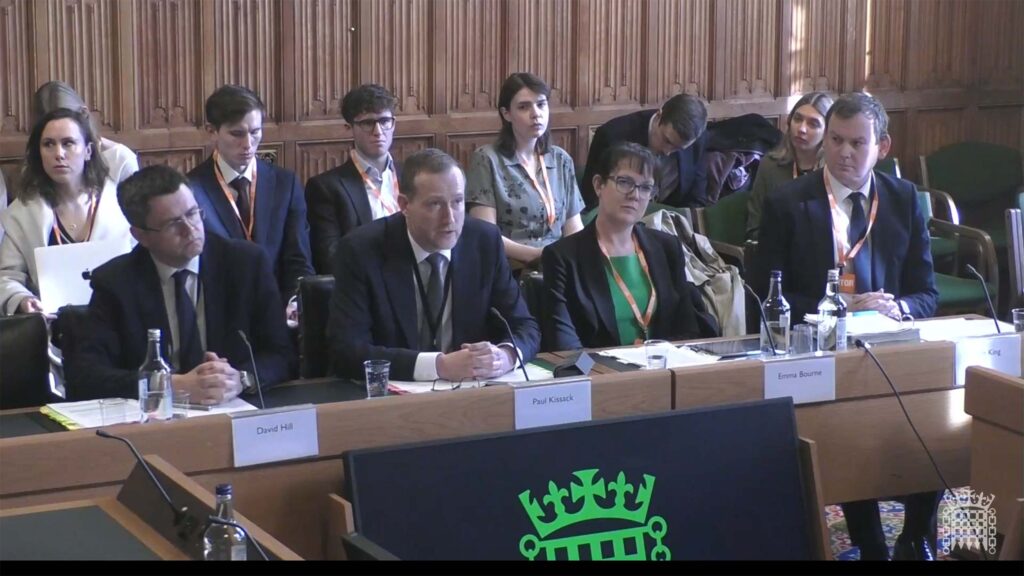 Paul Kissack (centre) at the hearing © Parliament TV
 A senior Defra official has admitted he is unaware of any contingency plans to address a looming shortage of sheep shearers in the UK, sparking fresh criticism that the department is failing farmers.
Speaking before MPs on Tuesday 3 March, Defra permanent secretary Paul Kissack acknowledged he did not know what steps, if any, had been put in place despite warnings that up to 1.5m sheep could go unshorn this summer after the Home Office denied visas for shearers from New Zealand and other countries.
Challenged by Environment, Food and Rural Affairs (Efra) chairman Alistair Carmichael about whether there had been discussions with the Home Office on the issue, Mr Kissack said: “I confess, I don’t know what our plan is on that. It hasn’t hit my desk at this point. Maybe it’s waiting for me when I get back.”
See also: Home Office visa decision sparks shearer shortage fears
Mr Carmichael, the Liberal Democrat MP for Orkney & Shetland, highlighted the seriousness of the issue.
“This is a significant problem,” he said. “It’s one of the government’s own making, because it’s the Home Office that has refused visas for these 75 foreign shearers. Has there not been any discussion between Defra and the Home Office on this?”
He warned of “a looming animal welfare crisis this year” if shearers are not available during the peak July and August months, noting that sheep left unshorn could face severe welfare consequences.
Mr Carmichael told Mr Kissack that during meetings with farmers, “I can’t think of one time where there has not had somebody say Defra, as a department, just isn’t fit for purpose”.
He said farmers’ “interaction and their perception of the department is a poor one”.
In response, Mr Kissack insisted Defra championed farming’s interests across Whitehall and suggested discussions with the Home Office may already have taken place.
“I suspect there has been conversations,” he said, promising to look into the matter.
Defra initiatives
Mr Kissack pointed to Defra initiatives that it says demonstrate support for farming, including the establishment of a Farming and Food Partnership Board to rebuild trust, sector-specific plans including the Land Use Framework – which is due to be published imminently – and the Farming Roadmap.
He also pointed to the baseline staff training programme at the Allerton Project in Leicestershire, which costs about £150 per head to give Defra staff hands-on farming experience.
Mr Kissack said the training was a “pretty good investment into one of the more important areas”, with the aim of ensuring officials better understood the sector.
SFI revamp
Mr Kissack also highlighted Defra’s attempts to rebuild trust over the Sustainable Farming Incentive (SFI) for England.
He said more than 40,000 farmers were now in SFI schemes and there had been “very positive feedback” from the NFU and CLA on the revised SFI26 offer.
The department was trying to provide “as much information as we possibly can, as early as we can”.
Mr Kissack promised his department would give a running commentary on the SFI26 budget once the scheme opens.
But he admitted: “There will come a point where we will have to close the window and we want to do that in an orderly way.”