Export potential lifts pig market outlook
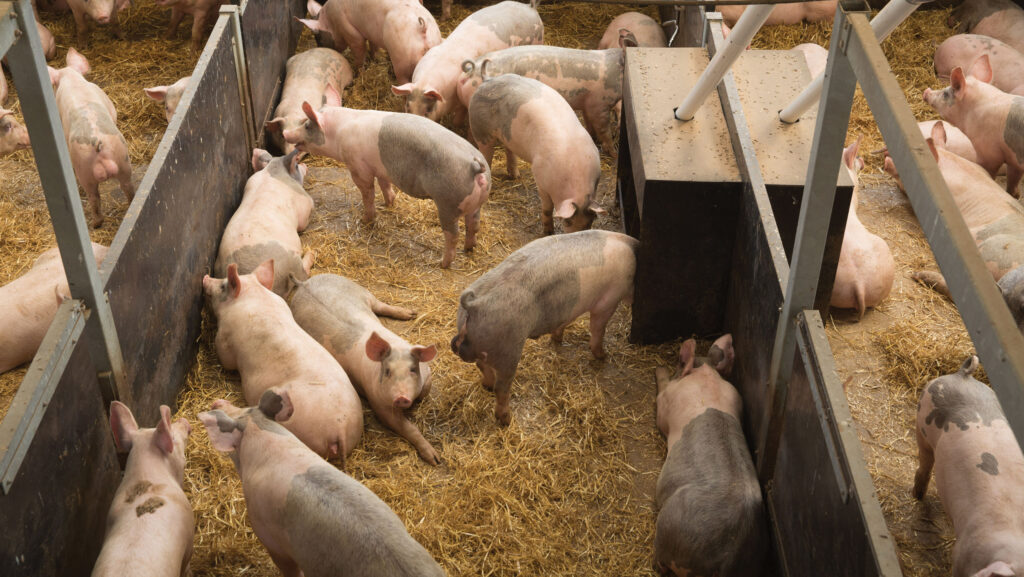 © Tim Scrivener
 Market prospects have brightened for pig producers, with stronger German prices supporting confidence and Danish welfare and environmental reforms potentially creating new export opportunities for the UK.
In the week to 15 August, the GB Standard Pig Price increased by 1.25p/kg, to 179.51p/kg, as slaughterings fell by 1,500 head to 163,900.
However, that was still 11,800 head up on the year, with prices down 28.25p/kg. And in the week to 22 August, the SPP eased back again to 178.39p/kg.
See also: Pig prices remain subdued in oversupplied market
According to Meadow Quality, sow prices are unchanged at 38-50p/kg, while fresh trade porkers and cutters are fetching 215-250p/kg and baconers 165-190p/kg.
“There is less weight in the pigs now averaging 89.9kg, and all seem to be moving at present, even with a few extra pigs coming onto the market,” said an MQ spokesperson.
On a positive front, German prices have firmed over the past three weeks, from a grade E low of 127.81p/kg to 141.65p/kg in the week ending 16 August.
The EU average, excluding the UK, rose from 126.97p/kg to 134.90p/kg over the same time.
Denmark exports about 85% of its 12.3m pigs and supplies about 21% of UK pork imports.
AHDB livestock analyst Adam Chowdry said maintaining competitiveness under stricter standards would be challenging. Lower Danish production and exports could tighten European supplies and alter trade flows, potentially creating openings for UK exporters.
Welfare and green credentials
Harry Batt, partner at Andersons Consulting, said the UK was well placed to benefit. “Welfare and the environment are at the forefront of livestock production now.
The UK should be in a better place than many other countries from a welfare and an environmental point of view, and we should be well placed to produce low-carbon-footprint pork,” he said.
Mr Batt urged the industry to promote its environmental and welfare credentials more proactively.
He noted that UK pig production is increasingly concentrated within integrated supply chains that should respond more quickly to changing conditions.
However, Mr Batt said the sector had struggled to react during the recent downturn caused by oversupply after China stopped buying Spanish pork.
Looking ahead, Mr Batt warned that disease outbreaks and geopolitical tensions would continue to disrupt trade.
“Across all sectors there needs to be more resilience in supply chains, because there will be more disruption and volatility in the future.”