

From soil to shelf: How supply chain partnerships add value
Scale, co-operation, efficiency and resilience across the supply chain can yield dividends for everyone involved, a Transition Project supply chain visit has heard.
The whole supply chain was represented on the visit from Reynolds Farmers to grain marketing company Frontier Agriculture, Camgrain farmers’ co-operative, Navara Oat Milling and finally plant-based drinks manufacturer Alpro.
See also: Are smaller dairy cows a concern for the beef supply chain?
Reynolds Farmers
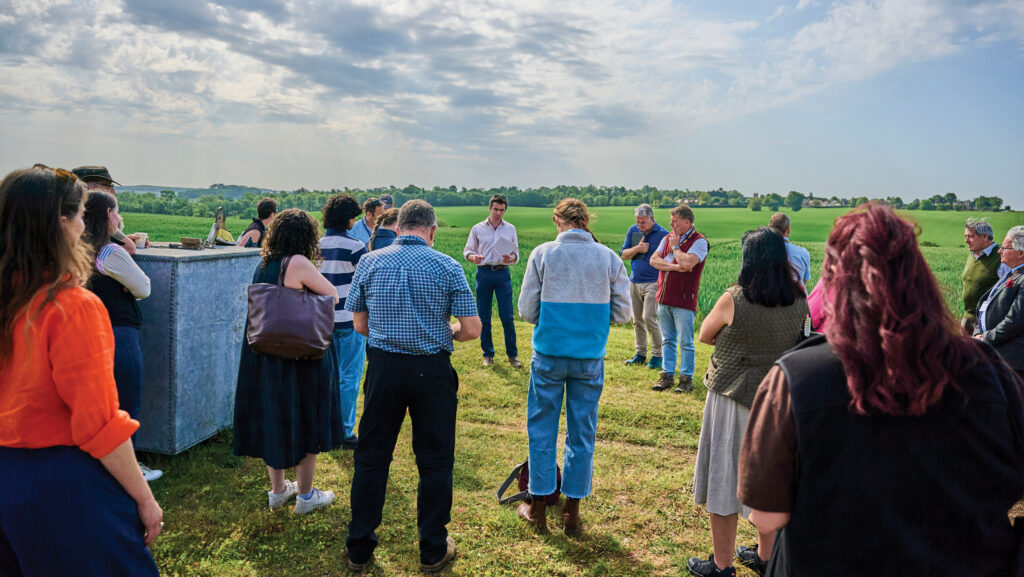
The day began at Reynolds Farmers, Manor Farm near Kettering – a 200ha mixed arable and livestock estate owned and managed by Henry and Ana Reynolds.
Underpinning its role as a robust link in the chain is Manor Farm’s business resilience through its approach to regen farming with a strong focus on soil structure on the heavy clay land.
Henry explained, the farm has a low soil disturbance approach after switching to a regen system in the early 2000s.
© Oli Lees
Straw is chopped so adds directly to soil organic matter and supports worm activity. Worm populations have improved soil structure and texture with better aeration and drainage characteristics, Henry said.
Worms also promote soil microbe growth, adding to the availability of nutrients for crop growth.
Further benefits to soil organic matter have been achieved by introducing sheep to the arable fields.
Previously the farm’s flock was run on dedicated pasture but allowing sheep access to arable fields to graze cover crops has helped boost soil organic matter and added nutrients without applying artificial nitrogen.
Tillage, fertiliser and chemical control strategies are based on assessment and carefully tailored to needs.
Henry’s father Stephen – a regen farming pioneer and active partner in the business – is a proponent of assessing soil structure by digging pits.
“Visually evaluating the structure allows the business to tailor its annual tillage programme for each field, optimising inputs and controlling costs,” said Stephen.
Overall the regen strategy has reduced fuel use by 27 litres/ha and slashed artificial fertiliser costs and insecticide use.
Knock-on benefits include less wear on machinery and equipment and a huge reduction in the farm’s carbon output. Resilience to extreme weather has also been improved.
The soil structure is now better able to retain moisture during dry weather and is freer draining, making it less prone to waterlogging and erosion in heavy rain.
Frontier Agriculture
Representing the next link in the chain, Frontier’s Tom Coulter, said the Reynolds’ approach is important because the whole supply chain is increasingly looking to demonstrate its green credentials and its resilience to environmental, geopolitical and social risk.
“Food processing and retail firms are under increasing pressure to demonstrate resilience to climate risks,” said Tom.
“Farms that can show how they have set up their businesses to cope with change are more likely to attract and retain contracts,” he said.
Frontier supplies inputs to growers and markets 5m tonnes of grain each year.
It acts as the primary grain marketing and distribution partner, to farmer-owned co-operative, Camgrain, the next link in the chain and a focus of the visit.
Camgrain
Camgrain CEO Simon Willis demonstrated how the huge scale of the operation near Kettering benefitted the co-operative’s grower members.
Across all of its sites, Camgrain can store 500,000t of grain allowing flexibility at peak harvest times, Simon pointed out.
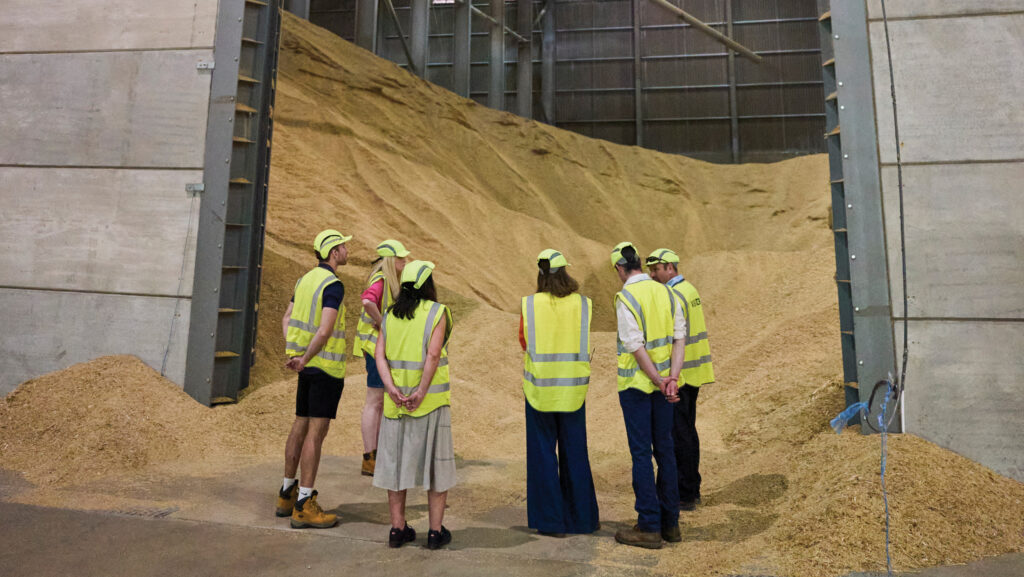
The huge grain shed at the Kettering site can hold 70,000t of grain which is closely managed from arrival by a computer-controlled system.
© Oli Lees
Grain is quality tested at unloading and then transferred by a conveyor at the top of the shed and dropped into partitioned zones.
Crops are monitored for moisture and heat then dried, cooled or treated to ensure the grain is held at peak condition.
Outflows are via augers running underneath the shed and controllers can select grain quantities from any particular zone according to customer spec.
It is even possible to combine zones to mix loads to reach the target requirements for characteristics like protein and moisture content.
Having access to these state-of-the-art drying, storage and processing facilities has major benefits for the co-operatives’ growers, who would otherwise face significant on-farm investment costs.
Navara Oat Milling
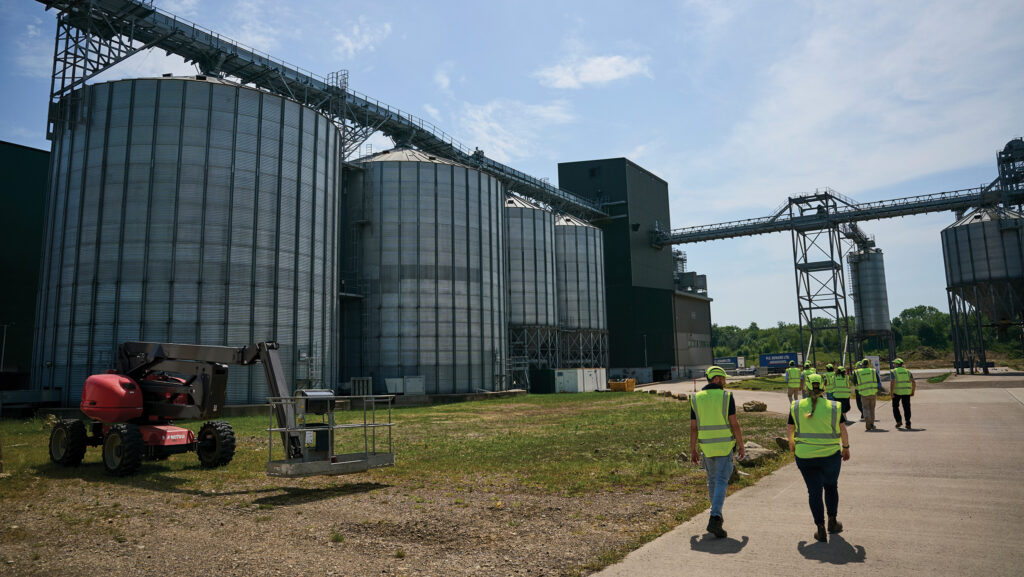
From Camgrain, oats are transferred via auger to the Navara Oat Milling company, a joint venture with Frontier.
Managing director Donna Smith explained that Navara’s plant is the largest oat milling and processing factory in Europe.
All of the oats are sourced from farms within a 75-mile radius to minimise food miles and carbon footprints, Donna said.
Having the high degree of transparency and being able to show everything from the farm to the oat flour we produce, provides assurances and key information to our customers, she added.
© Oli Lees
Alpro
One of Navara’s customers, and the final link in the chain, is plant-based drinks producer Alpro.
Danone’s Katie Smith explained that the company had recently committed to sourcing all of its oats for the British market exclusively from UK growers.
To make the switch to 100% British oats, the Navara Oat Mill has been crucial.
Their experience and close ties with local farmers, means we’ve been able to commit to source our oats from farmers mostly within an 80-mile radius of the Alpro’s site in nearby Burton Latimer.
By switching from sourcing oats in mainland Europe to local suppliers, we’ve substantially cut land miles – and with them, carbon emissions, said Katie.
Alpro switch to British oats
- 25% lower carbon footprint
- 20% reduction in land use
- 70% reduction in water use across the product lifecycle
- 6,000t reduction in Alpro’s annual carbon footprint
Explore more / Transition
During the series we follow our group of 16 Transition Farmers through the challenges and opportunities as they seek to improve their farm businesses.
Transition is an independent editorial initiative supported by our UK-wide network of partners, who have made it possible to bring you this series.
Visit the Transition content hub to find out more.
