Grassland management at Glastonbury festival site
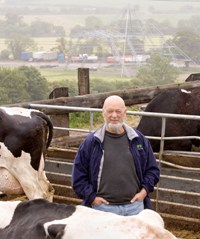
Michael Eavis can undoubtedly be viewed as an industry leader in farm diversification, having introduced the world-renowned Glastonbury Festival to his farm in 1970.
However, despite his obvious success as a music festival ideas man, his roots are still firmly in dairy farming. His role has undoubtedly changed over the years and having spent 40 years milking, he now views the farm more as a passion.
But, he still plays an integral part in the running of the farm, his key aim being to maximise cow comfort and welfare.
The income from the festival has certainly allowed us to farm better, says Mr Eavis. “Income from the festival has been drip feeding into the farm for years and allowed us to make gradual farm improvements and increase cow numbers.”
The farm currently has 320 Holstein Friesians, producing an average 10,000 litres/cow, with room to expand to 400 cows.
“The cows have the potential to do 11,000 litres but I would rather reduce the pressure on the cows and maximise longevity and welfare.”
All of the 500 acres of permanent pasture used for the festival are cut for silage prior to the event every year.
Producing a grass ley that will produce the best quality silage while being able to take a good beating from several thousand people walking over it is a definite challenge, and something that has taken years of trial and error, says estate manager Steven Kearle.
“When we were just using high-production perennial ryegrasses, the ley was completely destroyed after the festival. We are still learning but we are now using a 50:50 mix of old variety fescues to create a thicker base and high-sugar varieties.”
“Because we cannot guarantee a dry year and second cut silage is not an option, we must try and ensure we cut at least 80% of grass at first cut.”
The grass must be at post silage height for the festival to allow debris to be cleared as easily as possible so cows can be put out as soon as possible.
After the event, fields are cleared of litter first and then power-harrowed and litter-picked again. The harrow has a slit aerator on the front to help aerate and bring debris to the surface.
A large, industrial magnet is also used to pick up metal, says Mr Eavis. “In the past we have had huge problems with cows eating tent pegs and other metals. Although cows are rumen magneted, this is not enough.”
This year, the magnet is being modified to maximise efficiency. “The design for the new magnet, which will hopefully be ready this year, includes a metal detector which will locate non ferrous metals and spray the ground with a paint marker so the metal can be dug out by hand.”
On a dry year, grass comes back quickly, however wet years can cause problems. Having said that, 2007 was the only year in the event’s history where cows did not go out.
“It is essential ground is left to dry as much as possible. When pasture needs improvement we will reseed but we will never plough.”
It is important to remember this is a farm first and foremost, says Mr Kearle. “Cows are the most important”
Although the festival creates challenges with grassland management, Mr Keale views the farm and festival as being mutually beneficial.
“We may not be able to put up permanent fences because of the festival, but the festival creates enough infrastructure, putting up temporary paddocks is not too much of an issue.”
This year has also seen the building of a 400,000-gallon reservoir, say Mr Eavis. “The reservoir will hold drinking water for the festival and will be used long-term to hold bore water for the farm – essentially it will enable us to provide free water to the cows.”
An added challenge is the fact the slurry pit must double as a temporary septic tank during the festival, continues Mr Eavis. “The slurry pit can hold half a million gallons of slurry. During the event, human waste is sorted and filtered into the pit and pumped out into lorries for removal.”
The festival creates some unusual farming challenges, but also provides huge diversity and allows us to drive the business forward in the way we want, says Mr Keale.