How tight margins on farm are hitting agricultural machinery sales
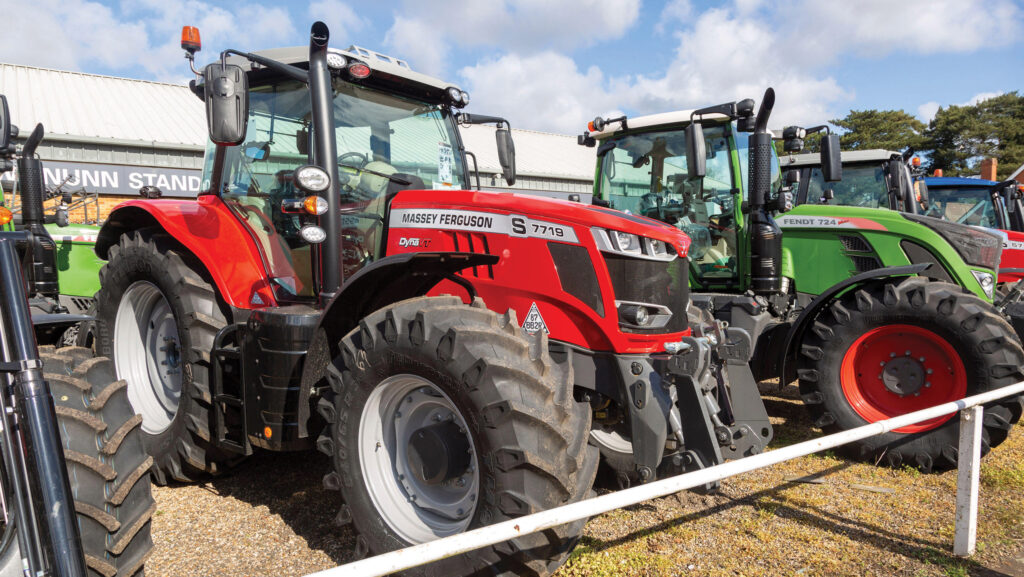 © Geogphotos/Alamy Stock Photo
 Machinery dealers are feeling the pinch as reduced demand from farmers for new kit hits their bottom line.
With fewer than 9,000 machines being registered in 2025, the Agricultural Engineers Association (AEA) says registrations are at their lowest levels since records began in 1964, and are likely at the lowest since before the Second World War.
See also: First impressions: John Deere’s 8RX 540 breaks new ground
However, the headline figures tell only part of the story, with today’s machines much larger and higher in value than their predecessors.
In terms of total horsepower and value, the decline is less severe than unit sales might suggest.
Even so, the sector is still enduring the worst slump in decades. AEA economist Stephen Howarth outlines two key factors at play.
“One is arable farmers are struggling,” he says. “The poor state of the market is in a large part driven by the difficulties in the arable sector.
“There’s been three bad years in a row, cash is tight for those farmers and that has had a knock-on effect on confidence in other parts of the industry.
“Even though livestock farmers have generally had a much better time of it over the past year, those parts of farming are lacking in confidence as well, which is impacting on investment.”
Issues such as changes to inheritance tax relief, uncertainty around future support policy, the sudden closure of the Sustainable Farming Incentive (SFI) scheme in England, and wider economic and political uncertainty have all contributed to reduced confidence.
Supply chain
A second factor affecting tractor registrations is supply chain disruption.
Mr Howarth says: “In the early part of 2024, we were still in a sort of recovery phase after post-Covid supply chain disruptions in 2022 and 2023.
“That meant lead times were extended, and the bigger and more complicated the machine was, the longer those lead times.
“It’s a difficult market here, but it’s been a pretty difficult market everywhere else in the world as well,” he adds.
Combine harvesters
Sales of new arable equipment and combines are also proving tricky, according to Mr Howarth.
“The 2024-25 season [for combines] was again, probably the worst since the war, certainly the worst in our records.
“It was a really difficult year for those, and it doesn’t look like the current season is going to be any better.”
Where farmers might have replaced their combines every five years, he thinks more will run them for seven or eight years before replacing.
“We actually had quite a good season for combine sales about three years ago, in the wake of the Ukraine war when crop prices were sky-high and arable farmers had a very good year.
“So actually, the fleet is probably a little bit newer than it might sometimes have been.”
Grassland kit
One segment of the market that has been doing better is grassland equipment and forage harvesters, according to the AEA.
This is in part due to a better period for the dairy sector last summer, although with farmgate milk prices having fallen since, it is unclear whether demand will hold up.
Mr Howarth suggests telehandlers are also doing OK, seeing a bit of a switch in demand away from lower horsepower tractors, due to their versatility.
Sales of ATVs and UTVs have also held up reasonably well.
Equipment grants
Capital grants for farming implements have also helped drive demand for certain equipment, such as direct drills.
However, the AEA has cautioned the grants can be a “double-edged sword” for suppliers as it make sales very fragmented, with volumes often plummeting outside the relevant application windows.
The AEA has called on Defra to adjust the timings of capital grant schemes to better suit arable farmers’ need for equipment.
Outlook
The machinery market appears to have turned a corner in the first two months of 2026, with some optimism returning. Tractor registrations in January and February were marginally above last year’s levels.
“I think we’re looking at a gradual recovery,” says Mr Howarth. “I don’t think we’re expecting a massive improvement this year, but it might be a little bit better than 2025.”
Pressure mounts on tractor manufacturers and dealers
Case New Holland (CNH) is one of the last major tractor brands manufacturing in the UK, with its New Holland plant in Basildon, Essex, alongside JCB’s Fastrac production line in Staffordshire.
CNH Industrial’s annual accounts for 2025 show revenue fell 9% year-on-year to US$18.1bn (£13.6bn).
The firm says unfavourable market conditions resulted in lower sales volumes, lower production, lower manufacturing capacity utilisation, higher sales discounts, and a higher provision for credit losses.
It expects some of these conditions to persist throughout the current year and has forecast sales within its agriculture segment to fall by up to 5%.
In a recent statement to shareholders, chairman Suzanne Heywood said: “We expect 2026 to represent the trough of the current agriculture cycle, and we are protecting profitability through cost discipline, structural improvements, and channel inventory reductions.
“The long‑term fundamentals of agriculture remain compelling – rising global food demand, finite arable land, and the growing dependence on technology to produce more with less.”
Dealers
Manufacturers are not alone, with seven of the 10 largest UK farm machinery dealers recording a decline in revenue in their latest available annual accounts, while one maintained current levels and two achieved minor increases.
The loss last September of Rea Valley Tractors, which had operated across seven branches, serves as a reminder of the fragility of the machinery sector.
Second-hand machinery still in vogue
The second-hand machinery market seems to have fared much better than new, with tractors and equipment selling well.
East Anglia-based auctioneer Cheffins reports sales of more than £12.4m during the first quarter of 2026, through its second-hand machinery sales at its site in Cambridgeshire and at on-farm auctions.
Sales are up 14.5% on the same period last year, with roughly 4,800 lots going under the hammer.
Oliver Godfrey, head of machinery auctions at Cheffins, says: “Looking at on-site dispersal sales, trade remains very strong for good quality, well maintained, well serviced, straight-from-farm machinery and equipment.
“The sales have been very well attended, with global competition, but ultimately domestic end-users and farmer buyers have been predominant in most of the acquisitions.”
He suggests that 75-80% of machinery from farm sales is being bought by end-users.
“The cost of new [machinery] is so high it makes it a bit prohibitive in some respects, but farmers are very keen to spec up, move forward and renew their fleet, and they’re looking at good quality straight-from-farm stock.”
Demand from UK farmers for lower horsepower good specification machines is also reported as strong, but auctioneers are seeing lower numbers of tractors being traded in against new machines.
Other kit
Mr Godfrey says: “Good quality cultivation kit and drills are selling very well and going to all parts.
“The plough also seems to be back in vogue and we’re selling some for good money.”
Bids from online buyers are becoming more prevalent, according to Mr Godfrey, with farmers increasingly willing to buy remotely.
He said: “Generally, the encouraging signs are that people are looking at farm sales to spec up and push their agri-businesses forward.”
Exports
Almost half (48%) of all agricultural machinery sold at Cheffins’ monthly sales was exported in 2025, at a value of £15.3m.
Roughly 87% of overseas sales went to European buyers, with the remainder sold further afield including northern Africa, South Africa, Turkey and New Zealand.
Cheffins director Joe Page says: “The costs of transport, customs and cleaning has all had an effect on the second-hand market.
“Demand from the overseas market continues to be focused on quality tractors, with a particular preference for John Deere and Fendt models, while there has also been a marked increase in the sales of JCB telehandlers, which have seen the most interest from Poland, Ukraine, Spain and domestic trade.”