Beef prices hold firm as cattle supplies tighten
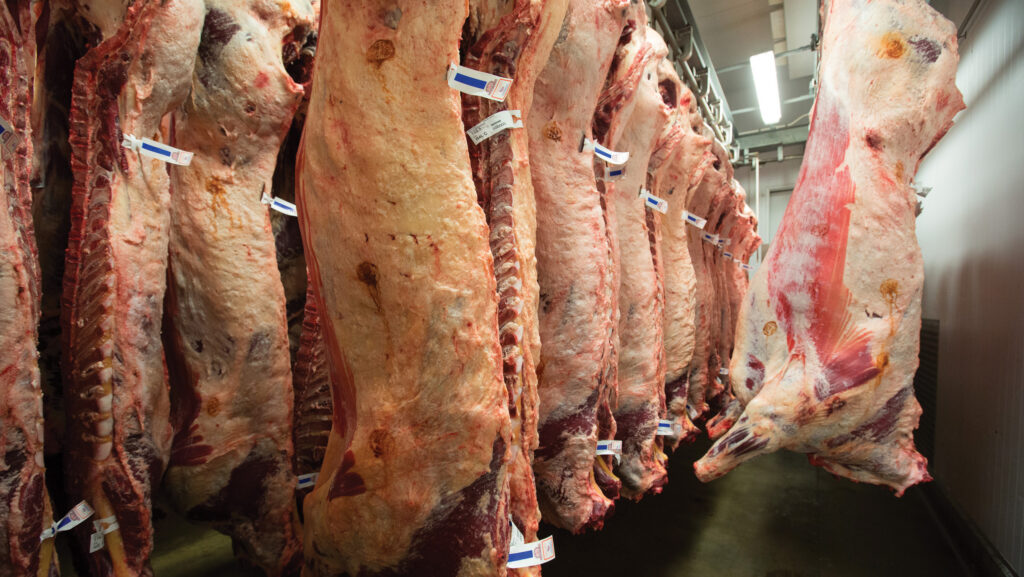 © Tim Scrivener
 Finished cattle prices remain strong, moving up across most categories in early July, before stabilising again by the middle of the month.
At the same time, slaughtering numbers are down, and with tight cattle supply underpinning the market, higher retail prices are beginning to temper consumer demand.
See also: Find all our market information in one place
Prime cattle slaughter in Great Britain was estimated to be down 2,000 head in the week ending 11 July, to 29,900. GB beef prices were at £6/kg deadweight, with R-grade cattle making £6-£6.05/kg.
In the Republic of Ireland, beef prices were up 5-6p/kg, week-on-week, to £5.55-£5.60, up £80/head in the past three weeks.
Meanwhile, GB abattoirs have announced an increase in slaughter charges to £4-5/head – equivalent to 2p/kg deadweight.
“If supplies into abattoirs go too low, their cost of killing an animal gets higher, and they need more animals to bring the cost down,” said Stuart Vile, ruminant manager at Meadow Quality.
“That said, it was pleasing to read that an abattoir sent out 2,500 sides to America recently.”
Expectations
However, UK beef production has exceeded expectations so far this year, according to Hannah Clarke, lead analyst at the AHDB.
“While slaughter numbers have been down versus 2025, prime carcass weights have been 10kg heavier on average, and this has supported beef production for the first six months of the year,” she said.
“Defra and BCMS figures suggest that prime cattle numbers for the rest of 2026 look similar to a year ago.”
On the retail side, many anticipated a surge in barbecue sales with continued fine weather and the Fifa World Cup, but this hasn’t materialised.
“Prices for fillet and sirloin steak have dropped, whereas everything else hasn’t,” said Mr Vile.
Foodservice has also been affected by price rises. “We know that consumers have adapted their spending by trading down in the beef category – smaller packs, moving away from steak, buying higher-fat mince, and trading out of beef altogether into other proteins like chicken and pork,” said Ms Clarke.
Global factors
The beef industry is keeping an eye on developments in the Middle East, with disruption to the Strait of Hormuz potentially increasing prices.
“Container costs have gone up, so that will add costs to imports,” noted Mr Vile.
But there are many other influences at play, including the US having the lowest cattle inventory since 1953.
And with the EU restricting access for Brazilian beef from 1 September, that meat will have to find a new home, potentially disrupting global supply, demand and pricing.
Imports are an ever-present part of the marketplace. “The supplier base is shifting to be more reliant on non-EU sources,” explained Ms Clarke.
“We’re seeing greater import volumes from New Zealand and Australia, mostly into the foodservice sector. However, Ireland remains our majority supplier – supplying over 70% of our imported beef.”
However, even if global factors should support beef prices, UK consumers are still under a cost-of-living pressure, which could affect domestic demand.
And although the market balance is currently favouring producers with strong prices, underpinned by limited cattle availability, a balance has to be struck between tight supplies and cautious consumer spending in the weeks ahead.
“Overall, we’re forecasting the 2026 prime cattle kill to be down 1% versus 2025, and 1% again in 2027, and weights should fall a little too,” said Ms Clarke.
AHDB data shows that margins have improved across most English beef enterprises compared with long-term averages, based on cost of production estimates for 2024-25.