Mandatory sheep classification expected from January 2023
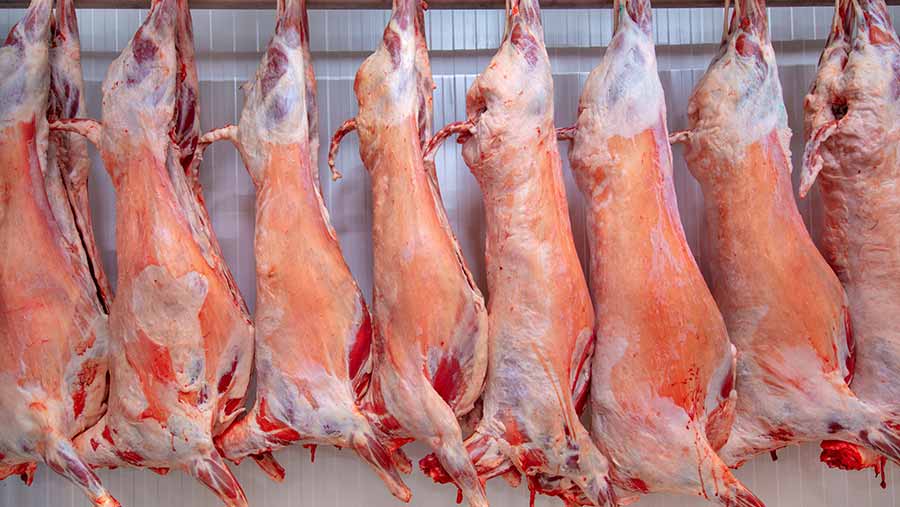 © Mehmet/Adobe Stock
 A new mandatory carcass classification and price reporting scheme for sheep is expected to launch next year in England and Wales.
The scheme would bring the sheep sector into line with beef and pork.
It is designed to offer fairer payments to producers and improve transparency in the sheepmeat market.
See also: Video: How farmer lambs 1,000 ewes inside without oral antibiotics
Animals will be uniformly classified, with payment based on a more consistent scale, according to Defra.
Industry bodies expect the scheme to launch in January 2023, although Defra cautions that as secondary legislation would be required, there is currently no fixed timetable.
Price reporting is likely to become mandatory for all abattoirs above a certain throughput.
The weighing process is also expected to be refined to the nearest 100g, instead of the nearest 500g. This should mean producers are paid more accurately and would limit carcass weights being rounded down.
A Defra spokesman said: “We intend to bring in carcass classification and price reporting for the sheep sector in line with that of the cattle and pig sectors, which is already mandatory.
“As part of our ongoing stakeholder engagement, we held an industry roundtable earlier this month to discuss our current proposals with the sector.”
The British Meat Processors Association (BMPA) is reportedly working with the relevant devolved administrations to ensure that a unified approach is offered nationwide.
The NFU has been campaigning for several years to bring sheep classification into line with other sectors and has welcomed the move to mandatory classification.
NFU chief livestock adviser John Royle said it should allow greater transparency for the industry on dressing specifications, weights and price reporting.
Mr Royle said: “The UK will be able to provide a more consistent product for the export market.
“Deadweight price reporting at the moment is done on a voluntary basis by some large abattoirs. By having all the abattoirs providing prices it will give a much better picture and will offer a better comparison between liveweight and deadweight prices.”
A Defra consultation on fairness in the supply chain was carried out in May 2018. This looked specifically at price reporting and carcass classification in the sheep sector. It found that there was strong support for bringing in mandatory classification and the use of the Europ grid.
Europ grid
The Europ grid is already commonly used for carcass classification and is likely to become the mandatory system.
Carcasses are classed based on both fat class and overall conformation.
In 2021, R3L lamb carcasses made up 31% of total throughputs in the AHDB’s lamb sample based on the Europ grid, with 60% of lambs classed as R for conformation and 51% classed as 3L for fat class. More than 60% of carcasses in the sample were between 18kg and 22kg.