

Advice on preparing for September’s SFI26 application window
 © Tim Scrivener
 The Sustainable Farming Incentive 2026 has now been opened to applications from smaller farms and those without a current ELM agreement for almost a month, following last year’s abrupt closure of the scheme and subsequent changes made to the offer.
Out of a total £240m budget confirmed for SFI26, some £60m was made available for this first window, with Defra unveiling the application process and budget allocation as simpler, fairer and more accessible.
See also: SFI26: Make the most of some ‘easy wins’, says Ceres Rural
Stressing that it is spreading the money and targeting family farms to give them greater certainty, Defra pointed out that any funding not allocated through the first window will be added to the budget for the second window, which is open to all farmers and starts in September.
The eligibility for the June window is narrow, experts claim, making the second window the key application timing for most farm businesses.
SFI26 – key changes
- Maximum funding cap of £100,000
- No increase to rotational action areas allowed
- Only one SFI26 agreement per SBI
- 71 actions available, down from 103
- Endorsed action GRH6 (species rich grassland) removed
- Payment rate decreases on legume fallow, herbal leys and winter bird food
- Unharvested cereal headland restricted to 24m
- Payments for plans and soil testing removed
- Moorland grazing payments increased
- Enhanced overwinter stubble restricted to 25%
- Zero insecticide action no longer permissible on maize
- No 5-year actions
Preparing for September
There is no official date for the opening of the September window, but it is already being predicted as a likely stampede, given the budget.
If an average SFI26 agreement has a value of £50,000, the pot allows for just 4,800 new agreements – meaning that it is unlikely to last very long.
Put another way, it will leave the RPA unable to fund more than half of the existing environmental support schemes due to end in the application period, given that there are 13,000 Countryside Stewardship agreements ending in December 2026 and 4,000 existing SFI agreements ending between September and December 2026.
With no indication of whether there will be future versions of SFI and the lack of forward projections and budgets for the next two to three years, there are understandable concerns being voiced across the industry.
Geoff Sansome, former head of agriculture at Natural England explains that the budget allocated to SFI 26 is equivalent to that of Entry Level Stewardship (ELS) when it was at its peak – which was 20 years ago.
“Growers received £60/ha when ELS was operational. When the SFI launched eight years ago, the premise was that it would be open to everyone with a rolling application window.
“Now we’ve had a very short finite first window with strict criteria and thousands of would-be applicants for the second window who are likely to fall outside of the timescales. How will they be able to apply?”
What to do now
Natalie Gaibani, head of farming at Strutt & Parker advises farmers that there are things they can do now to prepare for the September window opening.
With the budget expected to come under significant pressure, submitting applications promptly could be critical, she believes, so getting held up by administration issues can be avoided with a bit of office time.
“The first action is administration-based: check that your maps up to date on the RPA portal and that there’s nothing blocking land parcels that may be included in a new application,” she says.
This is something that farmers traditionally checked as part of their annual Basic Payment Scheme (BPS) claim, she notes.
“With BPS now gone, that routine has disappeared so unless farmers have updated their details for other reasons, they may find that their RPA records and maps are out of date.”
Common problems are digital maps showing incorrect land cover and land use for each land parcel, or maps not showing all the land parcels you want to include.
Natalie adds that these are the sort of issues which need fixing to avoid delays when it comes to submitting an SFI26 application.
“If a land parcel is incorrectly recorded as permanent grassland, for example, and you want to apply for an arable option, then the system won’t allow it.
“In the same way, land incorrectly shown as temporary grass will need the land use updating if you want to apply for the no insecticides on arable crops action.
“The land cover and land use must reflect the situation on the ground.”
Requests to add land or make changes to maps can be made online or using RLE1 form.
Other checks worth making include ensuring that the contact email address held by the RPA is up to date and the correct permissions have been assigned to your agent if you want them to resolve any outstanding errors and make the application on your behalf.
The second action is more strategic, she continues. “Decide what your purpose is with any new SFI agreement.
“Farmers need to plan for the long-term, so using the SFI to help with a permanent shift in farming methods makes sense.”
As money isn’t guaranteed beyond the current scheme, applicants should be clear about what sort of farm system they want to have in five to 10 years’ time.
“If you’re seeing a gradual erosion in yields and soils are depleted, you can’t continue like that. Having a plan will help to address some of the issues that most farms are facing.”
That plan may need to cover challenges such as coping with climate change, making changes to crop choices, managing water and integrating livestock, as well as how to develop a more regenerative and resilient farming system, she suggests.
“Unfortunately the SFI is only for three years, when farmers must think much longer term than that.
“While its short-term nature undermines strategic thinking, it’s what we have to work with and we should use it accordingly.”
Natalie accepts that the funding is unlikely to be sufficient for the number of applications expected.
“Don’t plan for next year on the assumption that you will get an SFI26 agreement,” she recommends.
On that basis, businesses need to have more than one plan – plan A for where an application is successful and plan B for where it isn’t, with a possible plan C too given recent volatility.
Plan B might include the odd field of unfunded fallow, notes Natalie, but for most farms the choice of not drilling crops isn’t an option.
“There are lower input and alternative crops available, as well as spring crops, which reduce the need for expensive inputs and allow farmers to change how they are farming.
“For most arable farms, wheat will still be a mainstay, even where premiums are very low or non-existent.”
She believes that the SFI budget allocated to the September window could go almost overnight, as there has been no guidance on how applications will be prioritised or whether there will be more funding next year.
For now, the company is assuming that it will be on a first come, first served basis.
“Defra has committed to publishing updates on how much of the budget has been allocated, so we will be alerted to when 25%, 50% and 75% has gone.”
Martin Lines, CEO of the Nature Friendly farming Network, has a similar view on the expected scramble for new agreements.
“It is highly likely that the September SFI26 window will be heavily oversubscribed and Defra needs to see this level of demand for what it is – a desire for urgent change that needs to be met with increased funding for nature-friendly solutions.
“Climate and nature breakdown pose a major threat to food and national security.”
He adds that farmers are already experiencing the impacts of increasingly volatile and extreme weather, which is affecting their livelihoods and their ability to produce food.
“The government must not let this become a lost opportunity: it must provide the investment and certainty that farmers need for a resilient, climate-proof food system.”
SFI26: Questions to ask
- Does the action fit the rotation and farming system?
- What will it cost to establish?
- What income is being foregone to do this action?
- Does it work with existing agreements?
- What are the long-term benefits of this action?
<li”>Can it be delivered with existing labour and machinery?
SFI Calculator
Strutt & Parker has developed a calculator which gives indicative costs for each of the SFI actions, so that its clients can assess the financial benefit of a new agreement.
Farmers can provide actual costs for use in the calculator, reveals Natalie, making the output relevant for their individual situation.
“Send us an idea of what you are thinking about with a new SFI agreement and we can put it through our calculator, so that any lost revenue from core farming activities becomes clear as well as any financial benefit.”
Having run a couple of scenarios through the calculator, there are already some learnings that can help to fine-tune applications, she adds.
“For a small arable farm, the calculator highlights that entering the scheme takes a lot of effort for little reward.”
For those, she suggests that the focus should be on the less productive and marginal areas, rather than ground that is serving the farm well.
“Cover crops need consideration too. Are they complementing your system or detracting from it? They can cause management issues as well as being an investment in soil health and function.”
On a larger 600ha arable farm, the financial benefit is clearer as the SFI payments help to mitigate any losses from moving to actions such as no-till and zero insecticide.
“What we’ve seen is that moving to these types of action can create issues with weed control and reduce yields, leading to a 15% drop in output. So there often is lost arable revenue which the SFI can help to offset.”
Expiring agreements
In a change to the current system, Defra has indicated that farmers with existing agreements (SFI, CS and HLS) that are due to expire soon may be able to prepare an application for the new scheme before their existing agreements expire.
Up until now, that hasn’t been possible – with SFI26 actions being incompatible with what’s already in place, so that Defra doesn’t pay twice for actions on the same land or double-fund.
Having listened to concerns, it has now announced that it is developing functionality within the application service to allow farmers to apply for land that is already covered, before their schemes expire.
As such, it should allow a seamless transition into a new scheme as the current one ends. This is expected to be in place as window 2 opens in September.
The move has been greeted with enthusiasm by the farming industry, as it will allow farm businesses to keep on delivering the environmental improvements that they are intent on doing, without disruption to cashflows and rotations.
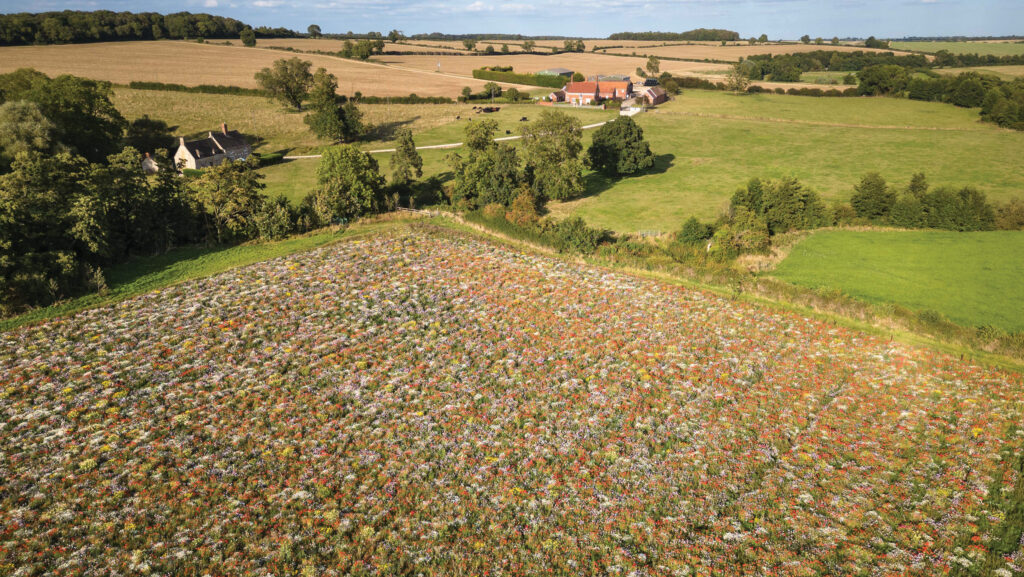
© Tim Scrivener
Case study: Smaller Farm, Nutfield Dairy, Surrey
For Matthew Elphick and Betsie Edge, tenant farmers and members of the Nature Friendly Farming Network, the Sustainable Farming Incentive is working very well on a smaller farm.
They have an SFI24 agreement, having just managed to get their application for their regenerative farm approved before the sudden cut-off last March.
“We were one of the lucky ones,” says Matthew. “It has helped to replace what we used to receive in BPS and allowed us to make plans at a very uncertain time.
“The abrupt closure of the scheme took everyone by surprise, so it’s good news for all farms that it is reopening.”
With 25 cows on 21ha, the couple process all the milk produced by the herd and sell it direct to the public, mainly through a converted milk float that operates as a mobile farm shop.
They also make cheese and yogurt and have just invested in a soft serve ice cream maker. That complements their 400l milk dispenser and display fridges containing cheese and yogurt, with many repeat customers visiting the shop every week.
“We sell almost all of our milk in this way – if there’s any left, it is used to make cheese the next day.”
The milk float is ‘open’ three times a week – Monday mornings, Wednesday afternoons and Saturdays, 10am-4pm.
The farm’s location near Redhill in Surrey means that there are plenty of consumers on their doorstep.
The SFI has validated what they were doing, he adds. Having already put the focus on soil health, they farm regeneratively and have chosen Shorthorn and Guernsey cows, both breeds which thrive on a pasture-based diet.
Input use is very low, with no bagged nitrogen fertiliser used at all. Biodiversity is thriving and the grazing cows are helping with carbon sequestration and climate change mitigation.
In terms of their SFI agreement, half of the farm is in the low input grassland action, while the other half is in herbal leys, reveals Matthew.
“They echo what we were doing already. It is disappointing to see that the payment rate for herbal leys has come down for new applicants, as they are working very well.”
He is also being rewarded for soil testing in his current agreement – but recognises that is now outside the scope of the scheme.
There are no other dairies in Surrey selling their own milk and not many micro dairies in the country, reveals Matthew.
“Having the quarterly income from SFI has been useful but it was the move to the converted milk float that was the gamechanger and made us a viable business.
”This year, they are intending to make good use of the capital grants offer to put in 1000m of hedgerows and upgrade their muck storage to include a covered yard and some concreting.
“We are now in a position where we can reinvest and develop the business,” he says. “Having certainty is really important – farming is a long-term business.”
Explore more / Transition
Follow the experiences of our 16 Transition Farmers and access in-depth supplements, expert webinars, live events and practical content covering the challenges and opportunities facing farm businesses.
Transition is an independent editorial initiative supported by our UK-wide network of partners.
Explore the Transition hub for the latest insights, resources and events.
