

Wales’ Sustainable Farming Scheme: What you need to know
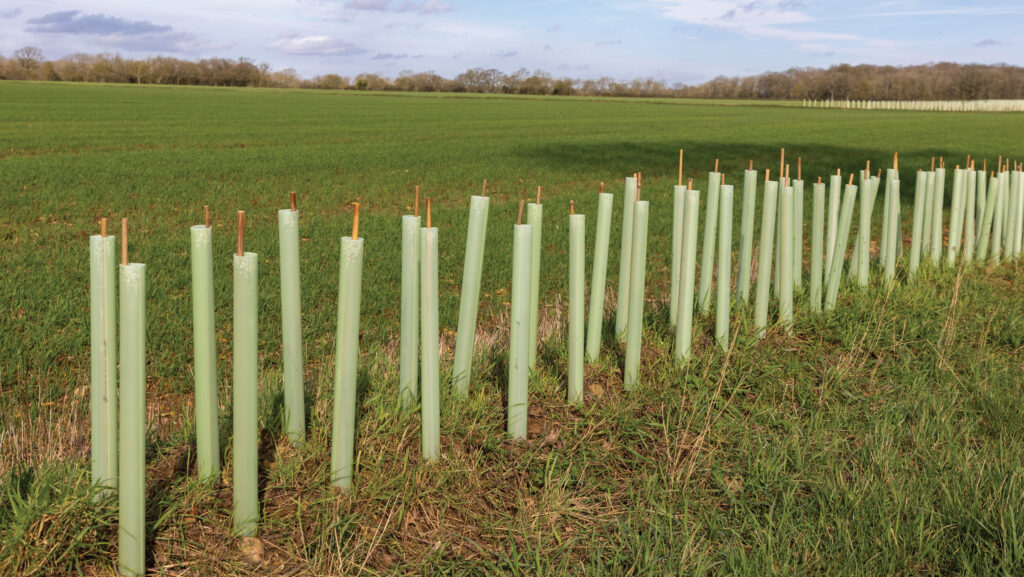 Newly planted hedge © GNP
 Spring is a busy and tiring season in agriculture as farmers juggle the demands of lambing, calving and establishing new crops.
This year, Welsh farmers have another task to shoehorn into their arduous workload – principally, a decision-making one.
It has been years in the making, indeed at times it seemed the day might never come.
But Wales’ new post-Brexit subsidy scheme for farmers is finally up and running, the application window live, and the cut-off point is fast approaching.
See also: More details of additional SFS layers revealed
The deadline date, 15 May, will be etched into farmers’ minds as the traditional, final day for submitting their Single Application Form to claim the Basic Payment Scheme (BPS).
Indeed, they can still apply for the BPS if they decide not to join the Sustainable Farming Scheme (SFS), and do so until that direct payment is phased out, but will face a 40% cut this year.
Some farmers are optimistic about joining the SFS, seeing it as a “no-brainer” for their businesses since they already meet some, if not all, of the demands on the list of actions the Welsh government expects in exchange for payments.
Payments
That tiered system allocates £70/ha on their first 70ha and the rest of the payment is capped at £2/ha, to make the budget go further.
There is other cash too, for woodland and habitat maintenance, at £62-£69/ha.
And a “social value” payment adds another £107/ha, while a one-off £1,000 “stability” payment is there for farmers farming 100ha or less.
For some, however, joining the scheme is not straightforward, with the onus on habitat provision a key sticking point.
Habitat requirement
The government insists they must actively manage at least 10% of their land as habitat, and without committing to that, they can’t join.
But some farmers say they simply can’t meet that demand as either they don’t have existing habitat or would need to cut stock numbers or crop acreage to achieve the 10%, which would effectively cut their farming income.
Wendy Jenkins, farm business consultant at Cymru Agricultural & Rural Advice (Cara), is supporting clients through the process and understands why some are fearful, particularly when it comes to the habitat requirement.
But she is more reassured since the finer details on how farms can get to that 10% were published.
When farmers apply to join the SFS, and many are doing so already since the application went live on 2 March, they must declare on that form how they plan to achieve their 10%.
Habitat can include any they already have – broad-leaf woodland in groups of more than 0.1ha counts, for instance.
If farms don’t have enough existing permanent habitat, there are alternatives that can be temporary and mostly factored into a farm’s rotation and field management fairly comfortably, Wendy advises.
“There are quite a few options which farmers shouldn’t struggle to achieve; arable growers could leave a field in winter stubble for example, that will count as habitat.”
There are a few practical choices for grassland farmers too, she adds.
“Establishing a mixed species ley for three years is on the list and that would tick off the habitat requirement for all of those three years.
“The late cut grassland could work for a lot of farmers too because it can include improved grassland – they will be allowed to fertilise it if they so wish before closing it off on 6 May until 15 July.
“That’s perhaps quite a good one for grassland farmers who might want a late cut of hay.”
Mandatory actions
There are 12 mandatory actions in total, including the habitat requirement, that the Welsh government expects in exchange for handing over cash to every farmer who joins the SFS.
Wendy sees most as not being too onerous, and she points out that many farmers are in fact already doing a number of the actions identified anyway, particularly if they are farm assured.
“The soil testing requirement, for example, is fairly standard, and if farmers aren’t already doing it, then it would be a good thing for them to do anyway.”
Even some of the actions on that list of 12 that farmers might not otherwise have considered are achievable without too much extra work, she thinks.
“The government wants farmers to complete six hours of training a year and a health and safety course, but these are all online and free,” she says.
Farmers will have a choice too, accredited courses that Farming Connect will run on topics such as animal health will count towards those six hours.
Benchmarking – a common feature in farm businesses and one that is proven to lift efficiency and therefore profitability – is another expectation.
But a new tool, Farmdata Plus, should make that easy to do, Wendy adds.
“All farmers must do is to input some figures into that app, choose key performance indicators [KPIs] like scanning percentage – sheep farmers will know that figure off the top of their heads anyway.
“The data will only need to be an input, farmers won’t be judged on it.
“The government isn’t insisting farmers make annual improvements to those figures, it’s just there to encourage them to do some benchmarking.”
Hedgerows and trees
The two options that consultants say are causing their clients the most concern are hedgerow management and tree planting.
Instead of cutting hedges annually, the government says farmers must limit it to every two years.
But it is allowing several exceptions, for hedges that border roads, footpaths and cow tracks for example, or if farmers need to do some ditch clearing.
After significant pressure from the industry, the government watered down its ambition on tree planting, to a requirement for every farmer to plant 250 trees by 2028, whatever the size of the farm.
However, some see that as unfair because whether a farmer has 10ha or 1,000ha, the same number applies.
There is an opportunity for farmers to build on the basic payments in two layers.
But even though the scheme is live there is still little detail on these and no mention of the payment rates – the government has promised to share that with farmers this summer.
All that is known is that money in the layer known as “Optional” will be directed towards enhanced habitat management and enhancing some of the other options in the entry-level “Universal” layer.
Unknowns
Strategically, does it therefore make sense to hold fire on some previously planned farming operations, which might feature in this layer, until the actions and payment rates are unveiled?
“If a farmer is planning to create habitat to qualify for the ‘Universal’ payments, by using the herbal ley option for example, they don’t need to do more than is necessary to get to the 10% for now, and use the ‘Optional’ layer to increase payments should they so choose,” says Wendy.
Other unknowns are the actions and payment rates in the third, “Collaborative” tier, which is intended to get groups of farmers working together, on supply chain projects perhaps, trialling more innovative approaches.
Like Scotland, Wales is ambitious to lower the age of slaughter of beef cattle, therefore innovations around that might feature on the Welsh government’s radar for this layer.
While the SFS still has many detractors, what is undeniable is that the final iteration has come a very long way since the first consultations in 2019 on what was then known as Brexit and Our Land and Sustainable Farming and Our Land, which barely mentioned food and farming.
Transition Farmer: Irwel Jones
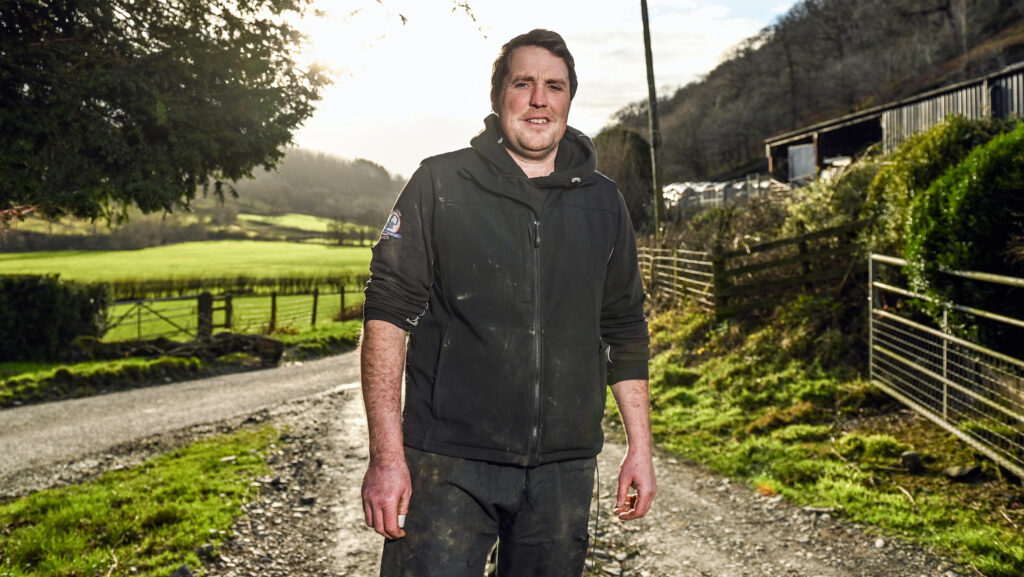
Irwel Jones © Richard Swingler
With a freshly lambed flock to manage and land that needs attention after a wet and challenging six months, Transition Farmer Irwel Jones has yet to take a deep dive into the Sustainable Farming Scheme.
From what he has picked up so far though, there is no question of him not signing up.
“Joining is pretty much a no-brainer for us as we have a lot of existing habitat already, and I’m hoping that the ‘Optional’ and ‘Collaborative’ elements will suit us, too.”
A source of frustration for Irwel though is that, theoretically, he is adhering to the rules of a scheme that the business won’t sign up to until May, and with some uncertainty maybe around the rules and payment rates.
This is because Wales goes to the polls on 7 May for the Senedd election and there is no assurance on who will form the next Welsh government.
“The rules and payment rates may change again,” Irwel worries.
He is comfortable with the detail laid out in the scheme so far as the “Universal” actions work for him.
“I haven’t really got a problem with these actions as most of it is just good practice, we would be working towards these anyway.” Irwel’s one concern is corroborating those 12 actions.
“I worry that evidencing may be onerous and time consuming and will lead to a proportion of the money intended for farmers being diverted to consultants.”
While the payments are important for his business, there is perhaps good reason why he has spent very little time considering the nuts and bolts of the scheme.
“I have instead been trying to focus on getting our costs on the actual farming side of things down so that we are not as dependent on government payments going forward.”
Explore more / Transition
During the series we follow our group of 16 Transition Farmers through the challenges and opportunities as they seek to improve their farm businesses.
Transition is an independent editorial initiative supported by our UK-wide network of partners, who have made it possible to bring you this series.
Visit the Transition content hub to find out more.
