

Tiered farm support in Scotland: How the system works
 © iStockphoto
 EU-era subsidies in Scotland have been replaced with a four-tier system intended to deliver food security, support rural livelihoods, and tackle the climate and nature crises.
Under the umbrella of the Agriculture and Rural Communities (Scotland) Act 2024, the country’s agricultural subsidy system is experiencing the most significant reform since Brexit.
See also: Crop Watch: South lacks rain as disease bites in Scotland
A cautious path to reform
Compared to other UK nations, though – notably England, where critics suggest that transition measures such as the abrupt withdrawal of the Basic Payment Scheme (BPS) are forcing farming off a “cliff edge” – the transition package is seen as less radical.
Farmers will still receive 70% of funding through direct payments although they must now do more for climate and nature through enhanced greening measures and the new calving interval conditionality for the Scottish Suckler Beef Support Scheme.
A desire to maintain stability is a reason given by the government for not deviating further from the historic Common Agricultural Policy (CAP) system.
Others suggest that a pro-independence government is keen to stick closer to a system that could align easily with the current CAP should Scotland one day rejoin the EU as an independent country.
Pressure to go further
Nim Kibbler, country manager for Scotland at the Nature Friendly Farming Network (NFFN), says that sending farmers off a cliff-edge in terms of support is not in anyone’s best interest.
However, she believes there is a case for going further. We need something that farmers can work at, and for some of the direct support to drop away, she says.
“We are not saying farmers should have to climb a mountain, but there has to be a policy that suits all farmers, not just those with the greatest lobbying power.”
Nim worries that Scottish policy is perhaps being designed to suit farmers who are the most opposed to change.
“Sometimes we think the loudest voices in the room are the majority but there are a lot of middle- and third-tier farmers who are just getting on with it.”
One of the difficulties in Scotland is the broad cross-section of agriculture types, some exceptionally fragile.
While transition in Scotland is not as radical as in England, moving away from a system that has offered financial stability for a generation is unquestionably difficult.
Yet, as Nim points out: “For some farmers this change will be tough but surely the statement ‘but we have always done it this way’ is the most costly a farmer could apply to their business?”
Some farmers are in the transition process, others are almost through it after spending years working towards it.
“Other people are flirting with the idea but it is scary, there is risk involved, and sometimes doing nothing can feel that there is no risk involved,” says Nim.
“What I don’t want to see in Scotland is people not changing their farming practices until they either hit full financial crisis or they have some sort of succession change on the farm.”
How the four-tier system works
The Scottish government framework falls into four tiers:
- Tier 1 entitles all farmers to a baseline payment if they meet basic environmental and animal welfare standards; at £399m, this is where most of the budget for Scottish agricultural support sits – in 2030 it will reduce to £332m
- Tier 2 rewards farmers for adopting greener and more ambitious practices, such as reducing tillage, protecting soils, and creating wildlife habitats; the new government has allocated £142m a year to this tier
- Tier 3 builds on the existing Agri-Environment Climate Scheme (AECS) by funding targeted environmental projects under longer-term agreements
- Tier 4 offers training, advice, and support networks to help farmers build knowledge, share best practice, and collaborate through local clusters.
Whole Farm Plans and compliance
All farmers with more than 3ha and are actively farming are eligible to join Tier 1.
An active farmer test will be introduced in a bid to move away from the 2005 conditionality baselines used historically.
To qualify for payment, all farmers must by now have a Whole Farm Plan in place. This plan must incorporate measures that meet the Scottish government’s aims for the way land is farmed.
These measures include: integrated pest management (IPM), animal health and welfare, biodiversity audit and a habitat map, soil health and management plan and a carbon audit.
© Alamy
Farmers who have found those requirements the most difficult are crofters whose systems have constraints and practices that differ from the majority.
For example, it might cost £600- £1,000 for soil testing but, depending on the size of the croft and in-bye land, a crofter might only qualify for an annual basic payment of £2,000.
Losing that £2,000 by not entering the scheme is not an option either because for some crofters that sum can equate to their annual fuel bill.
Tier 2 is also a direct payment but with enhanced greening that rewards farmers for going beyond base efficiency to lower emissions or protect nature.
Tier 3 is an indirect payment with nature and climate undertakings and payments for measures such as managing habitat for wading birds and conservation grazing.
A number of grants sit within Tier 3, for operational outputs but also capital grants under the Farming Future Investment Scheme.
The budget for those grants stood at £32m when the scheme was rolled out in 2025 with 100% payments but that is expected to reduce to £21m and farmers will only receive a proportion of their costs in grant funding.
Under those capital grants, some farmers were given money to pay for water infrastructure after dividing fields into smaller paddocks to apply mob grazing techniques.
There is also a Scottish Small Producers Grant for systems under 3ha – one grant of £33,000 was awarded to an organic producer in Dumfries and Galloway to meet the cost of a mobile butchery unit.
The EFA controversy
Tier 4, labelled as “complementary”, is targeted at delivering training and advice. Probably the most contentious aspect of the scheme overall is Ecological Focus Areas (EFAs) which require farmers to devote 5% of their land to an ecological purpose.
Some farmers won’t need to change their practices to comply with the EFA requirements – they are already meeting its objectives – but the government reckons it will introduce nature management on about 2,300 businesses who aren’t.
What has been controversial is the recent removal of certain exemptions – previously mixed or livestock farms that had more than 75% temporary grass or forage were exempt from EFA requirements but that exemption has now been withdrawn.
Any farm with more than 15ha of arable land which includes grasslands must now have EFA measures on 5% of their land.
They will have to pivot their practices to receive the base payment as financially it is not an option for them to not have an EFA and forego the payment.
The sudden withdrawal of the exemption and the pressure on farms that have maximised output to change practices has without doubt been challenging.
Calls for greater flexibility
According to NFU Scotland it has affected a number of farming businesses, particularly in areas such as Orkney and on mixed and dairy farms where temporary grassland forms an important part of the farming system.
Many of the EFA options were originally designed with arable businesses in mind, meaning there are fewer practical choices available for farmers whose businesses are based largely around temporary grassland, says Jonnie Hall, NFU Scotland’s deputy CEO and director of policy.
This has been especially challenging for some businesses already managing land under agri-environment schemes, where the options available can become increasingly limited.
NFU Scotland has consistently argued that environmental requirements should be designed in a way that supports profitable farming businesses.
Farmers and crofters are already delivering significant benefits for biodiversity, climate and soil health through their day-to-day farming activities, Jonnie maintains, and future support schemes should recognise and build on that existing good practice.
“While we recognise that environmental measures will continue to form an important part of future agricultural support, they must be practical, flexible and work alongside food production rather than unnecessarily restricting it.
“Our view has always been that support should reward agricultural activities that deliver environmental outcomes, rather than requiring measures that remove productive land from use where there is little practical benefit.”
Farmers affected by the change have adapted in several ways, by altering rotations, identifying alternative EFA options and reviewing how different areas of land are managed to meet the requirements.
However, there could be additional costs, complexity and administrative burden associated with these changes, particularly for businesses that have limited options available to them.
As the Scottish government develops future EFA proposals, including those relating to permanent grassland, Jonnie insists it will be important that the practical experience of farmers affected by these changes should help inform policy development.
“Scotland’s farming systems are incredibly diverse, and future schemes must reflect that reality,” he says.
“We want to see future EFA measures recognise existing good practice, protect the productive capacity of farmland, provide maximum flexibility for businesses and minimise unnecessary bureaucracy.
“Ultimately, any future requirements must be fair, workable and support profitable farming businesses, because profitable farms are the foundation for delivering food production, environmental outcomes and thriving rural communities.”
Nature-friendly farming and productivity
Nim believes that transitioning to more nature-friendly farming practices will in time be beneficial to the output on those farms.
“By taking out inorganic fertilisers, pesticides and other inputs, production might fall off for a couple of years but once soil health and the biodiversity around it has recovered the ecosystem services will start to kick back in and supply these for free.
“It might be difficult for farms that have historically used a lot of inputs to recognise this because, to them, those inputs are solutions but farmers just need to trust in the process.”
Case study: Alan Steven, Hillhead Farm, Fife
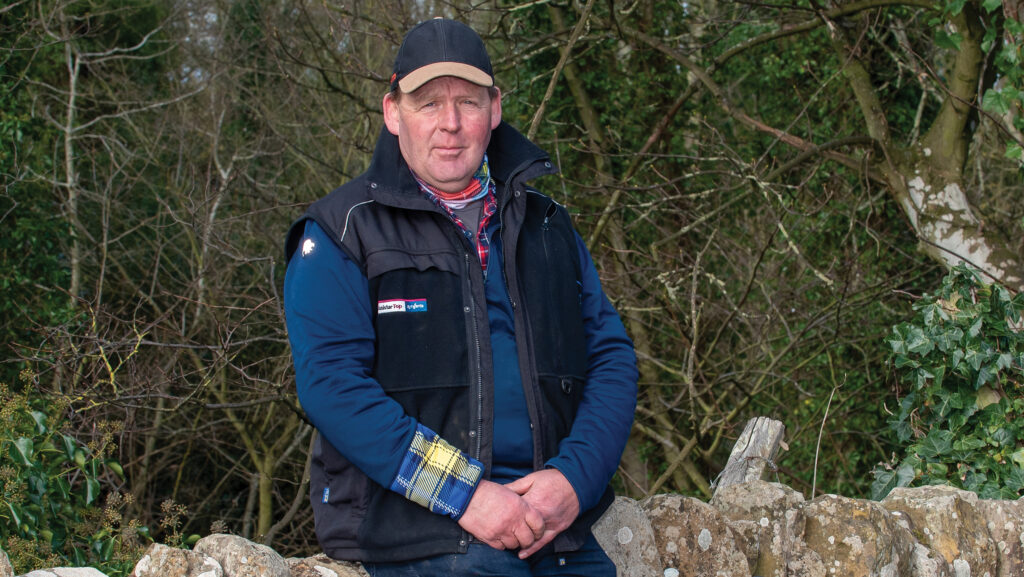
Combinable crops and vegetable grower Alan Steven sees his EFA as an incentive to improve soil health and structure.
At Hillhead Farm near St Andrews, Fife, he sows cover crops on EFA land as winter grazing for a neighbouring sheep farmer.
© Angus Findlay
Changes to the rules which now permit more grasses to be grown in the cover crop mix will allow for a more flexible grazing window, says Alan.
“There are certain fields where we can build fertility and with the sheep grazing the land their dung is providing us with organic matter.
“We don’t get a big income from the grazing but as long as we are getting something back that covers the cost of the seed and a bit more on top it works for us because of the goods it brings to the soil.”
The longer grazing period now permitted is beneficial too, Alan adds.
“We don’t want to graze too quickly because the crop and root structure need to develop, the longer window for that gives us more flexibility, it suits our system.
“We used to be more restricted on when we could graze and sometimes it wasn’t the best option, for example if the weather had turned wet and to get the grazing out of it we might have ended up destroying some of the benefits to soil structure the cover crop had provided.”
Environmental Focus Area changes
In 2027 the EFA requirement will increase to 7%, an incremental shift upwards which many in the industry predict could eventually rise to a ceiling of 10%.
To get on the front foot in preparation for that uplift, some farmers have already ringfenced 7%.
Lewis Butlin, rural consultancy technical manager at Agrovista, says notice of the 2% augmentation of EFAs had helped farmers with upfront planning, including those previously protected by the temporary grassland exemption.
The two new options of herb- and legume-rich pasture and low-input grassland have helped – if half a field accounted for 5% of their land they have instead sown the entire field with one of these leys in readiness for next year’s changes.
“Some arable farms have rejigged things slightly – where they have established buffer strips they have made sure there is enough there to make them up to 7% next year because if they are getting specialist seed mixes or equipment in they have decided to get the job done without having to revisit it again,” says Lewis.
The new options have mostly helped farmers achieve their EFA target. “I haven’t come across anyone who has struggled this year,” says Lewis.
“For the farmers who suddenly found themselves in the caveat of needing an EFA, where they have got livestock as well as arable they have looked at the catch crop option.
“For example, where they are growing spring barley they will sow an overwinter cover crop that they can graze off with the livestock and will then establish an arable crop or grassland next year.”
© iStockphoto
For dairy farms that have temporary grass in their rotation alongside brassicas and some crops – farms that had been affected by the removal of the EFA exemption – the legume and herb-rich pasture is an obvious choice, as it has allowed them to maintain a similar cropping.
It remains to be seen what further options are introduced in subsequent years.
Two years ago the Scottish government released 35 proposed options, many of which looked very similar to those that sit in England’s Sustainable Farming Incentive (SFI), perhaps an indication of the further EFA possibilities that will become available in the coming years.
This potential blueprint of things to come is likely to have been delayed because of uncertainty that historically existed over funding for agriculture from Westminster.
Last year marked a shift away from the system of the setting of an annual budget by the UK government to a three-year allocation.
It means there are two more years of guaranteed cash from Westminster, taking Scotland through to 2028.
Lewis believes that in 2028 more changes will be introduced, to Whole Farm Plans for example.
“There are five options available for these and there is talk of a sixth one coming in on nutrient management planning in 2028, in that year all soils will need to be sampled too, I think 2028 will be the pivotal change.”
Explore more / Transition
During the series we follow our group of 16 Transition Farmers through the challenges and opportunities as they seek to improve their farm businesses.
Transition is an independent editorial initiative supported by our UK-wide network of partners, who have made it possible to bring you this series.
Visit the Transition content hub to find out more.
