

Transition Farmer: Tough year forces green targets rethink
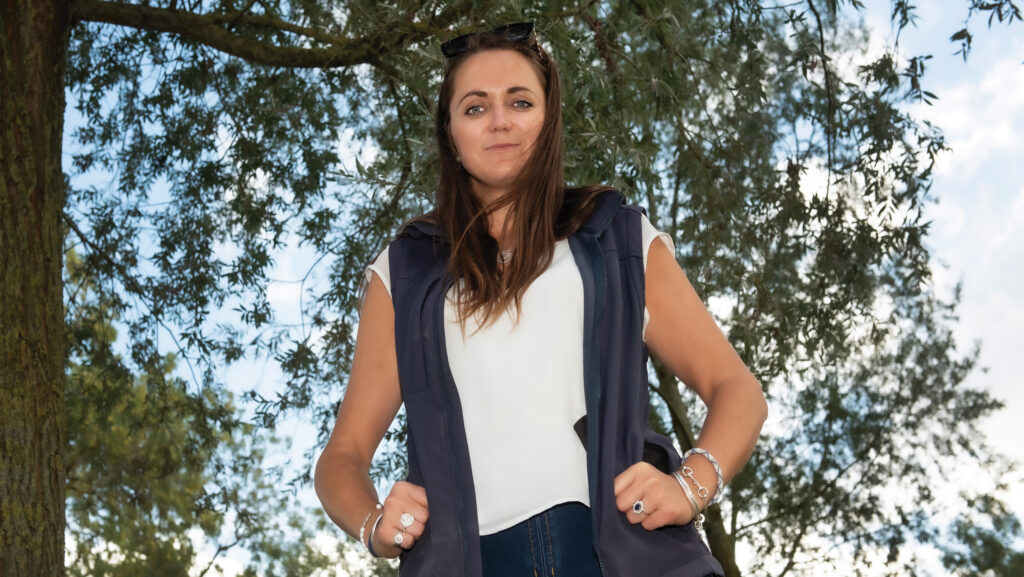 Beth Speakman © Phil Weedon
Our Farmers Weekly Transition farmers are striving to secure a better future for their businesses.
In Essex, the Speakmans are scrutinising their environmental objectives as farming profitability declines.
We catch up with Beth Speakman on progress towards the farm’s transition goals.
See also: All updates from Beth Speakman
Farm facts
Little Braxted Hall Farm, Essex
- Size 275ha
- Rainfall 610mm
- Soil Light gravel
Economic reality is forcing the Speakman family to scale back their environmental ambitions. After a tough year for the farm’s combinable cereal crops, they are rowing back on their timescales for environmental objectives.
“Farming is less financially viable at present, with low commodity prices and high input costs, so it is hard to justify spending money on trying to reduce our carbon footprint when we are not breaking even,” says Beth Speakman, who farms with her father, Kit, at Little Braxted Hall Farm, Witham, Essex.
See also: Easy harvest mostly disappointing for Arable Insights farmers
With their Countryside Stewardship (CS) agreements coming to an end in December 2026 followed by two Sustainable Farming Incentive (SFI) contracts terminating in 2027, they are pinning their hopes on securing an agreement in the latest round of SFI funding.
In September they applied for a low-input cereal option to grow more spring barley to derisk that enterprise – the payment of £354/ha is the equivalent of income received from over 2t/ha of spring barley at current prices, Beth calculates.
“Spring cereals are quite a challenging prospect if droughts become more frequent, but the opportunity to have guaranteed income from the SFI makes it worth the risk for us.
“We don’t farm on amazing fen land capable of yielding 12t/ha; ours is light, gravelly land, so for us a low-input cereal is a way of guaranteeing an income.”
In the past 12 months she has planted an additional 1.2ha of willows to extend the existing plantations of willows grown to produce cricket bats. This is grown on marshland that would otherwise have little value beyond grazing sheep. The next ambition is to increase the area of grassland used for seed production – the extent of that expansion depends on the contract that can be secured.
“That might have to be a decision for our 2027-28 cropping plan, as it is already set for 2026-27, but grass for seed is the most profitable arable crop we currently grow, with willow being our most lucrative overall,” says Beth.
For the beef enterprise, the strong performance captured in 2025 has persisted through 2026, but straw and feed cost pressures could affect profit. She is hoping to secure a straw-for-muck agreement to reduce the cost of winter bedding.
“We produce muck throughout the year and although we spread it on farm, we could reduce what we use to get straw at a decent price.”
Transition goal progress
- Bridging the income gap after stewardship
- Creating an integrated farm business
- Increasing grass and widening the rotation
Explore more / Transition
Follow the experiences of our 16 Transition Farmers and access in-depth supplements, expert webinars, live events and practical content covering the challenges and opportunities facing farm businesses.
Transition is an independent editorial initiative supported by our UK-wide network of partners.
Explore the Transition hub for the latest insights, resources and events.
