

2014 Farmers Weekly Awards Sheep finalists revealed
All three of this year’s Farmers Weekly Sheep Farmer of the Year finalists are working with the younger generation to ensure a vibrant and sustainable industry for the future.
They share strong visions for their respective businesses and collaborate with the wider industry to drive performance.
Martin Greenfield
Norton Barn Farm, Warwickshire
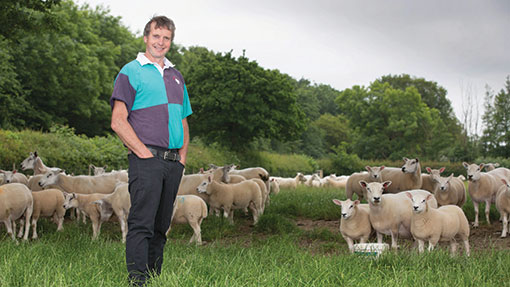
Warwickshire farmer Martin Greenfield is championing locally produced lamb.
Limited expansion opportunities meant Martin decided to develop a direct-selling outlet as a means of adding value to his produce, almost six years ago.
“There’s quite a lot of dairy herds [in the area] and anaerobic digesters are taking up some land now as well, so you’ve got to pay £300/acre to compete,” he explains.
Instead, he wanted to ensure as much of the retail price as possible came back to the farmgate and as a result started selling lamb at farmers’ markets.
Since then, sales have gone from strength to strength and the family has converted a small barn on the farm into a state-of-the-art butchering facility, with an estimated payback period of three years.
About four lambs are killed every week, although this rises to 10 during peak season. These are sold direct to customers from the farm and through a website.
But traditional, face-to-face selling remains a crucial part of the business.
Farm facts
- 1,000 Texel-cross Mule ewes
- Land totals 102ha, of which 73ha is farmed on a traditional tenancy and a further 29ha is rented
- Has an on-farm butchery and sells meat direct to the public
“We started doing Ashby and Bosworth farmers’ markets six years ago and we now sell between six and seven lambs there twice a month.
“We start selling at 9am and by 11am we’ve usually sold out.” Martin says this is testament to the quality of his produce.
Approximately 300 lambs are sold under the Greenfield banner each year. A further 500 are sold to local butchers and the remaining 1,000 are sold live at Newark and Melton Mowbray markets, where they regularly achieve top prices.
Direct selling
Martin says the secret to success when supplying customers direct is ensuring a quality, consistent product at a reasonable price.
As a result, the flock of 1,000 Texel-cross Mule ewes lamb in three blocks, starting with 240 in February, followed by 400 in March and the remainder in April.
This allows him to sell lamb year-round and avoid any major peaks and troughs in annual income.
This year’s lamb crop had an average scanning percentage of 200, and Martin aims to maximise the flock’s output.
Genetics
Good-quality genetics is the crux of his system and rams are bought from the Coton flock of Texels – a maedi visna-accredited flock.
“I look for a small head and something not too big across the shoulders so the ewes are easy to lamb.”
Sourcing from one flock reduces disease risks and all bought-in stock is quarantined and treated for scab. Martin trusts the breeder he buys from and believes this helps to produce a consistent product.
Meanwhile, replacement ewes are bought from Thame Market, Oxfordshire.
“For the past two years we kept our own ewe lambs to minimise disease risks, but they were too pure,” admits Martin. As a result, he is reverting back to sourcing replacements to ensure he has a suitable level of hybrid vigour within the flock.
“The ewes are producing just the type of lambs I want. They are a hardy, prolific, milky maternal dam, which requires a low level of concentrate,” he explains. He says he would ideally like to source replacements from a single source and build the same kind of partnership he has with his ram supplier.
Grassland
Good grassland is the bedrock of the enterprise and the aim is to finish all lambs off forage to keep feed costs low. This also serves as a fantastic selling point for his lamb.
Grassland is on a five-year grass-arable rotation and leys are made up of a mix of high-sugar grasses, red and white clover and chicory. Martin has been pivotal in setting up a grazing club in the area and hopes it will help him make more from grass, particularly in a year such as this when growth has been unprecedented.
From November through to October hoggets are outwintered on stubble turnips, which Martin says intensifies the flavour of the meat. He is also seeking advice on grassland management from Eblex and is actively looking to improve utilisation rates and animal performance.
Future
In the next two to five years Martin hopes to set up a farm shop to be run by his 16-year-old son Ben, who is already a skilled butcher.
“I would like to put at least half of the lamb crop through the butchery to lift the top-end margin and I’m hopeful a farm shop will maximise our retail sales and increase our profits,” he adds.
Martin also hopes to increase consumers’ appetite for Greenfield lamb on a global sale, with the ambition of getting his product on to plates in top-end restaurants in London and Paris.
John Harrison
Lowther Park Farms, Penrith
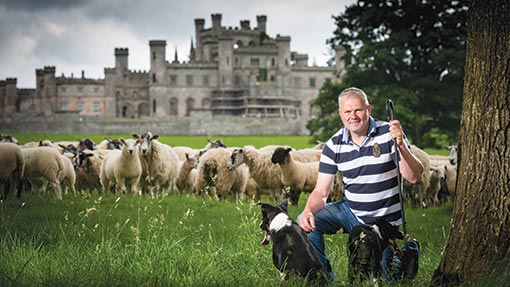
Since joining Lowther Park Farms as flock manager almost six years ago, John Harrison has transformed the sheep enterprise into a profitable business, increasing turnover by 20%.
Key to his success has been an overhaul of the breeding policy at the 1,400ha estate.
Previously the estate ran a flock of 3,000 Lleyn ewes, but in the past five years these have been gradually replaced with 5,200 North of England Mules.
“They were poor Lleyns. They had been crossed with a Scottish Blackface and we were getting poor results from the lambs sold.
“It was going to take us years to update them,” John explains, so instead the decision was taken to switch to Mule ewes.
Choice of breed was driven by the Mule’s reputation for longevity and the aim is to get five crops of lambs out of each ewe.
Production costs
Despite the fact sheep numbers have grown dramatically, costs have been reduced from £50 a ewe to £19.40 a ewe.
Integral to this is collaboration with tenant farms on the estate. Surplus muck is imported from tenanted dairy farms on the estate, which has helped reduce fertiliser costs, saving £30,000/year. In addition, breeding ewes are sent to dairy farms at tupping to increase lamb prolificacy.
Grassland is reseeded every three to four years with high-quality ryegrass and clover mixes and as a result of improved grassland productivity, stocking rates have been increased from 1.5 ewes an acre to 2.5 ewes an acre – grossing an additional £100/acre.
Farm facts
- Running a commercial flock of 5,200 Mule ewes, put to Suffolk- and Texel-cross Beltex rams, across 1,400ha
- Net profit equates to £14 a ewe
- Under an HLS/ELS agreement
Breeding
Ewes are mated to Suffolk- and Beltex-cross Charollais tups at a ratio of 30:1, which helps keep the lambing period tight. This year the majority of the flock lambed during a five-week period, starting in April.
“Suffolk tups go in for 14 days in September and are lifted after 14 days. Then Texel- and Beltex-cross tups go in,” explains John.
Labour costs are directed at lambing time, when the workforce ramps up from three to 14 to cope with the sheer number of ewes lambing indoors. And it is this attention to detail at lambing that is helping to boost performance.
This year scanning results averaged 192% – the highest to date.
“Between scanning and turnout, our mortality rate was less than 3%,” he says.
Lambs are weaned at the end of July or early August and about 80% are finished off grass and sold deadweight to Dunbia at more than 40kg. Last year’s crop net price was £65.55 a head.
Health is paramount and John works closely with his sheep vet to develop a solid flock health plan.
Ewes are vaccinated against abortion and for clostridial disease and pasteurella three weeks prior to lambing. Faecal egg counts are used as a tool to determine treatment for nematodirus, worms and fluke.
As if the flock at Lowther doesn’t keep him busy enough, John also runs a 70ha part-owned, part-tenanted farm, producing 225 high-value pedigree Swaledale ewes and tups.
“We keep it simple and easy. Everything is lambed outdoors early in April,” he explains.
Every year 140 ewes are sold direct off farm to one buyer, which is testament to the quality of the progeny. And John has sold rams up to £19,000.
Despite his passion for traditional sheep breeds, John is a progressive, modern farmer and is unafraid to embrace new technology and adapt to meet new challenges.
At Lowther they have just installed electronic ID recording and are about to start recording individual ewe performance and lamb growth rates.
But undoubtedly, one of John’s biggest assets is his leadership and vision for the future.
At lambing, staff have meals together every evening, which John says helps build team morale and work ethic. The two young shepherds, Anthony and Peter, are also encouraged to take charge of elements of the enterprise to give them a sense of responsibility, and John fully supports industry-led training days and courses.
“To get the best out of people you have to work as a team. I believe communication is one of the most important ways of motivating staff and inclusion is crucial.”
John Scott
Fearn Farm, Ross-shire
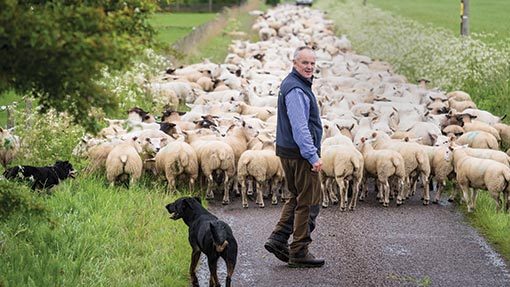
Scottish sheep farmer John Scott is a strong believer in grabbing opportunities when you can. This philosophy has seen his business grow rapidly in the past 22 months, with acreage doubling and the flock expanding threefold.
But despite rapid expansion, John has kept a close eye on performance. “We expanded massively in the autumn of 2012. I believe I’m a custodian for the next generation. It is my turn at the moment to lead the family farm just like my dad and his before.”
Mr Scott is determined to give his children the best start in life possible, which means a profitable business to inherit.
The flock now comprises 3,700 Cheviot and cross-bred ewes, run across the three units. The best ewes from a 1,300-strong breeding flock of Cheviots are put to a Cheviot ram and the rest are mated to Aberfield rams, which were recently introduced.
Meanwhile, ewes from the cross-bred flock of 1,200 ewes at the home farm are mated to terminal sires, along with the third flock of 1,200 Cheviots.
Farm facts
- Farming a total of 1,581ha – 410ha owned, 1,050ha rented, and a further 121ha on a five-year short limited-duration tenancy
- Part of the SRDP agri-environmental scheme
- Breeds and sells pedigree rams
Performance
Lambs at the home farm are creep-fed from the first seven days after birth and are sold at 20kg deadweight through Woodhead Brothers. Last year fat lambs averaged £4.08/kg.
“At the other two farms we monitor the lamb market and some will go prime, some store,” he explains.
This year’s average scanning percentage was 158%, but this is something John is determined to improve through better breeding.
“The Hill Cheviot is renowned for not being very prolific, but if we select for prolificacy we can soon lift it,” explains John.
As well as the commercial flock, John has a pedigree flock of Texel and embryo-transfer (ET) New Zealand Suffolks. Aberfield embryos were also implanted into commercial ewes in the autumn of 2013 and their performance is being monitored to see what they can add to the range of genetics offered by the ram breeding operation.
Pedigree sales
Pedigree stock is performance recorded, and 90% of the Texel shearling rams sold last year had indices in the top 5% of the breed.
Rams are maedi visna-accredited and sold through one on-farm ram sale, where 49 rams averaged 628gns last year.
“Until two years ago, all rams were sold at various auction centres throughout the country, but we spent a lot of money on feed, fuel and dressing sheep.”
Instead, the focus has switched to producing fit-for-purpose rams from forage. “We gave it the title ‘Great from Grass’ as we had no intention of feeding or dressing our rams,” he explains.
Given the farm’s remote location, a large part of its success has been a willingness to embrace social media as a tool for marketing stock.
Renewable energy
Sustainability is not only a key feature in the sheep flock. At the home farm John has a small-scale wind enterprise consisting of two 20kW turbines. The electricity produced is sold to the owner of a neighbouring cold potato store.
John says staff remains his biggest asset. “To get bigger and make a good job [of the business] I rely on a good team and give them the skills to push the business forward.
“The biggest challenge is our own mindset. Our thought process has become maximising our subsidy instead of maximising profit from farming.”
This is something John is determined to change and as a board member of Quality Meat Scotland and chair of the Scottish Sheep Industry Group, he is striving to encourage a sustainable sheep sector.
He also believes it is paramount to promote farming to the wider public, and this year the family featured on the hit BBC programme Lambing Live.
Looking ahead he believes grassland management, on his own farm and within the wider industry, could be improved to help streamline production costs.
Sponsor’s message
 “All three finalists are passionate about sheep farming and are educating and inspiring the younger generation to deliver a sustainable enterprise for generations to come”
Marcus Sanders
Trade marketing manager
Find out more about the 2014 Farmers Weekly Awards