

Advice on suckler cow checks after summer stresses
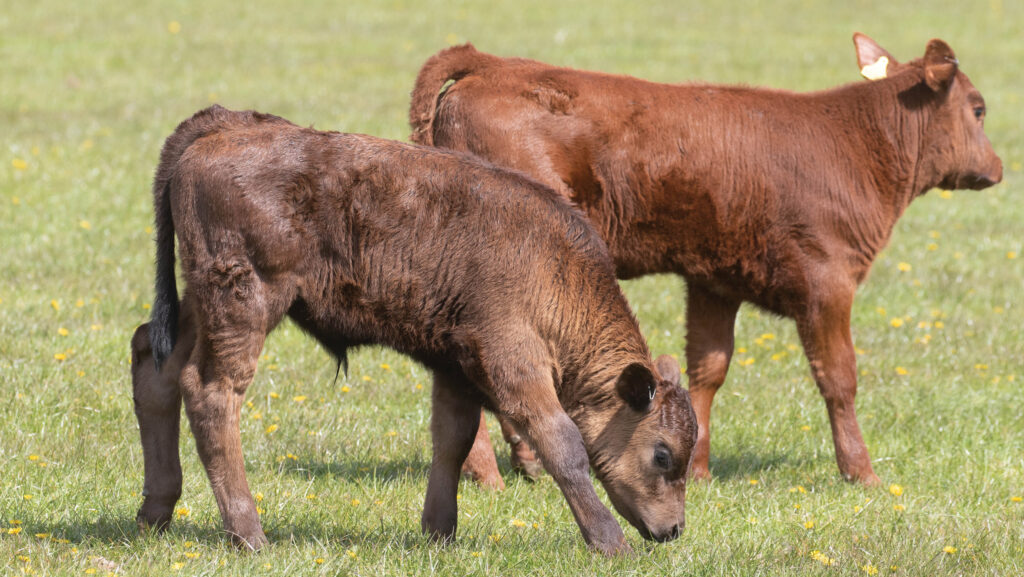 © Tim Scrivener
 Spring-calving suckler herds are advised to bring pregnancy checks forward this year and condition score cows at the same time.
After the challenges of heatwaves, drought, poor grass growth and bluetongue, there could be more empty cows and leaner animals this autumn.
See also: Causes of calving caesareans and how to reduce interventions
Determining pregnancies four to six weeks after the bulls come out and being able to identify cows for preferential management will pay dividends next spring, says Colin Mason, a consultant vet with Ruminant Revival.
He thinks September/October is the ideal time to start altering cow condition gradually, rather than making sudden dramatic change in the lead up to calving.
He advises focusing on the most vulnerable animals: lean cows and first and second calvers.
“There is potential this year for more cows to be empty, or calving later in the block, caused by heat stress, nutritional issues or bluetongue.
“Waiting to PD [pregnancy-diagnose] until November or December means you can do nothing about it, except cull empty cows,” he explains.
“With an earlier PD, you can also identify twins earlier and manage condition between now and calving – these cows [risk losing] weight growing two calves.”
Optimal performance
Target condition scores are 3 to 3.5 at housing in late October, with in-calf cows ideally losing no more than 0.5 score between then and calving.
Overall cow performance is better when condition is steadily maintained throughout the year, says Colin, instead of swinging between extremes.
Management to radically alter condition can have metabolic consequences for the cow and possibly affect early foetal development, as well as the quality of placenta formed, he adds.
“By New Year’s Day, a cow should be in the body condition score that she needs for calving, which is 2.5 to 3,” he says.
“An SRUC [Scotland’s Rural College] study of 3,000 cattle in farm systems in Scotland and northern England, however, showed just 35% were on target at housing and only 46% were on target six weeks before calving.”
Management options
Although an early pregnancy check may not coincide with routine handling and housing, Colin points out the benefits are more time and more options to tackle problems.
These range from weaning lean cows earlier, to reducing stocking rate to eke out supplies, supplementing pasture or culling poor performers sooner.
If cows are still thin at housing, Colin says that although there are still five months before calving, weight gain needs to occur before Christmas.
“If you assess condition in January for a 1 April calving, and cows are lean or obese, you have to radically gain or lose weight.
“At that stage, it creates problems as it’s too late. Consider it in October and you can do something about it.”
How condition score affects calving
Thin cows – below score 2.5 – have bigger problems at calving because they lack energy to calve.
The calf is less viable, colostrum quality is poorer and the cow’s own immunity is poorer, explains Colin Mason, a vet consultant with Ruminant Revival.
Scoring using the AHDB/SRUC/QMS scale of 1 to 5, where one unit of body condition score is equivalent to 13% in bodyweight, he points out that for a 700kg cow “that’s 90kg of weight”.
Cows at 3.5 to 4 are probably OK, but Colin says such animals need not be so fat – they are not efficient converters of feed and it’s a waste of resources.
Extremely fat cows – scoring more than 4.5 – are more likely to have calf viability problems and end up with dramatic weight loss post-calving as they quickly lose 1 score.
“Fat cows have fat deposition in the birth canal, and it makes a narrower, harder space to get a calf out.
“The cow is more prone to metabolic problems, with a drop in calcium mobilisation, which lowers her ability to push the calf out.”
It is possible that perfect autumn conditions will grow enough grass to put condition on thin cows cost-effectively from an extended grazing season on many farms.
Without it, supplementing will be necessary, and therefore Colin also suggests housing sooner to feed according to body condition.
Group cows for preferential treatment
He suggests objectively scoring cows then considering how many stable winter groups (to avoid moving cows and causing stress) can be housed, as well as how many different rations can be fed.
Where it’s not possible to easily run cows into handling, checking condition by eye will suffice.
“Even a good herd will have a spread in scores; the aim is to identify the more extreme outliers.
“Can you split cows into lean, perfect and fatter? Most farms could do at least two groups and preferentially feed them,” he says.
At the very least, thin cows can be put into a separate group with first and second calvers, which are more subordinate and still growing, so need extra care.
This group needs quantity and good quality of silage with the correct energy and protein levels to gain weight.
This is why it is essential to get silage analysed and take professional nutritional advice to target feed accordingly.
“You can’t know what effect silage will have on cows [without analysis].
“For example, if you feed good-quality silage ad-lib, [some] cows will gain too much weight,” says Colin, adding that feed access is also crucial.
“If you use ring feeders, a boss cow will be fat as butter, as she keeps the others away.
“On dairy farms, they allow 70cm a cow at the feed fence – use that as a minimum guide for beef cows.
“[When assessing feed space,] remember that in a suckler herd, there is a bigger age range, from two years to 10 years, so there will be some quite dominant cows.”
Cows in correct body condition produce more vigorous calves
Research by Scotland’s Rural College studied the impact of body condition in pregnant beef cows for calf welfare and lifetime productivity.
Conclusions
- Avoiding obesity, excessive leanness or large changes in condition over pregnancy produces more vigorous calves that grow faster
- Obesity during early stages of pregnancy is likely to be damaging, particularly if followed by substantial condition loss as pregnancy progresses
Results
- Cows that were lean in mid-pregnancy had calves that were 7% more vigorous at birth than calves of other cows
- Cows that were lean in late pregnancy had calves that were 7% less vigorous
- Cows that lost more than 0.5 condition points between mid- and late pregnancy had calves that were 5% smaller at birth and 13% smaller than calves from cows that gained more than 0.5 points
- Calf weight gain to weaning was about 1.5% better if the dam had stayed within 0.5 condition points between mid- and late pregnancy
Method
- 2,366 cows were condition scored at housing (mid-pregnancy) and again in early spring (late pregnancy)
- 21 farms with calf outcome data
- Located in Scotland and northern England
- Herds ranged in size from 36 to 348 cows
Source: Turner SP, Rutherford KMD, Donbavand JE and Jack MC (2021).