

FW Awards: Meet the 2026 Beef Farmer of the Year finalists
 2026 Beef Farmer of the Year finalists Luke Hawes (representing the Hawes family) Peter Lowe and Graham Parks © Oli Lees and Lee Boswell Photography
 This year’s finalists are maximising self-sufficiency and lowering costs by growing as much home-grown feed as possible.
See also: FW Awards 2026: Meet the finalists
Finalists
- Hawes Farms, Meads Farms, Aylesbury, Buckinghamshire
- Peter Lowe, Manor House Farm, Market Drayton, Shropshire
- Graham Parks, Overbank Farm, Macclesfield, Cheshire
The judges
- Gavin Hill – Gavin is a senior beef specialist at Scotland’s Rural College, with more than 30 years’ experience in consulting.
- Jonathan Chapman – Last year’s winner from Cornwall runs 210 pedigree Aberdeen Angus suckler cows, focused on low inputs and forage.
- Rhian Price – Freelance journalist and former FW livestock editor Rhian is also a partner in her family’s South Wales farm.
Hawes Farms, Meads Farms, Aylesbury, Buckinghamshire
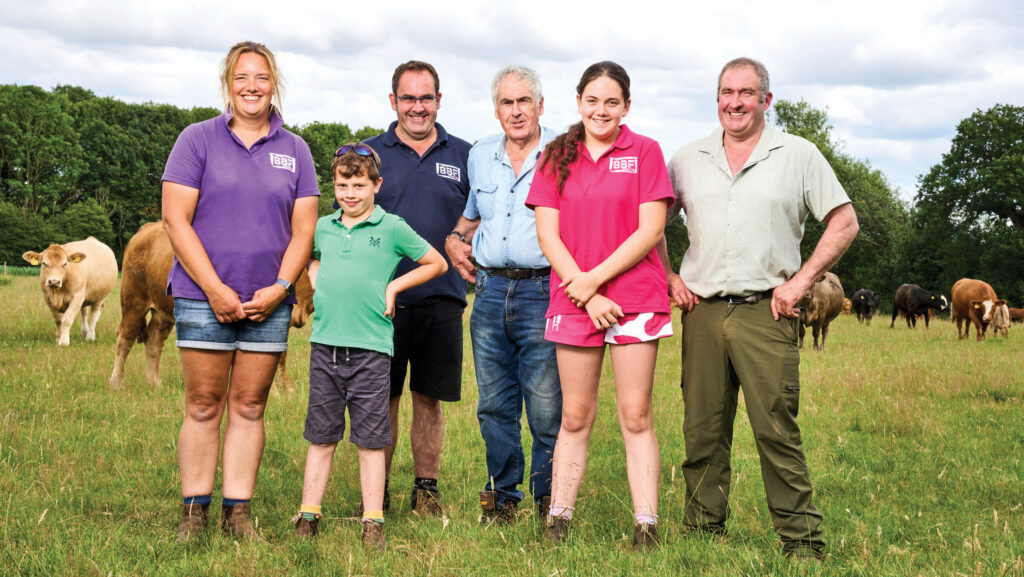
The Hawes family © Oli Lees
Investing in feed-efficient, fertile genetics and producing as much home-grown feed as possible have helped the Hawes family create a profitable beef enterprise at their Buckinghamshire farm.
Suckler cows have been at the heart of the Hawes family’s farm since Peter established the business 67 years ago. While the herd has evolved over the decades, the family’s focus has remained unchanged: breeding easy-calving and efficient suckler cattle that produce fast-growing finishing animals.
Farming is a family affair with Peter’s sons, Luke and Julian, and Luke’s wife, Claire, all partners in the business and sharing the workload. In 2014, they switched from using Simmental and British Blue-cross cows to Stabiliser genetics, and say they “haven’t looked back”.
About the herd
The closed herd is now almost entirely purebred Stabiliser, comprising 230 spring-calving cows.
Replacement heifers start calving in February over a nine-week period, followed by the main herd in March, with cows calving over 12 weeks. Bulls are sourced through the Stabiliser Society, with sires selected from the top 1% for profit index. This combines 15 economically important traits into a single breeding value.
The best home-bred heifers are retained as replacements, with the remainder finished for beef. A strict culling policy is improving cow efficiency. They have been culling older cows hard, resulting in a replacement rate of 17%. Animals are removed for bad udders, poor feet and mobility, bad temperament, or once they reach 10 years of age.
Maintaining herd health is a priority. The family operate a closed herd and adhere to a comprehensive vaccination plan. Routine screening is conducted for Johne’s disease, and animals that test positive are promptly culled.
Cattle management
The herd calves indoors, and calves are turned outside with their dams from March. Summer grazing is carried out predominantly on permanent pasture. Much of this is low-input, rented land across five holdings, secured on rolling annual agreements.
Herbal leys, grass and peas and beans are grown as part of the arable rotation, as break crops and to improve soil structure. In addition to fixing nitrogen, the peas and beans are crimped and fed to the finishing cattle, helping reduce purchased feed costs and improve overall self-sufficiency.
Typically, two cuts of high-quality clamp silage are taken before a third cut is baled. Last year’s first cut analysed at 35% dry matter (DM), metabolisable energy of 10.9MJ/kg DM and 14% crude protein.
Calves are weaned in November at about eight months of age. Last year, heifers averaged 327kg and bulls 360kg at weaning.
Where ground conditions allow, some cows remain at grass until Christmas, with the remainder wintered on hay and straw.
About one month before weaning, calves are fed creep comprising home-grown rolled wheat and oats. Bulls are then introduced to a growing ration with 50% grass silage. This is lowered to 40% with increased inclusion of cereal and moist feeds during the final four to five months.
Meanwhile, heifers graze for a second season before being finished at 18-20 months on a high-forage, low-starch and high-protein ration.
Purchased feeds consist of co-products such as biscuit meal and brewers’ grains sourced within 50 miles of the farm.
Finished cattle are sold to Morrisons through Woodheads, averaging 411kg deadweight and achieving target specifications of U4L.
Future
Once the herd is fully purebred, the Hawes hope to add value by marketing pedigree breeding stock alongside their commercial beef enterprise.
The numbers
6% barren rate in 2025
100% calving rate in 2026
1.8kg – liveweight of bulls from birth to slaughter
12 weeks calving period for cows
Farm facts
- Farming 300ha (121ha owned, the rest rented)
- 230 spring-calving Stabiliser suckler cows
- Growing oats, spring wheat, spring barley, peas and beans for crimping alongside grass
- Finishing bulls aged 12-13 months and heifers at 18-20 months following their second grazing season
- Supplying Woodheads/Morrisons
The judges liked
- Maximising genetics to breed a very productive suckler herd, achieving a tight calving and a 100% calving rate
- Strict breeding criteria to produce very docile cattle
- Excellent herd of Stabiliser cows
- Fantastic stockmanship
- Using estimated breeding values to produce highly efficient progeny
What the judges say
The Hawes are using high-growth sires and maternal genetics to produce progeny that finish quickly on largely home-grown feed. They are an excellent example of a profitable, mixed family farm.
Peter Lowe, Manor House Farm, Market Drayton, Shropshire
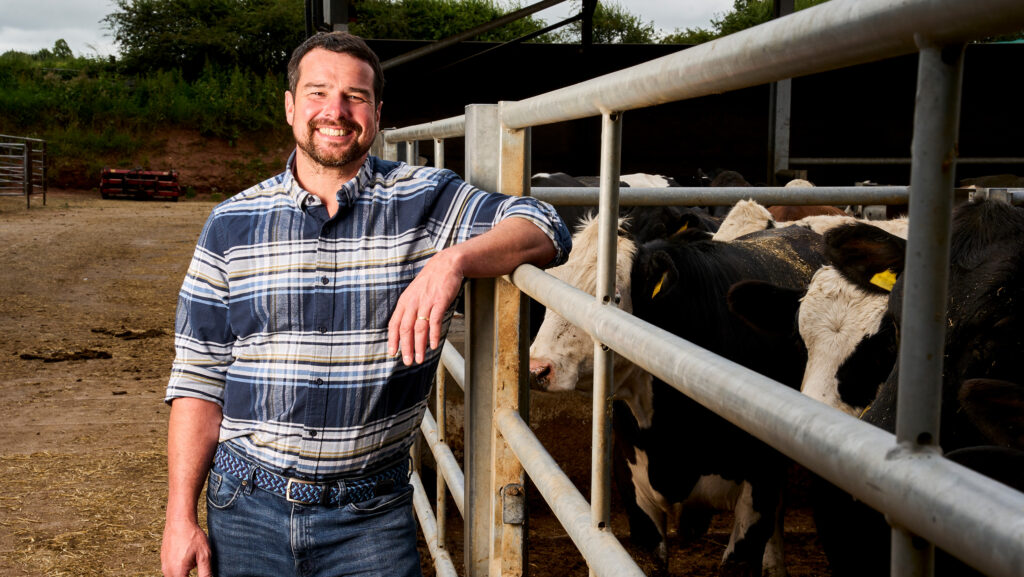
Peter Lowe © Oli Lees
Former chartered surveyor Peter Lowe has built a resilient store-to-finish beef enterprise through disciplined cost control.
He began his farming career on a 20ha county council holding in Staffordshire. He credits the experience with “making him” and teaching him the importance of keeping a close eye on costs.
Having relocated to Manor Farm, his wife’s family farm near Market Drayton, the business has evolved from calf rearing and lambing 200 ewes into a streamlined cattle-finishing enterprise focused on labour efficiency. Peter is constantly thinking outside the box to maximise margins while planning for the future.
About the business
He is currently increasing cattle numbers while finishing 2,000–3,000 store lambs annually. He farms more than 243ha, most of it rented from neighbouring estates on annual agreements.
Being surrounded by dairy farms, competition for land is fierce, but much of the available ground is low-input or in environmental schemes, making it less attractive to milk producers. Peter has turned this to his advantage by managing grazing and adhering to strict scheme rules in return for competitive rents.
Summer grazing costs about 70p a head a day, providing a cost-effective way to add weight to smaller animals. Surplus hay is often exchanged for straw, and some cattle are outwintered on turnips to reduce winter housing costs.
About half of the finishing ration is home grown. Straw, cereals and peas and beans are purchased from Peter’s father-in-law’s arable enterprise, with the remainder supplemented with by-products from the food industry.
The arable enterprise runs a rotation of winter barley, stubble turnips, spring barley, peas and beans before returning to winter barley. Minimum tillage has been practised for more than 12 years to protect soil structure.
Cattle management
Store cattle are sourced mainly through local markets, with some bought directly from farms. Lighter cattle weighing 350-450 kg graze through the summer, while heavier animals (more than 450 kg) head straight into finishing sheds. These are fed ad-lib silage and wholecrop peas and barley, alongside a cereal mix. This comprises biscuit meal, rolled barley, rolled wheat, molasses and minerals. The ration’s crude protein averages 14%.
Cattle are weighed on arrival and every month thereafter, with performance recorded on spreadsheets to monitor performance and buying decisions. Peter targets a finishing period of 90-120 days and aims to achieve a £500 margin between purchase and sale.
Purpose-built sheds maximise airflow and reduce the risk of pneumonia, helping to keep mortality below 1%.
The system has been designed to be as labour-efficient as possible. Bedding and feeding are carried out on alternate days, allowing daily tasks to be completed in just 1.5-2 hours. One employee has recently been taken on to work across the beef, sheep and arable enterprise, for which Peter does most of the contracting.
“The beef and sheep enterprises complement each other. As cattle move out of sheds in the autumn and grazing cattle come inside, it frees up cash to buy store lambs, which we run from February through to April. Then, more store cattle are purchased in the spring for grazing once lambs are sold,” he says.
Future
Peter plans to increase throughput to 1,200 finished cattle a year and hopes to secure TB-approved finishing unit status to reduce disease risk. “There’s no real financial reward, but it gives you peace of mind that you can continue trading if you do have a TB breakdown.”
The numbers
- £2.50 – feed costs a finished animal a day
- 70p – summer grazing costs a head a day
- <1% mortality from arrival to finish
- £500 – target margin for each finished animal
Farm facts
- Farms more than 243ha, with 23ha owned and the remainder rented, mainly on annual agreements
- Selling about 50 cattle monthly to ABP, Shrewsbury
- Buys store cattle and finishes them within 90-120 days
- Finishing 2,000-3,000 store lambs annually
- 35kW solar panels and heat pumps
The judges liked
- Incredibly resilient, can-do attitude
- Business growth – starting on a small county council holding, Peter is now farming more than 243ha
- Established strong relationships with landlords
- Highly labour-efficient system, running 1-2 labour units
- Simple, cost-effective cattle-finishing enterprise
- Forward-thinking business with clear goals for the future
What the judges say
Peter’s determination and ability to adapt have created an efficient business with a clear direction for the future. He has grown the business from small beginnings by seeking opportunities others might overlook.
Graham Parks, Overbank Farm, Macclesfield, Cheshire
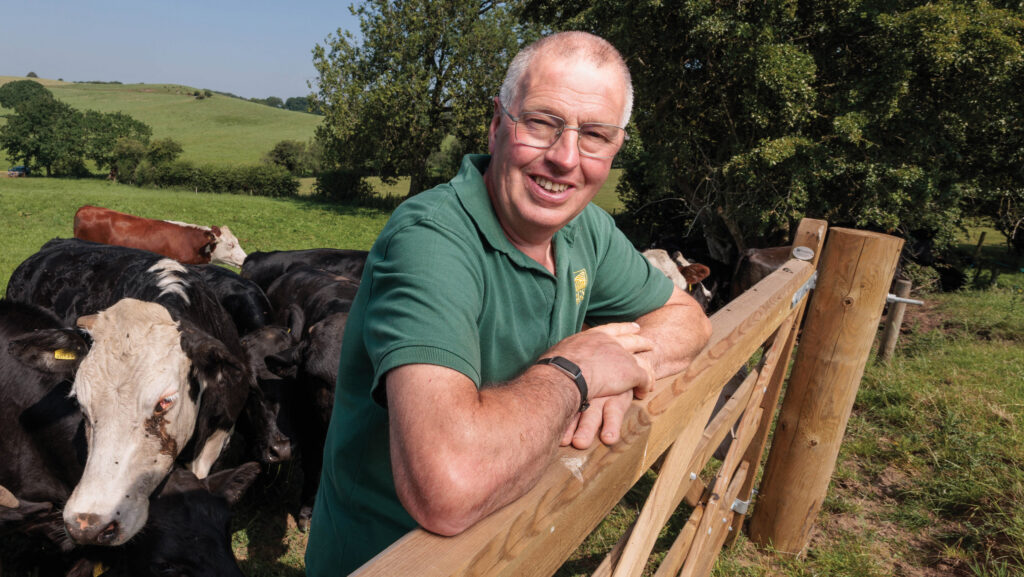
Graham Parks © Lee Boswell Photography
Tenant farmer Graham Parks is achieving enviable output from each hectare by running a simple and low-cost dairy-beef enterprise. The foundation stones of the business are built on good grassland management, which helps keep input costs to a minimum.
Graham formerly worked on a spring-calving dairy farm and has transferred the skills mastered there to his own beef farm. He originally began farming on a 20ha county council farm nearby before securing a farm business tenancy at Overbank Farm.
He has developed a close relationship with a dairy farmer from whom he sources all his calves each year.
About the system
Each year, 250 calves are sourced from North Wales. These are bred from Jersey-cross dairy cows and sired by Aberdeen Angus and Hereford bulls. The native breeds thrive on forage and are finished on a diet of 95% forage and grass. A small, strategic amount of concentrate is fed to ensure cattle are finished by 28 months.
Calves are bought over a six-week period aged seven to 14 days. On arrival, they are grouped in batches of 35-40 calves and fed milk replacer using a 50-teat milk buggy. They are fed twice daily for six weeks, then weaned over two weeks, during which they are fed once daily. Alongside this, they are offered ad-lib concentrate and are weaned weighing, on average, 75kg, having gained about 35kg.
Once weaned, calves are split into two groups and transition to grass. During their first summer, they are fed about 1kg of pellets a head a day using a quad bike and snacker.
Grassland management
Cattle graze rotationally for eight months of the year from 1 March until the end of October, which helps keep labour and input costs to a minimum. In fact, the farm is largely operated by Graham alone. He runs a leader-follower system to help manage pasture quality, with the older animals following calves and grazing to residuals of 1,500kg of dry matter/ha on two- to three-day breaks.
The farm’s sandy-loam soils are prone to burning off during the summer. To counter this, Graham has been establishing more herbal leys under the Sustainable Farming Incentive. And the upside of having lighter soils is that some cattle can be outwintered.
Each year, the poorest pasture is earmarked for reseeding. This is used to grow deferred grass for rising two-year-old bullocks, supplemented with big bale silage. Meanwhile, heifers are housed on a self-feed silage system.
The calves are split into batches by weight, with the smallest receiving 0.75kg of concentrates alongside high-quality silage. All silage is made from surplus grass on the grazing platform. This is typically taken after the first round and is of high quality, analysing with metabolisable energy of 11.5-12MJ/kg dry matter and 15-16% crude protein.
The aim is to finish cattle during their third season at grass. After turnout, heifers will be fed 1kg of concentrate and bullocks 2kg, with the aim of selling everything before housing on 31 October.
About two-thirds of the cattle are sold to Grassroots Farming for a regenerative premium, and the remainder are sold to Dunbia. Typically, bullocks and heifers kill out at 52%, weighing 299kg deadweight on average, and hit grades and fat classes of 0/R and +3 and +4L. This is no mean feat, given they are born averaging 30kg from Jersey-cross cows.
Future
With limited time left on his tenancy, Graham has a clear plan and is moving the business to a 16ha block of owned land plus rented ground.
The numbers
- 450kg – total concentrates fed to each animal
- 35kg milk powder consumed by each calf
- 170kg fertiliser applied a hectare
- 12t of grass grown annually for the past two years
Farm facts
- 760-head of native-cross dairy beef, sourced directly from one dairy farm
- Finishing 250 annually, aged 27-28 months
- Farming 117ha, part owned, part tenanted
- All grassland, growing some herbal leys under environmental schemes
- Supplying Dunbia and Grassroots Farming for a regenerative premium
The judges liked
- Running a simple system and making the most of what he has
- Extremely low input costs, only buying a strategic amount of concentrate
- High output of beef to the hectare
- Excellent grassland management
- Clear plan for when his tenancy ends
What the judges say
Graham has built a resilient dairy-beef enterprise by adopting dairy-grazing principles and building a strong relationship with his calf vendor. He is maximising environmental schemes and has total control over inputs.
A word from our sponsor

“We’re thrilled to sponsor the Farmers Weekly Awards again this year. It’s wonderful to see some of the best talent, dedication and attention to detail driving our industry forward. Good luck to all the finalists!”
Phil Hambling, director of agriculture and sustainable sourcing