NADIS Cattle & Sheep Health Bulletin – October 2007
Bluetongue in cattle and sheep
Phil Scott DVM&S, DipECBHM, CertCHP, DSHP, FRCVS
Bluetongue is a notifiable disease in the UK and suspected cases must be reported immediately to the local Animal Health Office.
The geographic distribution of bluetongue is dependent upon the Culicoides (midge) host and was restricted to African continent. Bluetongue is now also widespread within the USA, and occasionally outbreaks are reported in southern Europe following introduction from Africa.
In August 2006, bluetongue was diagnosed for the first time in sheep and cattle in the Netherlands but had been present undetected in Belgium and Germany several weeks earlier. Bluetongue virus was introduced into Suffolk in September 2007 presumably following transport of midges in air currents from continental Europe.
During summer months with temperatures in the southern England sufficient to support the Culicoides vector this disease may become a major problem.
Economic importance
Bluetongue virus infection has an enormous impact on sheep production in many countries on the African continent and elsewhere. Losses result primarily from mortality, reduced production during protracted convalescence including poor wool growth, and reduced reproductive performance including temporary ram infertility. The average mortality rate for sheep in the Netherlands during 2006 was 5 per cent in the flocks affected. Bluetongue virus has been identified in Australia but is not associated with overt disease in sheep.
It is very difficult to predict the likely economic impact of bluetongue on the UK livestock industry. While bluetongue cannot be transmitted to humans, food scares with temporary slump in demand would be inevitable.
Clinical signs
A veterinary surgeon must be contacted by the farmer where sheep or cattle present with lameness, high rectal temperatures, salivation, lacrimation and ocular and nasal discharges. Sheep and deer can also be affected. Bluetongue is a notifiable disease in the UK.
Sheep
The clinical signs, which vary depending upon viral strain and sheep breed, follow an incubation period of four to 12 days. Usually, only a small percentage of sheep develop clinical signs. In extensively managed flocks, unexplained sudden deaths may be the first evidence of disease. Affected sheep are pyrexic (up to 42.0C) and appear stiff and reluctant to move. They often adopt a roached back stance with the neck extended and the head held lowered (fig 1). There is oedema (swelling) of the face and ears (fig 2), and also pulmonary oedema which may cause dyspnoea (breathing difficulty). Erosions may appear on the lips progressing to ulcers (fig 2). There is often profuse salivation, and a serous to mucopurulent nasal discharge. There may be hyperaemia (reddening) of the coronary band, (fig 3) and around the muzzle and mouth.
The tongue may become swollen. Bluetongue infection during the breeding season may result in a large percentage of early embryonic losses with sheep returning to oestrus at irregular intervals.
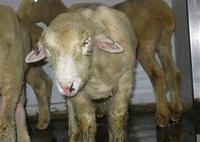 | 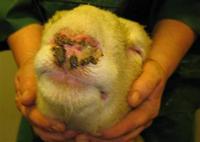 | |
| Fig 1: Early clinical case of BTV showing depressed appearance (photo courtesy UKVET) | Fig 2: Facial oedema and nasal excoriation of BTV infected sheep (photo courtesy UKVET) |
The most important differential diagnosis is foot and mouth disease but here a larger percentage of the flock may be affected with high temperatures, and mouth and foot lesions. Orf is easily distinguished from bluetongue. Clostridial disease such as bighead may cause sick sheep with swollen heads and high temperatures but only unvaccinated sheep and few sheep are affected.
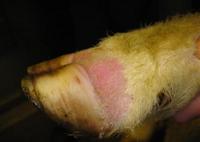
Cattle Fig 3: Typical foot lesion found in BTV infected sheep involving coronitis and inflammation of the whole claw region but no formation of blisters. Foot is hot to the touch (photo courtesy UKVET)
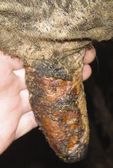
Affected cattle are febrile (up to 40.0 C) and appear stiff due to swelling of the coronary band at the top of the hooves (Fig 4)
and are very reluctant to move.
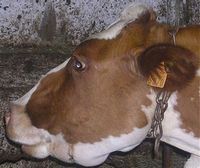
There is a serous to mucopurulent nasal discharge and erosions on the muzzle (fig 5) with sloughing of the mucosa. There is lacrimation but no obvious eye lesions.
Once again, the most important differential diagnosis is foot and mouth disease where there is profuse salivation, lameness and high rectal temperatures rapidly spreading to affect all cattle on the premises.
The important differential diagnoses are infectious bovine rhinotracheitis (group or herd) and malignant catarrhal fever in individual cattle.
Welfare implications
Mortality and protracted convalescence with susceptibility to secondary bacterial infections raise welfare concerns Diagnosis and treatment Diagnosis is based upon clinical signs, virus isolation and/or seroconversion to bluetongue virus.
Treatment is limited to antibiotic therapy to control secondary bacterial infections.
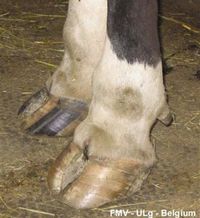 | 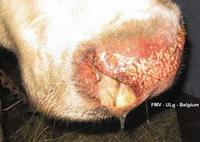 | |
Fig 4: Affected cattle are febrile (up to 40.0 C) and appear stiff due to swelling of the coronary band at the top of the hooves | Fig 5: There is a serous to mucopurulent nasal discharge extending to erosions on the muzzle with sloughing of the mucosa |
Fig 6: There is lacrimation but no obvious eye lesions Fig 7: Oral erosions are present in some cattle
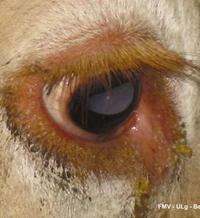
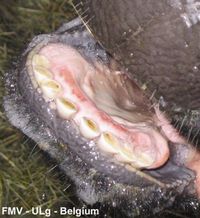
Fig 8: There is oedema (swelling) of the face. Fig 9: Extensive teat erosions may develop in some cattle
Control and prevention
Control of bluetongue is very difficult because of the large number of potential hosts and virus serotypes. While control is aimed at keeping susceptible animals away from the vector this is not always practical. Control of the Culicoides vector can be attempted with pour-on insecticides but this is expensive and does not achieve total freedom from the midge.
Vaccines are used extensively worldwide but not presently with the EU. Most modified live vaccines produce a viraemia in the vaccinated animal which affords the opportunity for further spread. Problems may arise with viral reassortment if viraemic animals are vaccinated with a modified live vaccine. The timing of vaccination will depend upon local factors, in particular the occurrence of high risk periods. In certain areas, lambing time may be changed such that waning of passively-derived antibody does not coincide with Culicoides activity.
The UK has adopted a slaughter policy for bluetongue at present (September 2007). Strict biosecurity and quarantine of all cattle and sheep brought on to a farm are essential for many diseases including bluetongue.
For the latest information on Bluetongue please visit www.defra.gov.uk