

Scottish beef scheme faces 400-day calving rule
 © Tim Scrivener
Scottish ministers have announced plans to tighten calving-interval requirements under the Scottish Suckler Beef Support Scheme, with an implemented reduction from 410 to 400 days set to apply in 2028 and 2029, subject to legislation.
The announcement, made by Scottish farming minister Jim Fairlie at NFU Scotland’s autumn conference in Edinburgh on Thursday 29 October, prompted concern from producers.
Some questioned whether sufficient evidence had been gathered before a decision was taken to tighten the rules, particularly following drought conditions and uncertainty over the impact of bluetongue on cattle fertility.
See also: Changes to Scots’ suckler beef scheme ‘damaging’ say auctioneers
The current Scottish Suckler Beef Support Scheme threshold is 410 days, introduced from 2025, with a derogation for businesses claiming 10 calves or fewer. The 410-day calving interval will remain the same in 2027.
NFU Scotland president Andrew Connon warned ministers against jeopardising recent signs of recovery in beef suckler herd numbers.
“We don’t want to extinguish that flicker of growth,” he said, calling for the science to be examined and the industry to be properly consulted.
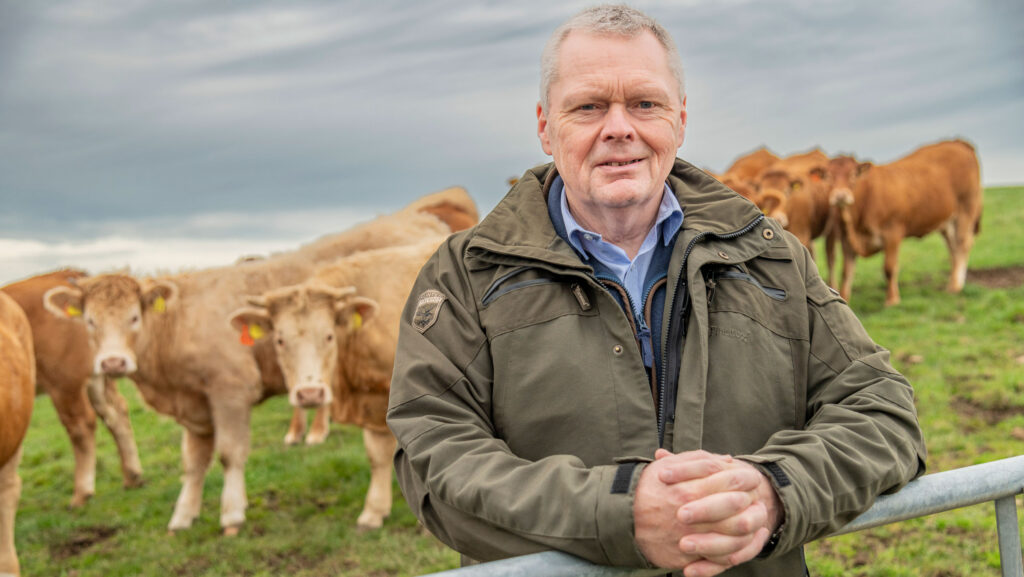
NFU Scotland president Andrew Connon © NFU Scotland
Mr Fairlie acknowledged that the decision would not be popular with some producers, but was informed by analysis from Scotland’s Rural College, which showed a correlation between calving intervals and carbon emissions reductions.
He argued that demonstrating progress on agricultural emissions was essential to defending continued direct support for the sector.
The Scottish government had rejected advice from the Climate Change Committee that would have required policies to actively reduce cattle and sheep numbers by as much as 26% by 2035, but Mr Fairlie said farmers must help deliver emissions reductions in return for that decision.
He said improvements in feed conversion and genetics would also contribute to reducing emissions, adding that the government would review the effects of the calving interval changes over the next few years.
Exceptional circumstances could still be considered through force majeure provisions, he added.
Ag transition update
NFU Scotland’s conference also heard that significant changes to agricultural support are expected by 2030, with funding increasingly directed towards active farmers who produce food and care for the environment.
Mr Fairlie said a policy development group was examining how existing funds could be redirected towards active farming businesses, but ruled out major changes to the current system before 2030.
“Come 2030 there will be some significant changes to who gets money and who doesn’t,” he said.
Cabinet secretary for climate action and rural affairs Gillian Martin MSP said the government wanted to provide greater certainty through Scotland’s agricultural transition, with a familiar payment structure retained while farmers prepared for reform.
The four-tier framework is expected to include baseline standards, enhanced support for sustainable and regenerative farming practices, and additional payments for elective environmental activities.
More than 70% of agricultural support in Scotland currently comes through direct payments, and Ms Martin insisted that, unlike south of the Border, Scotland would maintain that model.
Budget plea
Andrew Connon also called on the Scottish government to increase the agricultural budget from about £677m to £860m, arguing that inflation had significantly eroded the purchasing power of farm support.
He warned that rising input costs, pressure on farmgate margins and uncertainty over future policy were undermining businesses’ ability to invest.
The Scottish Budget is due to be delivered in the Scottish Parliament on 3 December.