

Advice as drought pressures dairy forage stocks
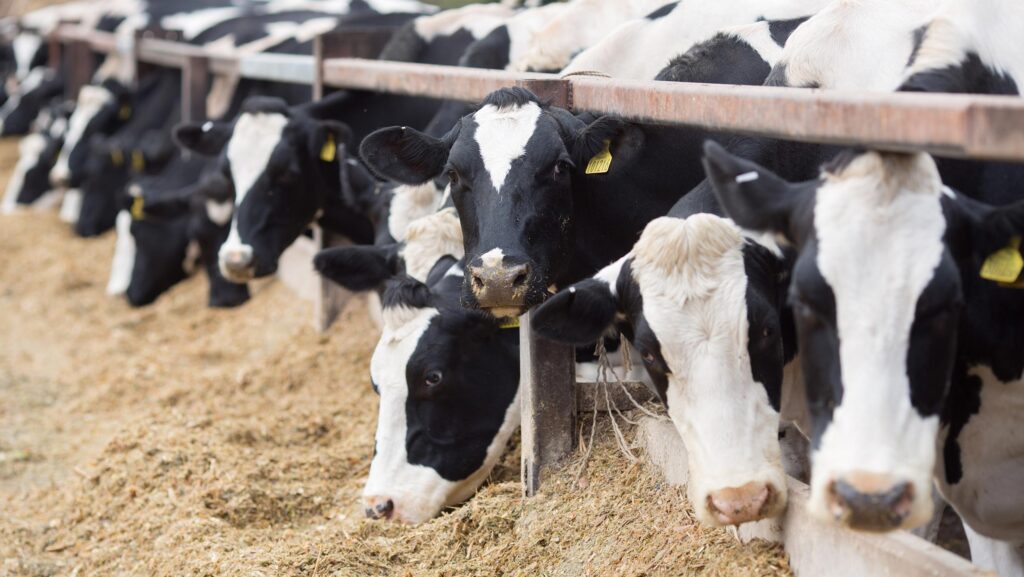 © Tim Scrivener
 Weeks of dry weather have taken their toll on forage crops, raising fears that many farmers will face winter feed shortages.
Nearly three-quarters of England and the whole of Wales are officially in drought.
Grass growth has halted across almost all parts of Britain, with only south-west Scotland still recording any, according to the latest AHDB Forage for Knowledge.
See also: Are longer rest periods feasible in grazing dairy herds?
Independent nutritionist Andrew Jones, of ChewintheCud, says the season started well in the South West but, after several weeks of no rain, the outlook is bleak unless rain comes imminently.
“We had a good spring, with rain at the right time. First- and second-cut grass silages look good quality and clamps were full.
“But only a handful of farmers have taken third cut, more to reset the field.”
He says some autumn-calving herds are already buying in whatever forage they can source locally to bridge the gap until silage clamps are opened at calving.
Meanwhile, others have had little choice but to open clamps reserved for the winter.
Grazing rotation length
Piers Badnell, LIC Pasture to Profit consultant, says the picture is similar across most of Britain, with many grass-based dairies forced to supplement feed or house cows.
He believes many producers failed to react quickly enough when growth rates began falling in June.
Those who did extend grazing rotation lengths to match declining growth rates quickly have been able to continue to feed grass, albeit only 4-5kg dry matter (DM) a head a day.
But without rain, even this will run out.
He says matching grazing rotation length to grass growth will become increasingly important.
“Grazing before the plant fully recovers reduces reserves and plant viability. If you’re looking after that plant, when it does rain it will respond a lot quicker.”
How to calculate grazing rotation length
If cows are entering paddocks at 2,800kg dry matter (DM)/ha and exiting at 1,500kg DM/ha, you require 1,300kg DM/ha of grass to grow (2,800 minus 1,500).
If grass grows at 50kg DM/ha daily, it will take 26 days to achieve this (1,300 divided by 50).
Therefore, you should be grazing cows on a 26-day rotation length.
Source: Piers Badnell
Maize outlook
While grass looks poor, maize crops generally appear better than last year, with good heights noted, but early tasselling of crops could indicate a very early harvest.
Neil Groom from Grainseed says crops in East Anglia and along the south coast will be ready to harvest in the next two weeks.
“Harvest was early last year, but [August] is unheard of.
“Some crops have double and triple cobs in response to high levels of sunshine and nutrients. This is not a problem providing fertilisation occurred.”
However, the concern is that high temperatures (above 30C) may have affected pollen viability during tasselling.
This could have impacted grain fertilisation, which could lead to lower starch levels.
Furthermore, Neil notes that crops on sandy, gravel soils in East Anglia that have not received rain since 10 June are suffering and have tasselled at just 1.2m tall.
Plan for the worst
Andrew is urging farmers to test conserved forages now and plan for the worst-case scenario.
He adds that feeding for marginal litres needs careful cost analysis given the milk price remains below the cost of production for many.
“Last year, a lot of people were saved by the rain in September, and they took a late fourth cut to help fill clamps,” he says.
However, farmers should have a contingency plan in case rain does not arrive by the same time this year.
He advises dairy producers to purchase feed now to avoid price increases later in the year, when demand could rise.
“Test your forages and make sure what you’re purchasing is right. If you need to replace starch, consider ground maize, rolled cereals, or a moist blend.
“Look at what’s most cost-effective on a dry matter basis and what fits your diet best.
“Don’t panic buy or buy something just because it is cheap, because it will usually cost more in the long term. Get some independent advice.”
Management for drier summers
Andrew says the past two summers show farmers need to adapt to the changing climate.
Reflecting on his experience of farming in Australia for 10 years, he believes farmers may need to adjust stocking rates to align with forage availability.
“There’s a place in South Australia that only has a growing period of six weeks, so they make all their forage in six weeks and feed the rest of the year,” he says.
Piers adds there is no single solution to overcoming drier summers.
Instead, farmers need to consider various strategies, including growing more diverse species, alongside brassicas, to act as a reserve for grass.
Brassicas also serve as a good break crop for grass reseeding, which can also aid drought tolerance.
“People don’t reseed enough. A reseed isn’t drought tolerant, but it will last longer into a drought,” he adds.
What to do when rain comes
The immediate challenge will be drought recovery when rain finally arrives.
The hard ground requires a week’s worth of steady rain to awaken the plant, Piers says.
Yet with no immediate rain forecast and grass requiring three weeks to recover after the rain, farmers are probably four to five weeks away from getting cows back to full appetite on grass, he calculates.
When rain does come, he cautions farmers against rushing back to grass too quickly, as the grass wedge will need to be reinstated.
This can be achieved by starting to graze paddocks at covers of 2,200-2,300kg DM/ha and gradually building average farm cover.
Producers also need to be mindful that soil nitrogen will have built up in the soil from decaying grass.
To avoid high nitrate and unpalatable grass, Piers advises delaying spreading bagged fertiliser until after the cows have grazed the grass that grows following rain.
“Long term, if these drier summers are going to be the new norm, think about what you can do differently.
“Now is the time to experiment and start adapting the system, because perennial ryegrass will struggle above 25C,” he says.
“On the upside, these drier summers and milder winters do give us opportunities to optimise grazing later in the year and get cows out to grass earlier in the spring to take advantage of winter grass growth.”
Forage tips to build resilience
- Test forages to balance rations cost-effectively
- Cull underperforming cows to reduce pressure on feed
- Shop around for feed and compare costs on a dry matter basis
- Seek independent advice on how to best balance winter rations
- React quickly: ensure grazing rotation length matches grass growth
- Consider using multispecies swards, modern varieties of cocksfoot, timothy and festulolium that can withstand warmer, drier conditions
- Plant summer brassicas as a break crop to feed cows during the dry period, before reseeding in the autumn
- Reseed regularly with varieties on the Recommended List to improve resilience against drier conditions
- Take advantage of milder springs and winters by lengthening the grazing period
Source: Piers Badnell and Andrew Jones