

How AI-linked cameras on backing gates can improve cow flow
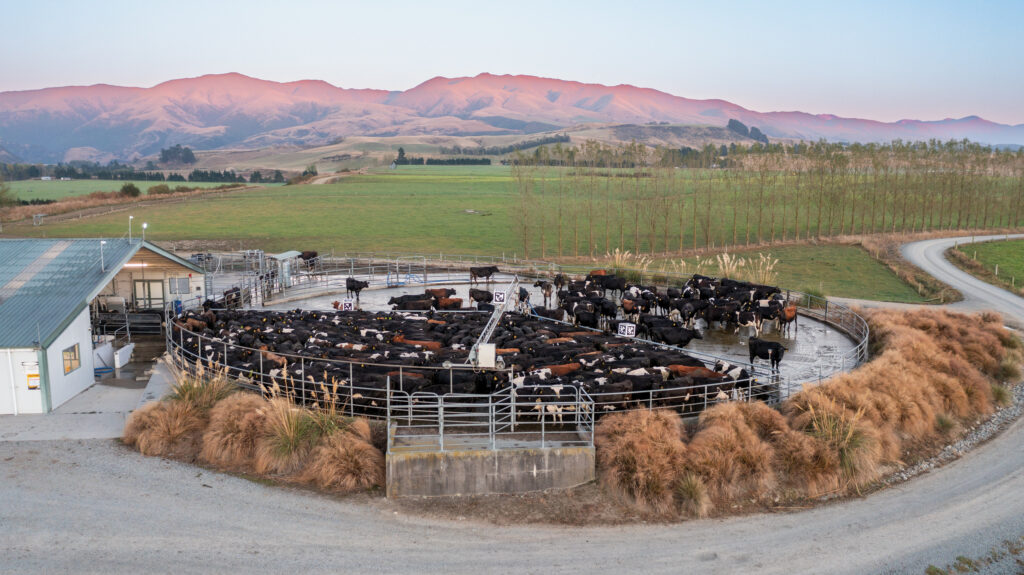 Dairy cows at Glenrie Farm in New Zealand © Livestock Visibility Solutions
 A backing gate to improve cow flow in the collecting yard can only be as good as the person controlling it.
But replacing a human with cameras linked to artificial intelligence to move the gate is saving the equivalent of £20,000/year in reduced power, labour and lameness costs on New Zealand dairy farms.
See also: How an adviser’s dairy foot health focus improved milk yields
Eight commercial farms have been trialling Flow, a system that uses computer vision and machine learning to standardise backing gate movements.
Consistency at every milking, every day, has led to a fall in daily milking times of between 30 and 70 minutes, in addition to having 15-20% fewer lame cows. (See table below)
Milking times of Flow backing gates v control |
|||||||||
|
|
Control |
Farm 1 (Glenire) |
Farm 2 |
Farm 3 |
Farm 4 |
Farm 5 |
Farm 6 |
Farm 7 |
Farm 8 |
|
Parlour size |
60 |
60 |
60 |
60 |
60 |
40 |
60 |
54 |
50 |
|
Parlour type |
Rotary |
Rotary |
Rotary |
Rotary |
Rotary |
Herringbone |
Rotary |
Rotary |
Rotary |
|
Collecting yard type |
Round |
Round |
Round |
Rectangle |
Rectangle |
Rectangle |
Round |
Round |
Round |
|
Herd size |
1,100 |
1,250 |
1,400 |
1,350 |
1,400 |
850 |
850 |
700 |
650 |
|
Average hours/milking |
3 |
2.8 |
3.2 |
2.95 |
3.1 |
1.9 |
1.9 |
1.5 |
1.45 |
|
Average milking seconds a cow (standardised to parlour type) |
9.81 |
8.06 |
8.22 |
7.86 |
7.97 |
8.04 |
8.04 |
7.71 |
8.03 |
|
Variation from control in total milking time (faster) % |
0 |
17.86 |
16.19 |
19.87 |
18.80 |
18.03 |
18.03 |
21.42 |
18.2 |
|
Source: Richard Appleby, Livestock Visibility Solutions |
|||||||||
Challenges training staff
Cows like routine, and good cow flow leads to a more efficient milking – and better animal welfare.
So, ideally, every milker should be trained to use a backing gate correctly at every milking.
However, Richard Appleby, former sharemilker and founder of Livestock Visibility Solutions, is well aware of the difficulties associated with handling these gates.
These include not just improper use, but a variation in use by different people, which disrupts cows and frustrates staff, followed by inefficient milking, white line disease or hock injuries.
Richard thinks it is hard for farm owners to keep training new staff, and getting them to retain that information.
This is further complicated when people have no previous agricultural experience, or do not speak English as a first language.
Yet, in an era of automation to remove clusters or draft cows, and technology that detects oestrus, he found it surprising nothing had been developed for backing gates.
Development of uniform gate
Flow began as a “lockdown project”, with Richard devising a system to create uniform gate movement, regardless of farm-specific variables (cow shape, size and number, collecting yard area, and parlour type).
He linked the electrics on a backing gate to two off-the-shelf industrial-strength cameras, attached them to a farm computer and programmed new software incorporating artificial intelligence (AI).
He explains that the cameras view the number of cows in the collecting yard (there is no need to identify individuals) and AI calculates the density; there is no standard number of cows to a square metre.
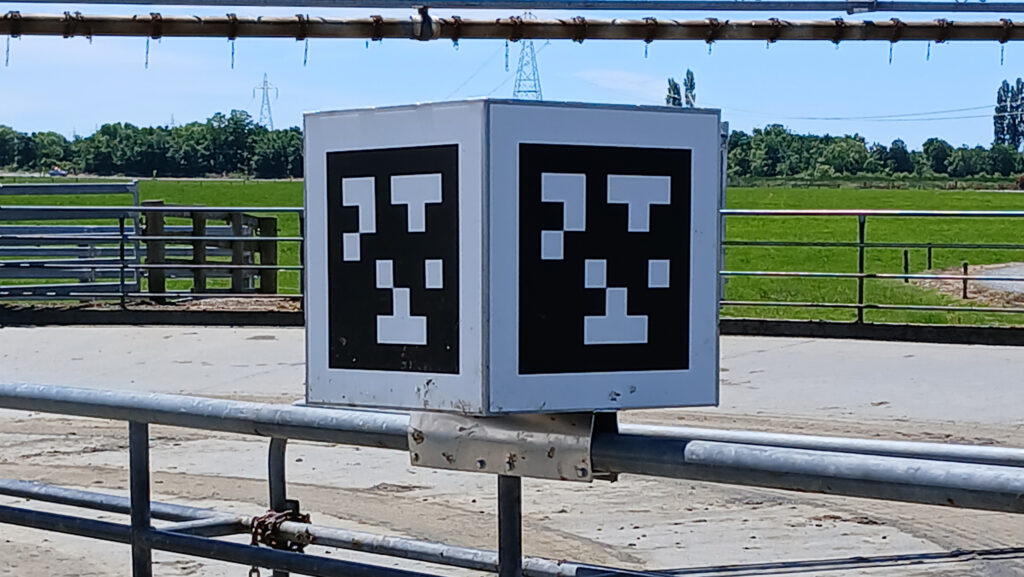
The Flow system camera © Livestock Visibility Solutions
It then builds a farm-specific knowledge base, which it uses to make standard movement decisions for the gate according to the live imaging supplied by the cameras at each milking.
“The AI is trained to recognise yard conditions and cow density across a diverse range of scenarios – such as fluctuating cow numbers – to ensure consistency.
“For example, when identifying black cows at night, a human operator might fail to spot certain animals and advance the gate [too far], causing compaction.
“Flow has been trained to identify a consistent headcount in all visibility conditions,” says Richard.
“Our system operates on real-time yard dynamics.
“Regardless of fluctuations in cow behaviour or parlour activity, density is maintained at a constant and steady level.
“This eliminates the risk of over-movement often associated with ‘creep’ features [found on some backing gates].”
Farm-specific AI learning
Depending on the farm, it takes two to eight weeks for AI to learn and perfect its database and technique. Speedier results come from farms already working more consistently in their routines, he adds.
Having worked closely with New Zealand lameness vet Neil Chesterton during the system’s development, Richard made sure it would operate in harmony with natural cow behaviour.
“It’s just the right amount of pressure – not too aggressive or too passive – and it’s consistent. It’s set up to take care of cows,” he says.
The backing gate still uses its bells or sirens as an audible warning to cows that it is about to move, although Flow first moves the gate back.
“We have found that a backward movement of about 15-20% of the forward duration yields the best outcomes to optimise cow training and take into account cow behaviour,” he says.
Return on investment
There is little physical maintenance required, however the AI software needs monthly support with upgrades and improvements to functionality (such as an on/off light) according to farmer feedback.
Richard says that farmers buy the kit, then pay a monthly licence fee for each cow. “We maintain it at our cost if they are in contract,” he adds.
Pilot farm savings
Annual savings from using artificial intelligence-controlled backing gate
- NZ$13,750 (£5,946) in reduced lameness
- NZ$6,023 (£2,604) in lower power costs
- NZ$27,732 (£11,991) in labour
- NZ$47,505 (£20,541) total savings in a milking season
Using standard New Zealand costs for the eight pilot farms, Richard calculated that, on average, a farm’s total savings came to NZ$47,505 (£20,541) in a milking season.
This means a payback of less than 12 months, while the return on investment for the licensing fee is NZ$6 (£2.60) to NZ$8 (£3.47) for every NZ$1 (£0.43) spent.
The system is now operational on 30 farms, and a pilot is planned in the UK.
Farmer experience
Farm manager Tony Watson admits he was sceptical about trying the Flow system at Te Awa Farm, Canterbury, New Zealand.
This 1,100-cow herd is part of the Craigmore Sustainables business, which milks 15,233 cows across 20 farms.
However, milking time in the 60-point rotary fell from 2.15 hours (or 8.14sec a cow) to 1.76 hours (or 6.66sec a cow) using a Flow-controlled backing gate.
“I could see that new milkers just hit the button and could forget it [the backing gate],” says Tony.
“We are able to run the dairy for less time, and the guys are able to get away early, which is good for morale.”
Aside from not having to keep training new people – and remind existing staff – how to use a gate correctly, Tony thinks the system would benefit farms using a lot of different people to milk.
“It gives a very consistent experience to cows in the yard compared with individuals and their [different] flicking on and off of backing gates,” he adds.
Calm cows
Reducing the lame-cow mob by two-thirds took the pressure off the team at Glenire Farm in South Canterbury, says farm manager Kerry Higgins.
This dairy platform of 350ha milks 1,250 cows through a 60-bail rotary. Instead of lifting feet, time was released for other jobs around the farm, he explains.
“If you can be consistent in the shed, consistent in what you are doing, cows love that,” he says.
“We’ve found that it’s increased our efficiency [because of] the constant flow of the animals; they’re nice and calm because the system’s working well.”