

Smart dairy investments when cashflow is tight
 © Tim Scrivener
 Operating in a tight financial climate means double-checking planned investments are really worth the money.
Before parking this year’s building (or maintenance) project because escalating input costs are squeezing the cashflow, first make time for a thorough cost review.
Then establish whether the resulting benefits are essential to improving farm efficiency, or are just “nice-to-have” extras that could be postponed.
See also: 10 ways to help shield dairy herds from sharp price shocks
Dairy farm consultant Pippa Piotrowicz of the Farm Consultancy Group, in Wiltshire, thinks that investment projects related to efficiency should still go ahead.
They will start the ball rolling on increasing productivity and debt repayment, as well as ensuring future sustainability.
“To answer the question of whether people should park ideas, the answer generally would be no, but the decision must be supported by a clear view of both the cost benefit and the affordability of the investment,” she says.
Efficiency improvements
An example would be replacing a handling setup, based on gates held together with baler twine, with a modern cattle handling system that substantially reduces the time it takes for TB testing, she says.
It can also make vet costs cheaper if it means a speedier operation to sort/treat or pregnancy test.
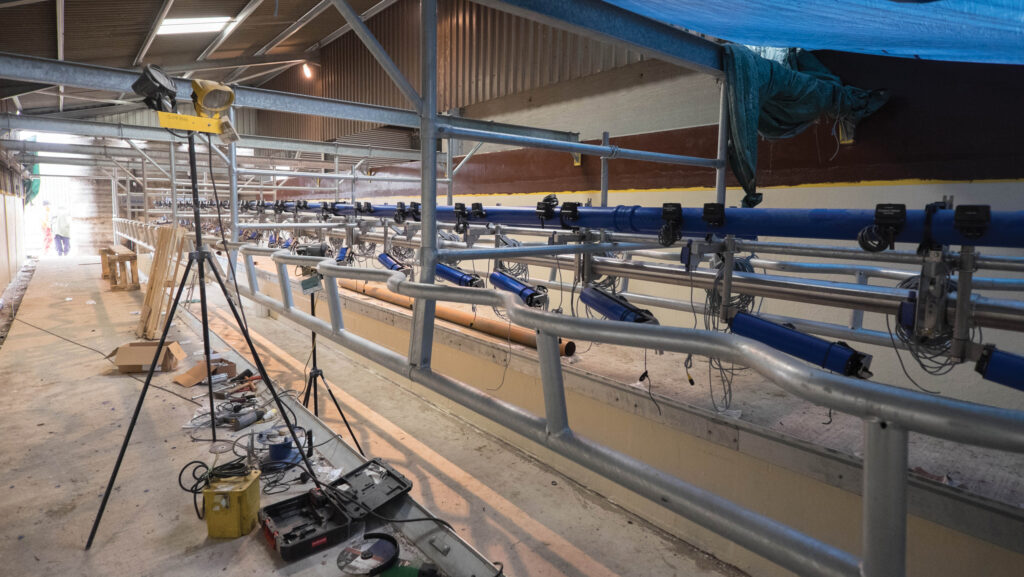
A more substantial decision would be upgrading or renewing an ageing milking parlour.
In this case, Pippa says that automatic cluster removers would be essential for good teat health, whereas a cluster flush function has to control farm-specific bacteria.
“Milk recording capability is essential for effective herd management. Feeders are essential if you are feeding to yield or use these to help manage grazing.
“If not, they fall more into the ‘nice-to-have’ category. Additional software can add value, but only if the farmer will use the information,” she explains.
It is important, however, to understand how this year’s lower income and higher costs are affecting the cashflow and what the consequences might be.
“Do you need to increase your overdraft temporarily, or longer term to give you flexibility in your system?” she says.
Capital projects
With a supportive bank prepared to increase the overdraft, Pippa says it is possible to continue with intended capital spend.
Smaller jobs such as new concrete or ventilation systems tend to be carried out in cashflow.
“One client had savings from when the milk price was good and used them to cover the milk price fall; they haven’t had to go for an overdraft increase from the bank.
“Instead, they were able to buy gates, water troughs and positive ventilation tubes for the calf shed as part of their regular spend.”
Major infrastructure projects – such as a new shed or parlour – with a loan in place will have been stress- tested as part of the planning process, meaning a proposal should be robust enough to continue despite a very different financial outlook.
“It may be possible to put a new loan for a big project on an interest-only period for 12-18 months if you think it will ease pressure this year. It may put pressure elsewhere, though,” she suggests.
Pippa thinks it is also worth checking interest rates on potential loans or asset finance schemes for the best on offer.
And she says there is no harm in shopping around for better prices (the usual three quotes) for materials if not already committed to contracts.
Running repairs
Continuing maintenance and repairs even in a downturn is important.
The alternative might be more breakdowns, repairs, escaping stock, and longer hours. Sooner or later, an even bigger investment will be required for repairs or replacements.
“If you don’t spend, it will catch up with you, and you end up spending even more,” says Pippa.
“Do it now – you will get the benefit and when the milk price is going in a positive direction you will be in the best situation to make the most of it, as you will have gone through the initial teething issues and be ready.”