

How milk source heat pumps have slashed dairy’s energy bills
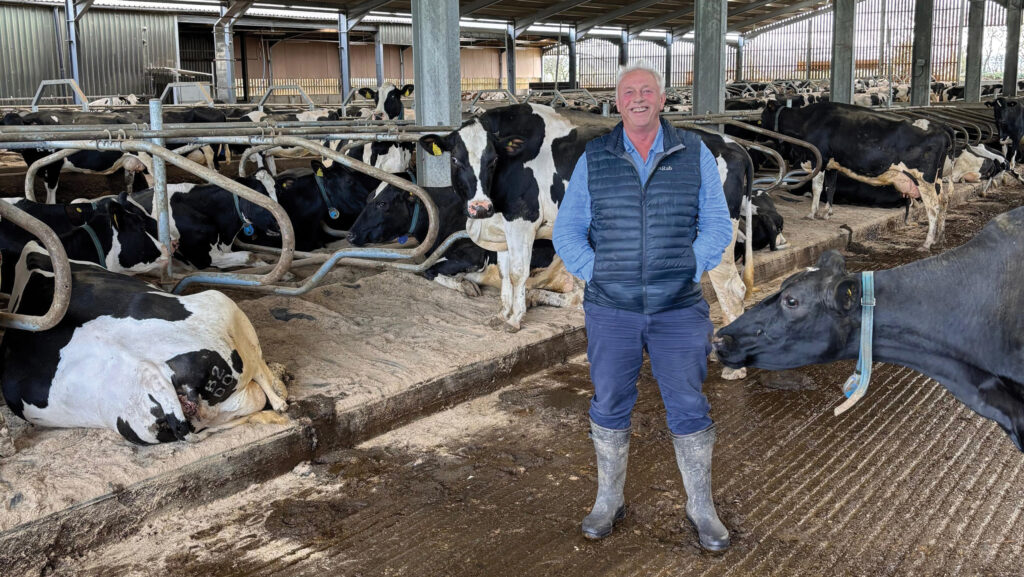 Chris Barber © Barber's
 Installing three milk source heat pumps is saving a Somerset cheesemaker more than £70,000 a year on electricity bills.
Investment by Barber’s, Maryland Farm, Ditcheat, in this new technology is also heating water more efficiently and cutting the business’s carbon emissions by almost 60t annually.
See also: How slurry investment will slash dairy unit’s energy bills
With 2,500 cows across seven units, energy use is not a marginal cost – it is a business-critical line on the balance sheet, and controlling electricity consumption is as important as maintaining milk quality.
Previously, energy bills on some units would regularly top more than £5,000, says Chris Barber, whose family has been making cheese for nearly 200 years.
It was vital that the business find an alternative, sustainable, solution.
New system
Barber’s milks 2,500 cows across seven units, with average herd size of 280-300 cows and one larger 400-cow unit.
All are run by contract herd managers and operate a block-calving system from July to early October.
Two of the sites fitted with Arkaya Energy’s Milk Source Heat Pump are 24/48 herringbone parlours producing up to 12,000 litres a day.
The third is a high-output 60-point rotary supplying milk for infant formula, where quality standards are particularly stringent, meaning milk must be cooled to below 5C by the end of milking.
Before installation, all three farms operated modern ice bank systems with heat recovery, heating water to 45-50C, so the benchmark for any replacement was already high, says Chris.
How it works
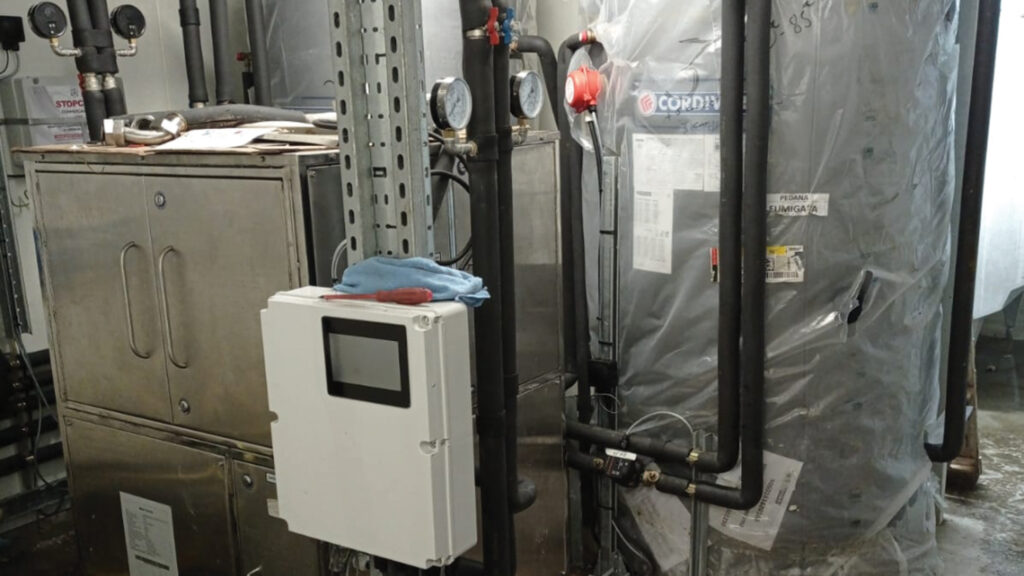
The first milk source heat pump at Barber’s Farm © Arkaya Energy
1. Heat is captured as milk is cooled
Milk leaves the cow at about 32-36C. As it passes through the plate cooler, the heat removed during cooling is retained within the system.
2. That recovered heat is circulated
A standard pump moves the captured energy through the system, similar to the way an ice bank would operate.
3. The heat is upgraded
Using Arkaya’s Milk Source Heat Pump technology, the system upgrades the extracted energy to produce high-grade hot water at up to 92C – enabling cooling and high-temperature water production with a single integrated system.
The outcome is that milk is cooled to 4C as required, while enough high-temperature water is generated for daily washing – eliminating the need for separate electric heaters.
The system meets the total cooling and hot water demand of a dairy unit – replacing traditional cooling systems, such as ice banks and standalone water heaters, with a single integrated platform.
Fault detection and performance optimisation are handled centrally, improving reliability – a key hurdle in early development.
Remote monitoring now comes as standard across all installations, ensuring consistent performance and early fault detection, explains Kumo Sharma, founder of Arkaya Energy and pioneer of the technology.
Energy and carbon savings
While the installation and day-to-day use of the heat pumps have not made a noticeable difference to work routines, the energy savings have been colossal, says Chris.
Using a baseline electricity price of 25p/kWh, annual savings across the three farms have been calculated as:
Farm one – 24/48 herringbone
- 83,232kWh saved annually
- 228kWh/day
- £20,808/year
- 16.3t carbon dioxide reduction
Farm two – 24/48 herringbone
- 78,840 kWh saved annually
- 216kWh/day
- £19,710/year
- 15.7t carbon dioxide reduction
Farm three – 60-point rotary
- 127,020kWh projected annual saving*
- £31,775/year
- 24.9t carbon dioxide reduction
*Projected as pump installed less than one year ago. Figures based on current performance.
Combined saving: £72,288/year – equivalent to £198/day. In total, the three installations reduce emissions by about 57t of carbon dioxide annually.
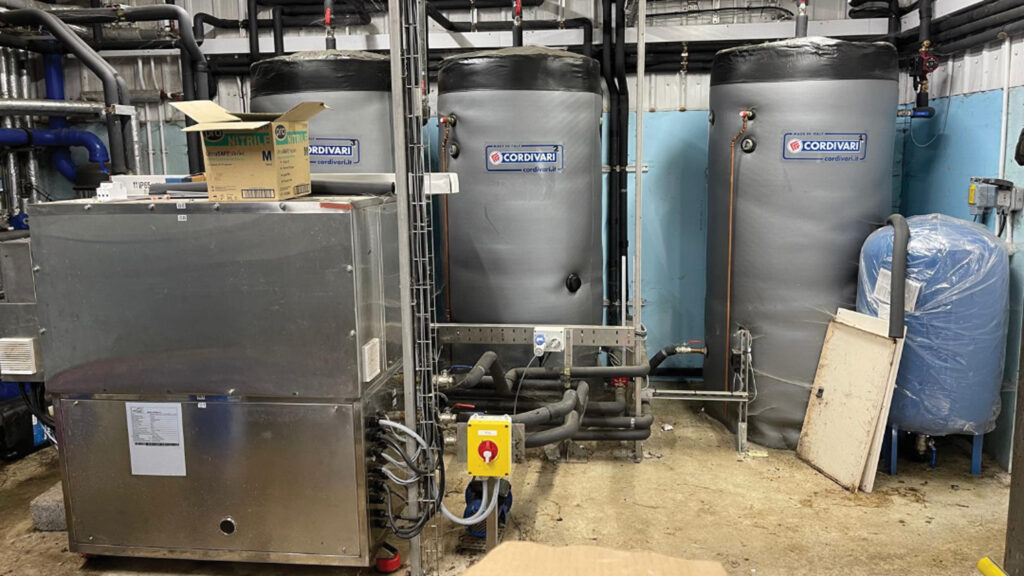
The second milk source heat pump at Barber’s Farm © Arkaya Energy
Hot water
In place of three 450-litre parlour heaters, and two bulk tank heaters at the rotary site, the heat pumps deliver wash water at a consistent 92C-plus, with capacity for two hot washes a day plus a surplus.
As well as saving energy, improved Bactoscan results have been reported following installation, notes Chris.
Investment and payback
An installed system costs start from about £25,000, depending on herd size and configuration, with larger rotary installations costing more.
The technology is operating across a range of setups, from robotic dairies to high-output rotary parlours.
With annual savings ranging from £20,000 to more than £30,000 a farm at current energy prices, payback periods are competitive – particularly where ice banks or electric wash heaters are approaching replacement age, explains Kumo.
For Chris, the decision was as much about direction of travel as short-term return.
“As a company, we’re looking to reduce our carbon footprint and encourage the farmers who supply us to do the same,” he says. “If we can pioneer something that works, that benefits everyone.”
Business resilience
Discussions are under way about applying the same principles within the cheese factory itself, where steam and process heat requirements present further opportunity for integration of high-grade heat.
For now, however, the focus remains firmly on dairy units. Cutting electricity use by up to 52%, 48% and 44% respectively on three farms, the system is more than a sustainability gesture.
And as energy volatility continues to shape margins, that may prove just as valuable as milk price. “We instantly saved money,” says Chris. “Save money, save carbon. We’re all in a better place.”
Independent verification
Given the importance of cooling performance, the milk source heat pump at Barber’s 60-point rotary was independently assessed by NFU Energy.
Electricity consumption before and after installation of the milk source heat pump was analysed.
Key findings:
- Average saving of 297kWh/day between July and November while the pre-cooler was offline
- Average saving of 348kWh/day in December once pre-cooling resumed
- Saving equivalent to a 44% reduction in electricity use compared with the previous year
- Estimated monthly savings ranged from £1,630 to £2,590 (at £0.24/kWh)
- The system replaced the ice builder and multiple 450-litre wash water heaters
- Delivered consistent 85C-plus hot water for two daily hot washes
- Throughout the trial period, milk consistently achieved sub-5C within required timeframes, meeting the strict specifications for infant formula supply.
From university project to Dairy-Tech Innovation Award winner

Ramesh Sharma, Princess Anne and Kumo Sharma at the presentation © Lloyd Sturdy
The milk source heat pump has its roots in research carried out by Arkaya Energy founder Kumo Sharma shortly after graduating in 2016.
Working on high-temperature heat pump development as part of Innovate UK-backed projects, Kumo focused on improving efficiency and increasing usable output temperatures – initially for domestic systems.
A chance trial on a dairy farm in 2017 shifted the direction of travel.
Recognising that milk cooling and hot water demand occur simultaneously, he began refining the technology specifically for dairy units.
Early on-farm prototypes focused largely on water heating.
However, through ongoing development work with Barber’s from 2019 onwards, the system evolved to integrate both milk cooling and high-temperature water production in one unit.
Reliability and data monitoring became a key focus. Current systems collect multiple operational data points and are remotely monitored to ensure consistent performance.
Commercial installations began in 2023, and the technology is now operating on more than 20 dairy farms across the UK.
The system received the Royal Dairy Innovation Award at Dairy-Tech 2026, recognising its potential to reduce on-farm energy use while maintaining strict milk cooling standards.