

Improving fertility in the high-yielding dairy cow
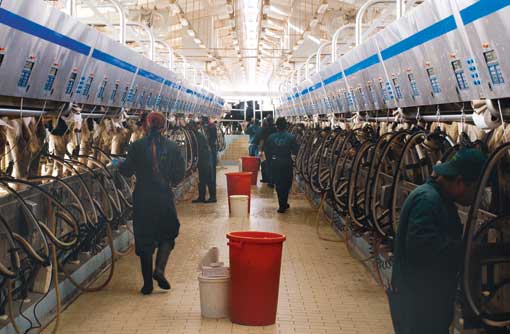
How can we improve fertility in the high-yielding dairy cow? Kingshay consultant Paul Robinson reports on findings from his 2009 Nuffield scholarship looking at large scale units in Saudi Arabia and Canada.
Poor fertility is often caused by a number of complex factors. It is easy to highlight the negative correlation of yield a cow and fertility, because this can be clearly measured, but this is not the whole picture.
Many high-yielding cows across the world have acceptable fertility – some American herds I visited were producing more than 14,000 litres a cow with a conception rate of more than 44% and a calving interval of 410 days. This shows the capability of the Holstein with correct management – something a number of herds I visited demonstrated exceptionally well:
Al Safi dairy, Saudi Arabia
The world’s largest integrated dairy farm
Al Safi dairy farm is situated near Al Kharj, Saudi Arabia. The 38,000-head herd includes 22,000 milking cows and followers.
All the milk is processed on site through the Danone factory.
It has been suggested that cows don’t last in Saudi Arabia, and this could be true for some dairy units. But Al Safi has a reasonably good cow longevity record, with cows averaging 3.5 lactations.
This is compared with a UK average estimate of 3.1 lactations a cow, according to National Milk Records (NMR).
The replacement rate is down to 23% on one unit. In fact, the manager of unit 110 took pride in showing records of 1996 to 1999-born cows.
If records of cow longevity were not evidence enough, a walk through the herd highlighted thousands of cows in good health.
Fertility is inbred into Safi cows due to the culling policy. Cows have a maximum of four services to become pregnant and after that they are allocated as barren. Most cows are culled for not being in-calf and this removes inherent poor breeders from the system.
What can be learnt from Al Safi?
Some of the Saudi Arabian systems cannot be replicated in UK conditions and some may not be appropriate or profitable, but there are lessons to be learnt.
High staffing levels and protocols which are strictly adhered to are very important drivers. The staff have specific jobs and specialise in this area.
Fertility management is multi-faceted, but the main reasons behind the success at Al Safi are:
• Dry open diets, which promote good rumen health
• A heat detection rate of 72% through visual observation
• Good herd health with a full vaccination programme
• The low levels of liquid slurry, leading to dry, hard hooves
• Very low numbers of lame cows
• Mastitis levels running below 1% in the herd
• High staffing levels
• Sand packs and loafing paddocks
• Comprehensive protocols
• Dedicated management team
• Cows bred to be fertile
• On-site vets
Although health traits are multi-factorial, lameness management is crucial to fertility improvement. Al Safi has a rigid hoof care regime, low levels of liquid slurry and good rumen health.
This encourages good heat expression when coupled with sand loafing paddocks.
Many farms do not have good hoof care programmes and this shows in the level of lameness in UK herds (about 40%).
A universal locomotion scoring system is now available and this should be used comprehensively as a management tool to reduce lameness – lameness is one health issue that can only be tackled at farm level.
Mastitis incidence is particularly low at Al Safi, partly due to the dry conditions, but also due to the aggressive approach taken.
Full parlour protocols are adhered to religiously – every new mastitis case is sampled and analysed on site.
These cows are immediately separated into a mastitis group.
Al Safi dairy also has a rolling heat detection rate of 72%, driven by having staff rotas solely to detect heat and serve cows.
Improving fertility starts with heat detection. And, with a UK average heat detection rate of only 45%, most herds will be challenged to achieve an acceptable calving interval.
Chaput Farms, Vermont, Canada
If there was ever a case for highlighting what impact an excellent herd manager can have, Chaput Farms would be high on the list.
Chaput Farms is close to the Canadian border in Vermont.
About 850 cows are milked three times a day through a 32:32 rapid exit parlour. The facilities are functional and a new dry cow yard was nearing completion when I visited.
The main focus of the farm is the development of a bio digester, which has now been commissioned.
The owners have a hands-off management style, which had led to poor performance in the hands of a lower-quality herdsman.
The herd manager at Chaput is now Eric Schneider. Mr Schneider is a true cow enthusiast and applies every attention to detail in less-than-favourable circumstances.
What makes him more remarkable is the fact he is registered legally blind. He reads cow records with a magnifying glass and has a telescope to recognise cows in the yards.
His focus and knowledge of the performance figures is as good as any you will find and the improvements made over three years has added another $600,000 (£378,840) to the output.
What can be learnt from Chaput Farms?
The role of the herdsman needs to evolve to cater for increased cow numbers and production pressure, swapping the muck fork for the laptop.
The main focus should be “cow time” which centres around health and production. A significant amount of time should be dedicated to the following:
• Recording – milk, fertility, cow health and KPIs
• Record analysis
• Fertility analysis
• Heat detection and AI
• Liaison with vet/nutritionist/advisers
• Herd health monitoring
• Hoof care
• Transition cow management and fresh cow checks
• Staff management, development and training
• Embracing and developing protocols
• Ground-level nutrition eg diet presentation and monitoring.
• Good herdsmen are invaluable and should be treated as such.
• The herdsman needs to be given time to do the important tasks listed and lower-skilled labour should be employed to do the basic manual tasks.
• UK herdsmen are often stretched, doing too many jobs at once. Some herdsmen are not good at routines, but these drive larger, more progressive units along with strict protocols.
• The two key areas have to be hoof care and heat detection.
• Hoof care is not just picking up cows’ feet, but attention to diets and slurry management.
• Heat detection needs to be more rigid; checking cows at least three times a day for 20 minutes or using some form of automation.
• Paul Robinson is also technical consultant for Thompsons of York.
Key farm facts
850 cows
Milking three times a day
32:32 rapid exit parlour
Focus on performance figures
Do you think high cow numbers means low welfare? Join the debate
Key farm facts
• Total of 38,000 head, including 22,000 milkers and followers
• Milk processed through Danone factory
• Focus on fertility through strict protocols and culling