

FW Awards: Meet the 2026 Poultry Farmer of the Year finalists
 Mark Gorton, Will and Kate Martin, and Robert Parker © Jason Bye, Emily Fleur and Phil Weedon
 Unlike last year when all three finalists were egg producers, this year sees three poultrymeat producers vying for the coveted title.
See also: FW Awards 2026: Meet the finalists
The finalists
- Mark Gorton, Traditional Norfolk Poultry, Shropham, Norfolk
- Will and Kate Martin, Treway Farm, Coombe, Cornwall
- Robert Parker, Park Farm, Thorington, Suffolk
The judges
- Gary Ford – With a long career in the poultry sector, independent judge Gary is head of strategy for the British Free Range Egg Producers Association
- Hugh Carter – Last year’s winner Hugh runs a 124,000-bird egg laying unit in County Durham as part of a regenerative farming system
- Philip Clarke – Farmers Weekly News editor and former editor of Poultry World, Philip has been judging the poultry category for 16 years
Mark Gorton, Traditional Norfolk Poultry, Shropham, Norfolk
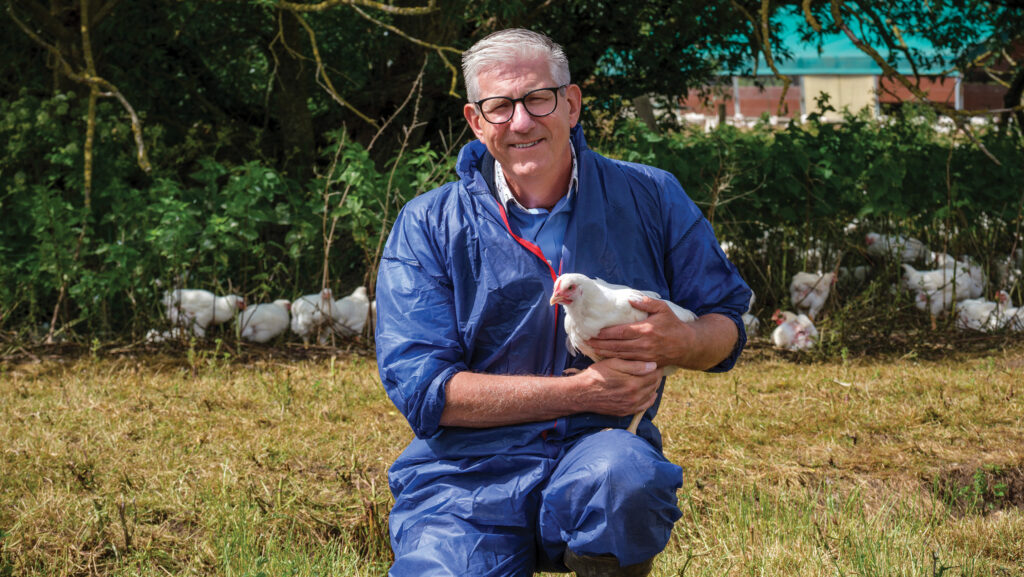
Mark Gorton © Jason Bye
Starting out with just 12 turkeys and an entrepreneurial spirit as a teenager, Mark Gorton has worked hard to fulfil his lifelong dream of becoming a poultry producer – and then some.
What was once a small, backyard operation supplying a few local butchers has grown into a modern, £55m turnover business encompassing production, processing and product development for top restaurants and major retailers.
Mark has grown with the business too, taking on various roles in the wider industry, but never losing sight of the fact he is a poultry farmer first and foremost.
Business
Traditional Norfolk Poultry may have started out in seasonal turkey production, but the bulk of revenue – about 80% – now comes from free-range chickens.
These are slow-growing birds, and the factory processes more than 100,000 a week at its own factory near Thetford, including 10,000 of its own Norfolk Black breed.
Combined with free-range seasonal turkey production – involving around 350,000 birds for the Christmas market – the firm has over 90 growing sites on 55 farms, mostly in Norfolk and Suffolk.
These are typically located on rented ground, with a combination of static sheds, mobile units and polytunnels.
Mark has also developed a contract growing operation, allowing other farmers to invest in their own infrastructure, with TNP supplying the birds and feed.
The company has developed strong relationships with most of the big retailers, providing them with high-end chicken and turkey. “I have a policy of not having more than 30% of our business with any one retailer, to limit exposure,” says Mark.
Product development is another key focus, with a range of novel chicken and turkey dishes developed in the firm’s own kitchen.
Technical
TNP operates two basic systems for free-range chicken production – a “whole life cycle” model, where the birds use the same shed from chick to finishing at 56-63 days old, and a “brood and move” system.
“This may mean ‘double handling’, but they have even higher welfare once they get to the mobile sheds or polytunnels,” says Mark.
Being free range and slow growing, stocking rates are generally kept below 20kg/sq m when the birds are inside. Mortality is low – about 3-4% for chickens, and less than 2% for turkeys.
“Most of the estates we rent ground from have gamekeepers, so foxes are well controlled.”
The turkeys are mainly grown in polytunnels, typically housing 10,000 birds, most of which also have access to woodland. All are grown to Red Tractor and RSPCA standards.
Having lost nine separate farms to avian influenza (AI) in 2022 – including 300,000 chickens and 50,000 turkeys – the business pays close attention to biosecurity.
Mark has also been closely involved in AI vaccine development, hosting trials for the Animal and Plant Health Agency – a world first.
Future plans
Expansion is an ongoing target for Traditional Norfolk Poultry as the quality end of the market continues to grow.
The firm is actively looking for more farmers in East Anglia to join the contract scheme to boost free-range chicken and turkey production.
Mark is also involved with the renowned John Innes Centre in Norwich, developing a new protein crop as a potential replacement for soya in poultry diets.
And having hosted school visits in the past, he is keen to do so again. “Farmers should not be using biosecurity as an excuse to keep people out,” he says.
The numbers
- 55 farms with poultry production on site
- 10,000 Norfolk Black chickens processed each week
- 10% window space on mobile sheds
- 2.7 typical slaughter weight in kgs at 56 days of age
- 400 additional workers employed for Christmas turkey processing
Farm facts
- Free-range chicken and seasonal turkey production for high end market
- Production mostly in owned mobile sheds and polytunnels on rented sites
- All birds processed in own slaughterhouse
- Slow-growing breeds of chicken, plus rare breeds of turkey
- Range and shed enrichments at all sites
The judges liked
- Proactive approach to innovation, especially with avian influenza vaccination trials
- Constant emphasis on high bird welfare in free-range systems
- Involvement in the wider industry, helping to set the standard
- Entrepreneurial spirit with a commitment to future growth
What the judges say
Mark retains a real involvement in the business while also aiming to ‘put something back’ with his various roles in the wider industry.
Will and Kate Martin, Treway Farm, Coombe, Cornwall
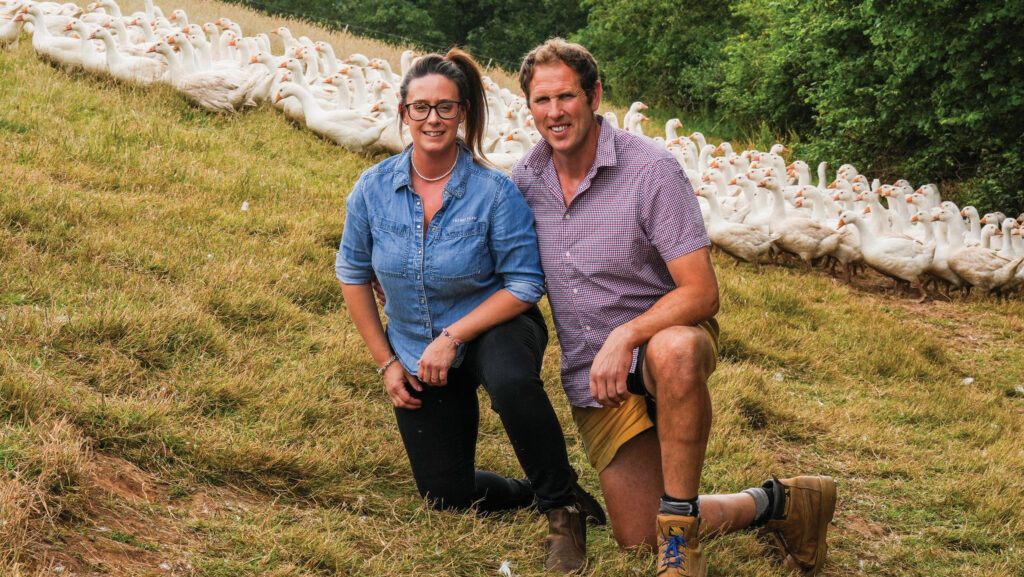
Will and Kate Martin © Emily Fleur
Coming into the sector from non-farming backgrounds, Will and Kate Martin have had to learn from scratch as they have built up a thriving beef and poultry enterprise.
Having secured the 100-acre farm at Coombe in west Cornwall soon after leaving Harper Adams University, and then meeting Kate, Will started contract rearing dairy heifers, then built up his own suckler herd and moved into direct selling.
“About 10 years ago, we bought 25 seasonal turkeys and reared them up for family and friends” he says.
“That went well and the next year we were doing 150. Now we’re approaching 3,000.” The couple also rear around 250 geese for the seasonal Christmas market.
Business
Selling direct is the name of the game for both beef and poultry, and Kate is highly proactive on the marketing side – online, at food shows and at farmers’ markets.
“We sell about 80% of our birds direct, but are increasingly being approached by stockists who want our award-winning product,” she says.
As well as a weekly marketing email and recipe idea, Kate produces a regular blog with updates on family farming life, which is followed by around 5,000 regulars.
“We have taken outside advice to ensure our website ranks highly when people conduct a Google search,” she adds.
Delivery firm DPD handles nationwide distribution, and the couple also operate farm collection days just before Christmas, with over 1,000 visitors coming to the farm shop.
While about 60% of the turkeys are sold as whole birds, the trend is towards breasts and crowns, which command a higher margin.
Kate has also worked hard to develop a thriving post-Christmas market for brown meat. “People often think our turkey legs are lamb,” she says.
She is proud to report an 80-90% customer retention rate, with overall demand growing in line with reputation.
Technical
The turkey operation dovetails nicely with the suckler beef enterprise, occupying buildings that the cows vacate in the spring.
The goslings arrive in May from Germany, followed by the day-old turkeys in late June. Once brooded, the turkeys occupy a nearby cattle shed, with access to the range from eight weeks old.
The birds typically eat their way through 28kg of feed to produce a 5-6kg carcass, finished on a barley-rich diet.
“Mortality is generally less than 2% and, apart from a probiotic in the early stages, there is no use of vaccines or antibiotics,” says Will.
Slaughtering turkeys starts on 28 November at 24 weeks old, after which the geese are processed.
The turkeys are dry-plucked, game hung for 10 days, and either butchered or packaged whole.
The couple employ about 50 full- and part-time staff in the run-up to Christmas. “We recruit locally, and are very flexible with hours,” says Kate.
“We pay a piece rate of £4.25 a stag and £3.75 a hen, so the best pluckers can earn more than £20 an hour.”
With an emphasis on sustainability, all birds are packaged in recyclable materials, including wool insulation which customers send back in return for a £10 discount voucher.
Future plans
With space on the farm now fully utilized, the Martins plan to build a new production and processing facility on 10-acres of owned land nearby.
“This will be a gamechanger as it will give us more space and allow easier access on our collection days,” says Will. Planning permission will be submitted this autumn.
With more space, the couple are eyeing up continued expansion, with the target to produce 10,000 birds a year within five years.
The numbers
- 2,750 Bronze turkeys in production for Christmas 2026
- 900 boxes of geese and turkey sent to customers last Christmas
- 4,000 trees being planted under “Forest For Cornwall” scheme
- 70% of customers involved in wool recycling scheme
- 5 part-time staff helping to butcher and package meat all-year round
Farm facts
- 300 acres of owned and tenanted land, shared by suckler beef, rose veal, turkeys and geese
- Turkeys occupy available cattle sheds from July to late November
- Geese kept in bespoke shed on separate range
- Two chillers located inside old stone barns, with new large fridge-freezer outside
- Holiday cottage from converted bull pen provides supplementary income
The judges liked
- Self-starters with real passion for farming and poultry
- Impressive profit margin linked to excellent resource management and direct sales
- Exemplary communication and marketing skills
- Both are involved with the wider poultry industry
What the judges say
Will and Kate have combined passion with entrepreneurial flair to build their business, making optimum use of every resource at their disposal on their small Cornish farm.
Robert Parker, Park Farm, Thorington, Suffolk
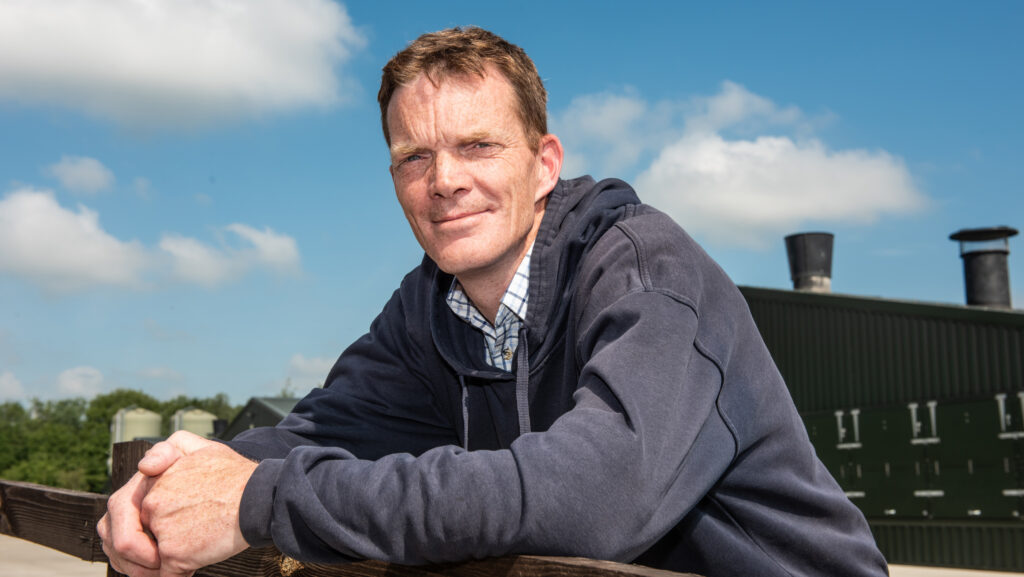
Robert Parker © Phil Weedon
They say that travel broadens the mind and Robert Parker has certainly moved around in his poultry career.
Having left school at 17, Robert went straight into poultry farming, managing a small broiler unit in Somerset.
A series of moves took him to various broiler management jobs across the south of England and in Ireland, before moving to Shropshire to manage a new-build, supplying Cargill.
Two years out of the industry running a pub developed a new skill set, but Robert soon realised his heart and soul were in poultry production, culminating in a move to Suffolk, to help run Park Farm, for the Fairs family. And there he has stayed for 16 years.
Business
Initially, the new-build involved seven sheds, but this has since been expanded to 10, now holding around 447,000 birds following a reduction in stocking rates.
The sheds are rented by a large poultry integrator, which supplies the feed and chicks, which Robert and his staff rear to slaughter weight.
The business model is backed by strong social and environmental credentials.
Robert is especially keen on giving youngsters a chance, with a track record of taking on staff with few academic qualifications, putting them through poultry training with Poultec, guiding them through the learning process to achieve best possible results.
“I started with little, and I’m happy to give others a chance,” he says. “We have to encourage more young people into this industry.”
With a viewing room, the farm has played host to regular primary school visits and Open Farm Sunday events. “We should be proud of what we do, and not shy away from it,” he says.
To maintain good relations with local residents, Robert also donates free chicken to nearby households at Christmas.
Technical
With Marks & Spencer one of the main end customers, there is a particular emphasis on bird health and welfare, with the Ross 308 birds stocked to a maximum 30kg/sq m.
While the farm is consistently among the top performers in terms of European Production Efficiency Factor (EPEF), the real focus is on profitability per sq m. “You can still lose money, even if you have a top EPEF result,” says Robert.
A low feed conversion ratio is central to this, with the farm currently achieving 1.42:1. The farm also boasts a low level of hock burn and pododermatitis of just 3% – something Robert attributes to powerful ventilation and being on top of enteritis
The staff are also encouraged to cull hard early, to take out any obviously weak or unfit birds.
Attention to detail is everything – from knowing the age of the parent flocks from which his chick intake is coming, to setting the height of the drinker lines and feeders to ensure the birds get a good intake of water and feed.
A ground source heating system provides underfloor heating in all the sheds.
Future plans
Expansion is very much part of the plan for Robert, though this would have to be at a new site.
“We see our farm operating at a larger scale with improved efficiency, stronger margins and a clear focus on high welfare and environmental sustainability.”
Robert says he would like to be involved in the next reduction in stocking densities, down to 28kg/sq m.
“I’m also keen to be involved with M&S in the slower-growing end product, as well as lowering the carbon footprint of poultry production,” he says.
The numbers
- 446,600 birds on site at any one point in time
- 4 full-time staff
- 1.9 average slaughter weight in kgs at time of thinning
- 2.6m litres of water used each crop
- 600kW of energy produced by solar installation
Farm facts
- 10 modern broiler sheds surrounded by natural woodland and grass meadow
- Sits within a larger arable business, which supplies some of the feed
- Poultry litter used to fertilise arable ground or exported to central power stations
- Ground-mounted solar array provides full power needs for first 20 days of each flock
- Large area of meadow, to encourage biodiversity
The judges liked
- Strong social awareness and excellent staff management
- Good grasp of numbers and full understanding of production costs
- Open approach to public relations and sharing information with others
- Good relations with entire supply chain – suppliers, processors and end customers
What the judges say
Robert combines excellent business skills with openness and a strong social conscience, leading a broiler business that others in the poultry sector can aspire to.
A word from our sponsor
“We’ve been delighted to support this year’s Poultry Farmer of the Year award and attend the judging visits as observers, giving us the opportunity to see first-hand the dedication, innovation and commitment shown by each outstanding finalist.”